Thank you for visiting SNEWPapers!
Sign up free
The New Hampshire Gazette And Historical Chronicle
Portsmouth, Greenland, Rockingham County, New Hampshire
What is this article about?
Dr. Musgrave responds to Chevalier d'Eon's denial of past overtures to impeach British figures for selling the peace to France, citing 1765-1766 advertisements and letters that d'Eon did not directly contradict, amid ongoing diplomatic and personal disputes involving French court figures.
Clipping
OCR Quality
Full Text
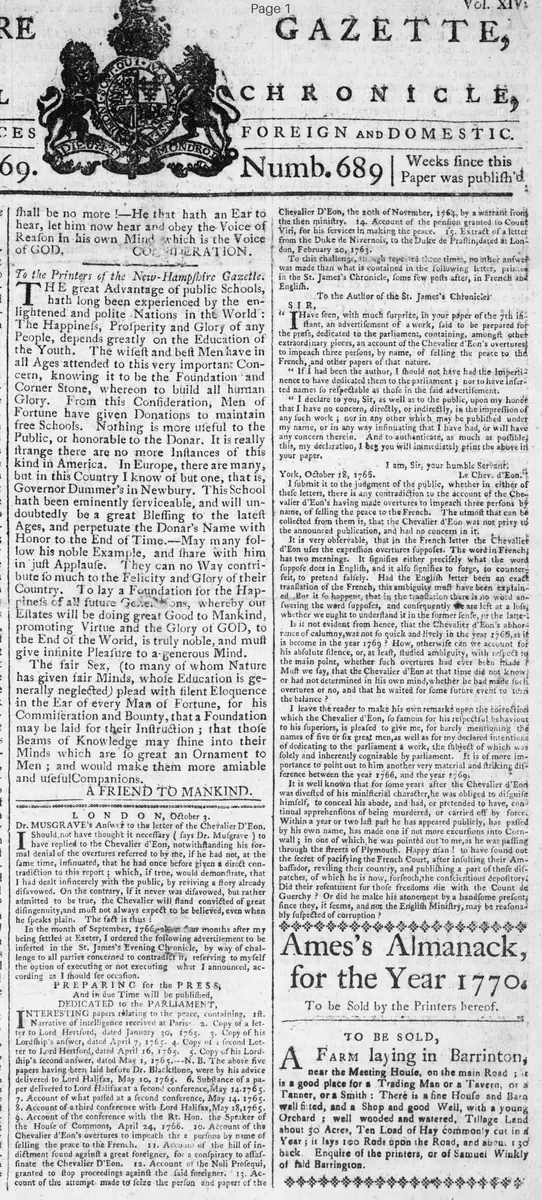
LONDON, October 3.
Dr. MUSGRAVE's Answer to the letter of the Chevalier D'Eon.
I should not have thought it necessary (says Dr. Musgrave) to have replied to the Chevalier d'Eon, notwithstanding his formal denial of the overtures referred to by me, if he had not, at the same time, insinuated, that he had once before given a direct contradiction to this report; which, if true, would demonstrate, that I had dealt insincerely with the public, by reviving a story already disavowed. On the contrary, if it never was disavowed, but rather admitted to be true, the Chevalier will stand convicted of great disingenuity, and must not always expect to be believed, even when he speaks plain. The fact is thus:
In the month of September, 1766—about six months after my being settled at Exeter, I ordered the following advertisement to be inserted in the St. James's Evening Chronicle, by way of challenge to all parties concerned to contradict it; reserving to myself the option of executing or not executing what I announced, according as I should see occasion.
PREPARING for the PRESS,
And in due Time will be published,
DEDICATED to the PARLIAMENT,
INTERESTING papers relating to the peace, containing, 1st. Narrative of intelligence received at Paris. 2. Copy of a letter to Lord Hertford, dated January 30, 1765. 3. Copy of his Lordship's answer, dated April 7, 1765. 4. Copy of a second Letter to Lord Hertford, dated April 16, 1765. 5. Copy of his Lordship's second answer, dated May 1, 1765.—N. B. The above five papers having been laid before Dr. Blackstone, were by his advice delivered to Lord Halifax, May 10, 1765. 6. Substance of a paper delivered to Lord Halifax at a second conference, May 14, 1765. 7. Account of what passed at a second conference, May 14, 1765. 8. Account of a third conference with Lord Halifax, May 18, 1765. 9. Account of the conference with the Rt. Hon. the Speaker of the House of Commons, April 24, 1766. 10. Account of the Chevalier d'Eon's overtures to impeach three persons by name of selling the peace to the French. 11. Account of the bill of indictment found against a great foreigner, for a conspiracy to assassinate the Chevalier D'Eon. 12. Account of the Noli Prosequi, granted to stop proceedings against the said foreigner. 13. Account of the attempt made to seize the person and papers of the Chevalier D'Eon, the 20th of November, 1764, by a warrant from the then ministry. 14. Account of the pension granted to Count Viri, for his services in making the peace. 15. Extract of a letter from the Duke de Nivernois, to the Duke de Praslin; dated at London, February 20, 1763.
To this challenge, though repeated three times, no other answer was made than what is contained in the following letter, printed in the St. James's Chronicle, some few posts after, in French and English.
To the Author of the St. James's Chronicle,
SIR,
I have seen, with much surprize, in your paper of the 7th instant, an advertisement of a work, said to be prepared for the press, dedicated to the parliament, containing, amongst other extraordinary pieces, an account of the Chevalier d'Eon's overtures to impeach three persons, by name, of selling the peace to the French, and other papers of that nature.
If I had been the author, I should not have had the impertinence to have dedicated them to the parliament; nor to have inserted names so respectable as those in the said advertisement.
I declare to you, Sir, as well as to the public, upon my honor that I have no concern, directly, or indirectly, in the impression of any such work; nor in any other which may be published under my name, or in any way insinuating that I have had, or will have any concern therein. And to authenticate, as much as possible this, my declaration, I beg you will immediately print the above in your paper.
I am, Sir, your humble Servant,
York, October 18, 1765.
Le Chev. d'Eon.
I submit it to the judgment of the public, whether in either of these letters, there is any contradiction to the account of the Chevalier d'Eon's having made overtures to impeach three persons by name, of selling the peace to the French. The utmost that can be collected from them is, that the Chevalier d'Eon was not privy to the announced publication, and had no concern in it.
It is very observable, that in the French letter the Chevalier d'Eon uses the expression overtures supposes. The word in French has two meanings. It signifies either precisely what the word suppose does in English, and it also signifies to forge, to counterfeit, to pretend falsely. Had the English letter been an exact translation of the French, this ambiguity must have been explained. But it so happens, that in the translation there is no word answering the word supposes, and consequently we are left at a loss whether we ought to understand it in the former sense, or the latter!
Is it not evident from hence, that the Chevalier d'Eon's abhorrence of calumny, was not so quick and lively in the year 1765, as it is become in the year 1769? How, otherwise can we account for his absolute silence, or, at least, studied ambiguity, with respect to the main point, whether such overtures had ever been made?
Must we say, that the Chevalier d'Eon at that time did not know or had not determined in his own mind, whether he had made such overtures or no, and that he waited for some future event to turn the balance?
I leave the reader to make his own remarks upon the correction which the Chevalier d'Eon, so famous for his respectful behaviour to his superiors, is pleased to give me, for barely mentioning the names of five or six great men, as well as for my declared intentions of dedicating to the parliament a work, the subject of which was solely and inherently cognizable by parliament. It is of more importance to point out to him another very material and striking difference between the year 1766, and the year 1769.
It is well known that for some years after the Chevalier d'Eon was divested of his ministerial character, he was obliged to disguise himself, to conceal his abode, and had, or pretended to have, continual apprehensions of being murdered, or carried off by force.
Within a year or two last past he has appeared publicly, has passed by his own name, has made one if not more excursions into Cornwall; in one of which he was pointed out to me, as he was passing through the streets of Plymouth. Happy man! to have found out the secret of pacifying the French Court, after insulting their Ambassador, reviling their country, and publishing a part of those dispatches, of which he is now, forsooth, the conscientious depository.
Did their resentment for those freedoms die with the Count de Guerchy? Or did he make his atonement by a handsome present; since they, it seems, and not the English Ministry, may be reasonably suspected of corruption?
What sub-type of article is it?
What keywords are associated?
What entities or persons were involved?
Where did it happen?
Foreign News Details
Primary Location
Paris
Event Date
October 3, 1769
Key Persons
Outcome
dr. musgrave rebuts chevalier d'eon's denial of 1765 overtures to impeach three persons for selling the peace to france, highlighting ambiguities in d'eon's past responses and his changed circumstances by 1769.
Event Details
Dr. Musgrave defends his reference to Chevalier d'Eon's past overtures to impeach British figures for selling the peace, citing a 1766 advertisement listing papers on peace negotiations and d'Eon's ambiguous 1765 letter denying involvement in the publication but not the overtures themselves; notes linguistic ambiguity in French 'supposes'; discusses d'Eon's earlier disguises and fears versus recent public appearances and speculated pacification of the French court.