Thank you for visiting SNEWPapers!
Sign up free
The Richmond Palladium And Sun Telegram
Richmond, Wayne County, Indiana
What is this article about?
Carl Ackerman's article details Edward Bernstein's assessment of Socialism's role in wartime Germany: minimal true influence despite some protections, post-war strength hinging on fair peace terms and party fidelity to principles, and firm opposition to annexing Belgium for a just European peace. (248 characters)
Merged-components note: This is a continued article on the attitude of Socialism in Germany; original labels were 'story' and 'foreign_news', but overall content is a narrative article, so relabeled to 'story'.
Clippings
1 of 2
OCR Quality
Full Text
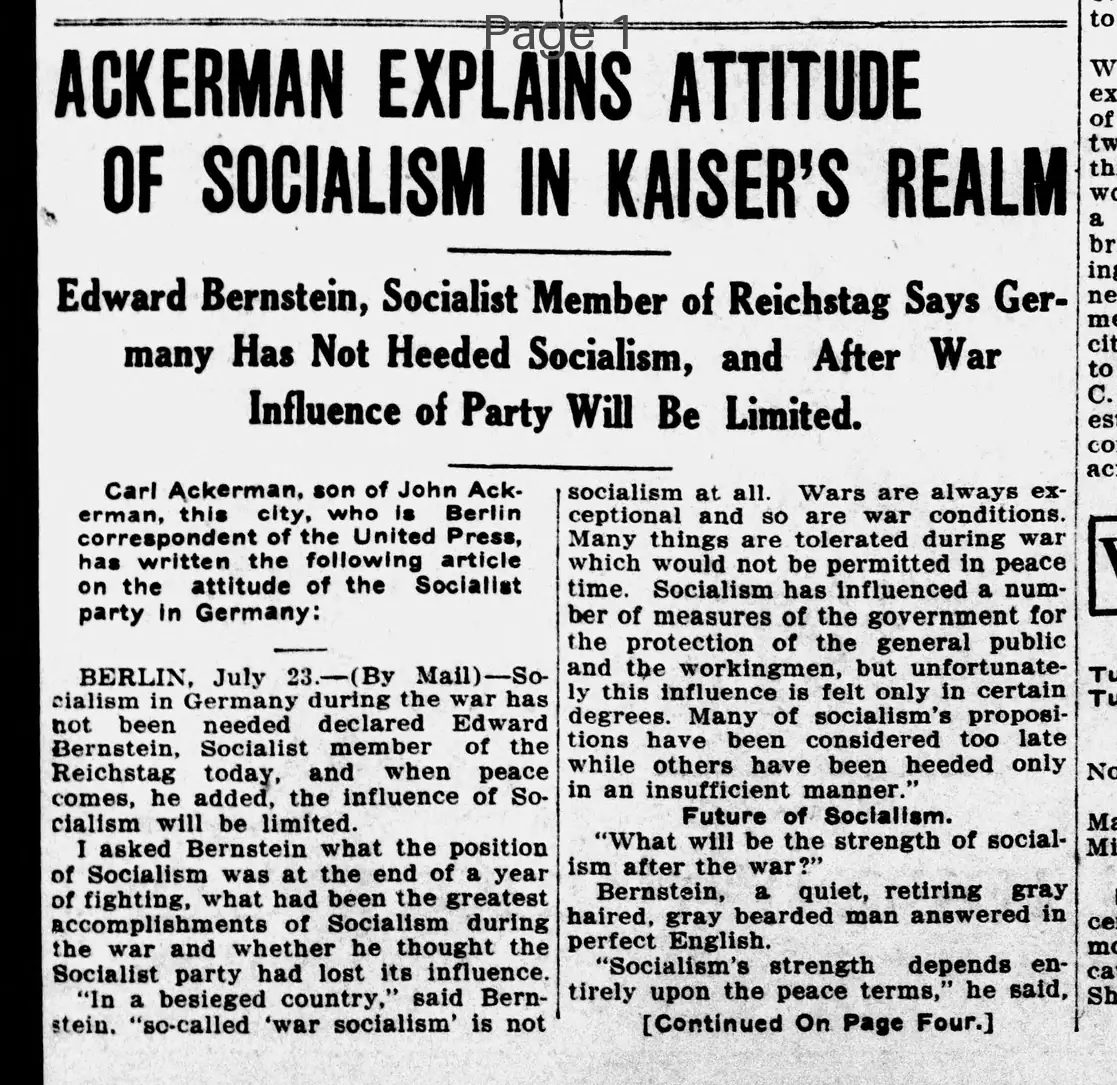
Carl Ackerman, son of John Ackerman, this city, who is Berlin correspondent of the United Press, has written the following article on the attitude of the Socialist party in Germany:
BERLIN, July 23.-(By Mail)--Socialism in Germany during the war has not been needed declared Edward Bernstein, Socialist member of the Reichstag today, and when peace comes, he added, the influence of Socialism will be limited.
I asked Bernstein what the position of Socialism was at the end of a year of fighting, what had been the greatest accomplishments of Socialism during the war and whether he thought the Socialist party had lost its influence.
"In a besieged country," said Bernstein, "so-called 'war socialism' is not socialism at all. Wars are always exceptional and so are war conditions. Many things are tolerated during war which would not be permitted in peace time. Socialism has influenced a number of measures of the government for the protection of the general public and the workingmen, but unfortunately this influence is felt only in certain degrees. Many of socialism's propositions have been considered too late while others have been heeded only in an insufficient manner."
Future of Socialism.
"What will be the strength of socialism after the war?"
Bernstein, a quiet, retiring gray haired, gray bearded man answered in perfect English.
"Socialism's strength depends entirely upon the peace terms," he said,
[Continued On Page Four.]
ACKERMAN
[Continued From Page One]
"It is quite conditional. I can only express
my hopes. Much depends upon
the attitude of the party itself. I hope
the party will be united and that it
will stand forth in the great strength.
And its strength depends upon the
faithfulness of the party to the old
and proved principles of social democracy.
"According to our constitution the
Kaiser has to determine Germany's
peace terms. The Kaiser will hear the
Chancellor and the other representatives
of the government. The Chancellor,
himself, will hear the parties. But
we are not endowed with constitutional
influence. War was declared before
the Reichstag was convened, and, so
the Reichstag will, when the time
comes for peace, not have the determination
in the matter. We have been
promised that our views will be heard
but they will not be decisive. The influence
of socialism will be limited."
The recent appeal of the socialists
for peace, he said, expressed simply
a "general opinion" and he could not
authoritatively state which division of
the socialists was the strongest today
in the masses of the party. "The Socialist
representatives in the Reichstag
now," he said, "were elected before
the war. They can with a certainty
voice only the opinions of their constituents
as that voice was known before
the war."
Asked what the attitude of the socialists
toward Belgium would
be
when peace comes, he said:
"On principle our party opposes any
oppression of a nation by force. But
with this opposition on principle that
question will not end. It might be put
in the shape of a bundle of measures,
some more or less enticing even to
socialists, and I am not in the position
to state in advance what the attitude
of the social democratic parliamentary
group as a whole will be toward
these. I only know that I and a
good number of my friends would very
strongly object to the annexation of
Belgium. In my opinion it would be
unpardonable to keep or coerce that
country. I trust none of the genuine
democrats in Germany would sanction
it."
Bernstein then referred to an article
he wrote on the subject for "Die
Menschheit" a paper of Lausanne,
Switzerland in which he said:
"Germany would become the most
hated nation of Europe and would at
the same time load upon itself a terrible
economic burden. He who strives
for the forced annexation of Belgium
or something like it imagines himself
a patriot but in reality he strives for a
pandora present for the German people,
a curse for the future of Europe.
"The question for the safety of the
future peace cannot be solved here nor
on the other side through robbing land
and by violence to national freedom.
It can be solved only by a peace which
recognizes the right of self-government
of the nations and safeguard
through binding treaties and the restriction
of armaments. This work
only a Congress of the European nations
can bring about."
What sub-type of article is it?
What themes does it cover?
What keywords are associated?
What entities or persons were involved?
Where did it happen?
Story Details
Key Persons
Location
Berlin, Germany
Event Date
July 23
Story Details
Edward Bernstein discusses the limited influence of Socialism during the war in Germany, its partial impact on government measures, future strength depending on peace terms and party unity, and opposition to the annexation of Belgium, advocating for a peace recognizing national self-government.