Thank you for visiting SNEWPapers!
Sign up free
Poem
June 16, 1837
The Liberator
Boston, Suffolk County, Massachusetts
What is this article about?
A poignant narrative poem critiquing the exploitative British factory system, vividly portraying the physical and emotional toll on a pale orphan child enduring endless toil, abuse, and joyless rest at home.
Clipping
OCR Quality
98%
Excellent
Full Text
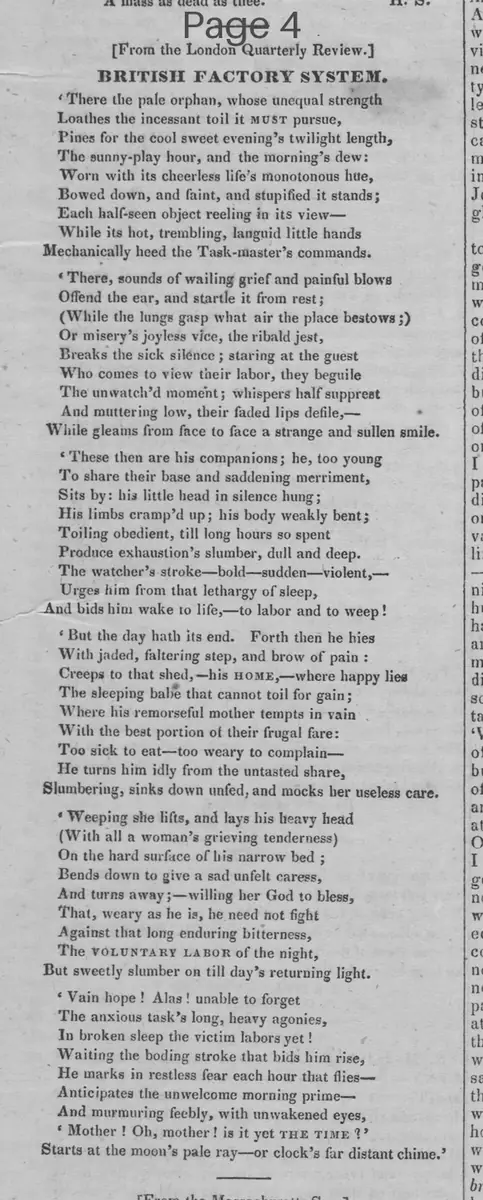
[From the London Quarterly Review.]
BRITISH FACTORY SYSTEM
There the pale orphan, whose unequal strength
Loathes the incessant toil it must pursue,
Pines for the cool sweet evening's twilight length,
The sunny play hour, and the morning's dew:
Worn with its cheerless life's monotonous hue,
Bowed down, and faint, and stupified it stands;
Each half-seen object reeling in its view—
While its hot, trembling, languid little hands
Mechanically heed the Task-master's commands.
There, sounds of wailing grief and painful blows
Offend the ear, and startle it from rest;
(While the lungs gasp what air the place bestows;)
Or misery's joyless vice, the ribald jest,
Breaks the sick silence; staring at the guest
Who comes to view their labor, they beguile
The unwatch'd moment; whispers half supprest
And muttering low, their faded lips defile,
—
While gleams from face to face a strange and sullen smile.
These then are his companions; he, too young
To share their base and saddening merriment,
Sits by: his little head in silence hung;
His limbs cramp'd up; his body weakly bent;
Toiling obedient, till long hours so spent
Produce exhaustion's slumber, dull and deep.
The watcher's stroke—bold—sudden—violent,
—
Urges him from that lethargy of sleep,
And bids him wake to life,—to labor and to weep!
But the day hath its end. Forth then he hies
With jaded, faltering step, and brow of pain:
Creeps to that shed,—his HOME,—where happy lies
The sleeping babe that cannot toil for gain;
Where his remorseful mother tempts in vain
With the best portion of their frugal fare:
Too sick to eat—too weary to complain—
He turns him idly from the untasted share,
Slumbering, sinks down unfed, and mocks her useless care.
Weeping she lifts, and lays his heavy head
(With all a woman's grieving tenderness)
On the hard surface of his narrow bed;
Bends down to give a sad unfelt caress,
And turns away;—willing her God to bless,
That, weary as he is, he need not fight
Against that long enduring bitterness,
The VOLUNTARY LABOR of the night,
But sweetly slumber on till day's returning light.
Vain hope! Alas! unable to forget
The anxious task's long, heavy agonies,
In broken sleep the victim labors yet!
Waiting the boding stroke that bids him rise.
He marks in restless fear each hour that flies—
Anticipates the unwelcome morning prime—
And murmuring feebly, with unwakened eyes,
'Mother! Oh, mother! is it yet THE TIME?'
Starts at the moon's pale ray—or clock's far distant chime.
BRITISH FACTORY SYSTEM
There the pale orphan, whose unequal strength
Loathes the incessant toil it must pursue,
Pines for the cool sweet evening's twilight length,
The sunny play hour, and the morning's dew:
Worn with its cheerless life's monotonous hue,
Bowed down, and faint, and stupified it stands;
Each half-seen object reeling in its view—
While its hot, trembling, languid little hands
Mechanically heed the Task-master's commands.
There, sounds of wailing grief and painful blows
Offend the ear, and startle it from rest;
(While the lungs gasp what air the place bestows;)
Or misery's joyless vice, the ribald jest,
Breaks the sick silence; staring at the guest
Who comes to view their labor, they beguile
The unwatch'd moment; whispers half supprest
And muttering low, their faded lips defile,
—
While gleams from face to face a strange and sullen smile.
These then are his companions; he, too young
To share their base and saddening merriment,
Sits by: his little head in silence hung;
His limbs cramp'd up; his body weakly bent;
Toiling obedient, till long hours so spent
Produce exhaustion's slumber, dull and deep.
The watcher's stroke—bold—sudden—violent,
—
Urges him from that lethargy of sleep,
And bids him wake to life,—to labor and to weep!
But the day hath its end. Forth then he hies
With jaded, faltering step, and brow of pain:
Creeps to that shed,—his HOME,—where happy lies
The sleeping babe that cannot toil for gain;
Where his remorseful mother tempts in vain
With the best portion of their frugal fare:
Too sick to eat—too weary to complain—
He turns him idly from the untasted share,
Slumbering, sinks down unfed, and mocks her useless care.
Weeping she lifts, and lays his heavy head
(With all a woman's grieving tenderness)
On the hard surface of his narrow bed;
Bends down to give a sad unfelt caress,
And turns away;—willing her God to bless,
That, weary as he is, he need not fight
Against that long enduring bitterness,
The VOLUNTARY LABOR of the night,
But sweetly slumber on till day's returning light.
Vain hope! Alas! unable to forget
The anxious task's long, heavy agonies,
In broken sleep the victim labors yet!
Waiting the boding stroke that bids him rise.
He marks in restless fear each hour that flies—
Anticipates the unwelcome morning prime—
And murmuring feebly, with unwakened eyes,
'Mother! Oh, mother! is it yet THE TIME?'
Starts at the moon's pale ray—or clock's far distant chime.
What sub-type of article is it?
Satire
Ballad
What themes does it cover?
Satire Society
Moral Virtue
Political
What keywords are associated?
Child Labor
Factory System
Orphan Toil
Industrial Exploitation
Social Critique
British Factories
Worker Misery
What entities or persons were involved?
From The London Quarterly Review.
Poem Details
Title
British Factory System
Author
From The London Quarterly Review.
Subject
Child Labor In British Factories
Key Lines
There The Pale Orphan, Whose Unequal Strength
Loathes The Incessant Toil It Must Pursue,
Pines For The Cool Sweet Evening's Twilight Length,
The Sunny Play Hour, And The Morning's Dew:
'Mother! Oh, Mother! Is It Yet The Time?'
Starts At The Moon's Pale Ray—Or Clock's Far Distant Chime.
The Voluntary Labor Of The Night,