Thank you for visiting SNEWPapers!
Sign up free
The Tipton Advertiser
Tipton, Cedar County, Iowa
What is this article about?
A soldier's letter from Camp at Jacinto, Mississippi, dated September 25, 1862, details the Union victory over Confederate General Price at the Battle of Iuka. Despite being outnumbered, Union forces under Rosecrans engaged and repelled Price's troops, suffering heavy casualties, particularly the 5th Regiment.
Clipping
OCR Quality
Full Text
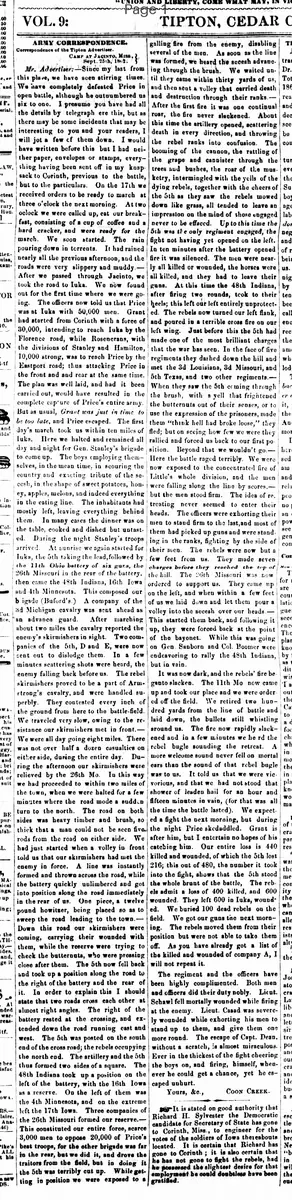
Any correspondence.
Correspondence of the Tipton Advertiser:
Camp at Jacinto, Miss,
Sept. 25th, 1862.
Mr. Advertiser: Since my last from
this place, we have seen stirring times.
We have completely defeated Price in
open battle, although he outnumbered us
six to one. I presume you have had all
the details by telegraph ere this, but as
there may be some incidents that may be
interesting to you and your readers. I
will jot a few of them down. I would
have written before this but I had neither
paper, envelopes or stamps, everything having been sent off in my knapsack to Corinth, previous to the battle,
but to the particulars. On the 17th we
received orders to be ready to march at
three o'clock the next morning. At two
o'clock we were called up, ate our breakfast, consisting of a cup of coffee and a
hard cracker, and were ready for the
march. We soon started. The rain
pouring down in torrents. It had rained
nearly all the previous afternoon, and the
roads were very slippery and muddy.
After we passed through Jacinto, we
took the road to Iuka. We now found
out for the first time where we were going.
The officers now told us that Price
was at Iuka with 50,000 men. Grant
had started from Corinth with a force of
30,000, intending to reach Iuka by the
Florence road, while Rosecrans, with
the divisions of Stanley and Hamilton,
10,000 strong, was to reach Price by the
Eastport road: thus attacking Price in
the front and rear at the same time.
The plan was well laid, and had it been
carried out, would have resulted in the
complete capture of Price's entire army.
But as usual, Grant was just in time to
be too late, and Price escaped. The first
day's march took us within ten miles of
Iuka. Here we halted and remained all
day and night for Gen. Stanley's brigade
to come up. The boys employing themselves, in the mean time, in scouring the
country and exacting tribute of the secesh, in the shape of sweet potatoes, honey,
apples, melons, and indeed everything
in the eating line. The inhabitants had
mostly left, leaving everything behind
them. In many cases the dinner was on
the table, cooked and dished but untasted.
During the night Stanley's troops
arrived. At sunrise we again started for
Iuka, the 5th taking the lead, followed by
the 11th Ohio battery of six guns, the
26th Missouri in the rear of the battery,
then came the 48th Indiana, 16th Iowa
and 4th Minnesota. This composed our
brigade (Buford's.) A company of the
3d Michigan cavalry was sent ahead as
an advance guard. After marching
about two miles the cavalry reported the
enemy's skirmishers in sight. Two companies of the 5th, D and E, were now
sent out to dislodge them. In a few
minutes scattering shots were heard, the
enemy falling back before us. The rebel
skirmishers proved to be a part of Armstrong's cavalry, and were handled superbly. They contested every inch of
the ground from here to the battle-field.
We traveled very slow, owing to the resistance our skirmishers met in front.
We were all day going eight miles. There
was not over half a dozen casualties on
either side, during the entire day. During the afternoon our skirmishers were
relieved by the 26th Mo. In this way
we had proceeded to within two miles of
the town, when we were halted for a few
minutes where the road made a sudden
turn to the north. The road on both
sides was heavy timber and brush, so
thick that a man could not be seen five
rods from the road on either side. We
had just started when a volley in front
told us that our skirmishers had met the
enemy in force. A line was instantly
formed and thrown across the road, while
the battery quickly unlimbered and got
into position along the road immediately
in the rear of us. One piece, a twelve
pound howitzer, being placed so as to
sweep the road leading to the town.
Down this road our skirmishers were
coming, carrying their wounded with
them, while the reserve were trying to
check the butternuts, who were pressing
close after them. The 5th now fell back
and took up a position along the road to
the right of the battery and the rear of
it. In order to explain this I should
state that two roads cross each other at
almost right angles. The right of the
battery rested at the crossing, and extended down the road running east and
west. The 5th was posted on the south
end of the cross road; the rebels occupying the north end. The artillery and the 5th
thus formed two sides of a square. The
48th Indiana took up a position on the
left of the battery, with the 16th Iowa
as a reserve. On the left of them was
the 4th Minnesota, and on the extreme
left the 17th Iowa. Three companies of
the 26th Missouri formed our reserve.
This constituted our entire force, scarce
3,000 men to oppose 20,000 of Price's
best troops, for the other brigade was far
in the rear, but we did it, and drove the
traitors from the field, but in doing it
the 5th was terribly cut up. While getting in position we
were exposed to a
galling fire from the enemy, disabling
several of the men. As soon as the line
was formed, we heard the secesh advancing through the brush. We waited until they came within thirty yards of us,
and then sent a volley that carried death
and destruction through their ranks.
After the first fire it was one continual
roar, the fire never slackened. About
this time the artillery opened, scattering
death in every direction, and throwing
the rebel ranks into confusion. The
booming of the cannon, the rattling of
the grape and canister through the
trees and bushes, the roar of the musketry, intermingled with the yells of the
dying rebels, together with the cheers of
the 5th as they saw the rebels mowed
down like grass, all tended to leave an
impression on the mind of those engaged
never to be effaced. Up to this time the
5th was the only regiment engaged, the
fight not having yet opened on the left.
In ten minutes after the battery opened
fire it was silenced. The men were nearly all killed or wounded, the horses were
all killed, and they had to leave their
guns. At this time the 48th Indiana,
after firing two rounds, took to their
heels; this left our left entirely unprotected. The rebels now turned our left flank,
and poured in a terrible cross fire on our
left wing. Just before this the 5th had
made one of the most brilliant charges
that the war has seen. In the face of five
regiments they dashed down the hill and
met the 3d Louisiana, 3d Missouri, and
5th Texas, and two other regiments.
When they saw the 5th coming through
the brush, with a yell that frightened
the butternuts out of their senses, or to
use the expression of the prisoners, made
them "think hell had broke loose," they
fled; but on seeing how few we were they
rallied and forced us back to our first position. Beyond that we wouldn't go.
Here the battle raged terribly. We were
now exposed to the concentrated fire of
Little's whole division, and the men
were falling along the line by scores.
but the men stood firm. The idea of retreating never seemed to enter their
heads. The officers were exhorting their
men to stand firm to the last, and most of
them had picked up guns and were standing in the ranks, fighting by the side of
their men. The rebels were now but a
few feet from us. They made seven
charges before they reached the top of
the hill. The 26th Missouri was now
ordered to support us. They came up
on the left, and when within a few feet
of us we laid down and let them pour a
volley into the secesh over our heads.
This started them back, and following it
up, they were forced back at the point
of the bayonet. While this was going
on Gen Sanborn and Col. Boomer were
endeavoring to rally the 48th Indiana
but in vain.
It was now dark, and the rebels' fire began to slacken. The 11th Mo now came
up and took our place and we were ordered off the field. We retired two hundred yards from the line of battle and
laid down, the bullets still whistling
around us. The fire now rapidly slackened and in a few minutes we heard the
rebel bugle sounding the retreat. A
more welcome sound never fell on mortal
ears than the sound of that rebel bugle
was to us. It told us that we were victorious, and that we had not stood that
shower of leaden hail for an hour and
fifteen minutes in vain, (for that was all
the time the battle lasted). We expected a fight the next morning, but during
the night Price skedaddled. Grant is
after him, but I entertain no hopes of his
catching him. Our entire loss is 440
killed and wounded, of which the 5th lost 216; this out of 480, the number it took
into the fight, shows that the 5th stood
the whole brunt of the battle. The rebels admit a loss of 400 killed, and 600
wounded. They left 600 in Iuka, wounded. We buried 100 dead rebels on the
field. We got our guns the next morning. The rebels moved them from their
position but were not able to take them
off. As you have already got a list of
the killed and wounded of company A, I
will not repeat it
The regiment and the officers have
been highly complimented. Both men
and officers did their duty nobly. Lieut.
Schawl fell mortally wounded while firing at the enemy. Lieut. Casad was severely wounded while exhorting his men to
stand up to them, and give them one
more round. The escape of Capt. Dean,
without a scratch, is almost miraculous.
Ever in the thickest of the fight cheering the boys on, and firing, himself, when
ever he could get a chance, yet he escaped unhurt.
Yours, &c.,
Coon Creek.
What sub-type of article is it?
What keywords are associated?
What entities or persons were involved?
Where did it happen?
Domestic News Details
Primary Location
Iuka, Miss
Event Date
September 1862
Key Persons
Outcome
union loss: 440 killed and wounded, including 216 from the 5th regiment out of 480 engaged. rebel loss: 400 killed, 600 wounded, 600 wounded left in iuka, 100 dead buried on field. price defeated but escaped; union recovered artillery.
Event Details
Union forces under Rosecrans marched to Iuka to attack Price's Confederate army in front and rear with support from Grant. After skirmishes, the 5th Regiment and Buford's Brigade engaged Price's troops near Iuka, holding position against superior numbers for over an hour until dark, forcing rebel retreat. The 5th made a brilliant charge but suffered heavy losses.