Thank you for visiting SNEWPapers!
Sign up free
Lynchburg Virginian
Lynchburg, Virginia
What is this article about?
An argumentative essay from Bedford County, Pennsylvania, advocating the superiority of oxen over horses for farm labor, citing their lower costs, greater durability, ease of maintenance, and overall economic benefits for farmers, while criticizing the excessive use of horses as a cause of financial ruin and societal issues.
Clipping
OCR Quality
Full Text
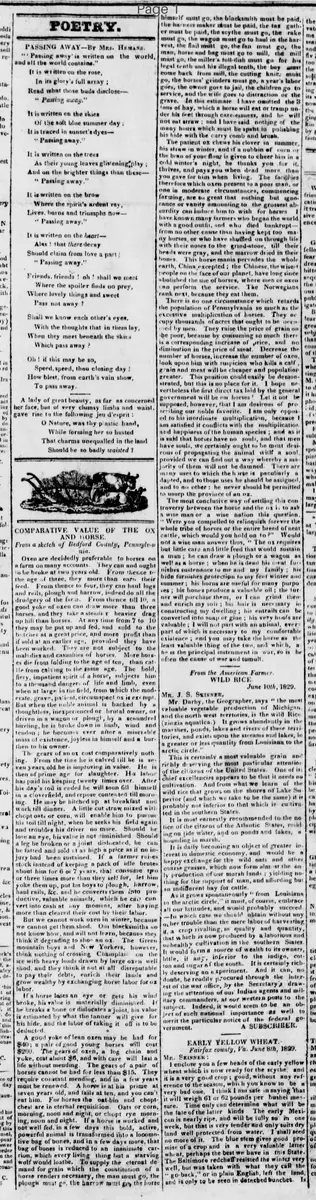
From a sketch of Bedford County, Pennsylvania.
Oxen are decidedly preferable to horses on a farm on many accounts. They can and ought to be broke at two years old. From thence to the age of three, they more than earn their feed. From thence to four, they can haul logs and rails, plough and harrow, indeed do all the drudgery of the farm. From thence till ten, a good yoke of oxen can draw more than three horses, and they take a steadier heavier drag up hill than horses. At any time from 7 to 10 they may be put up and fed, and sold to the butcher at a great price, and more profit than if sold at an earlier age, provided they have been worked. They are not subject to the maladies and casualties of horses. More horses die from foaling to the age of ten, than cattle from calving to the same age. The bold, fiery, impatient spirit of a horse, subjects him to a thousand dangers of life and limb, even when at large in the field, from which the moderate, grave, patient, circumspect ox is exempt. But when the noble animal is backed by a thoughtless, inexperienced or brutal owner, or driven in a wagon or plough, by a scoundrel hireling, he is broke down in limb, wind and tendon ; he becomes ever after a miserable mass of existence, joyless in himself and a burden to his owner.
The gears of an ox cost comparatively nothing. From the time he is calved till he is seven years old he is improving in value. He is then of prime age for slaughter. His labor has paid his keeping twenty times over. After his day's toil is ended he will soon fill himself in a clover field, and repose contented till morning. He may be hitched up at breakfast and work till dinner. A little cut straw mixed with chopt oats or corn, will enable him to pursue his toil till night, when he seeks his field again and troubles his driver no more. Should he lose an eye. his value is not diminished. Should a leg be broken or a joint dislocated, he can be fatted and sold at as high a price as if no injury had been sustained. If a farmer raises stock instead of keeping a pack of idle brutes about him for 6 or 7 years. that consume two or three times more than they sell for, let him yoke them up, put his boys to plough, harrow, haul rails, &c. and he converts them into productive, valuable animals, which he can convert into cash at any moment, after having more than cleared their cost by their labor.
But we cannot work oxen in winter, because we cannot get them shod. Our blacksmiths do not know how, and will not learn, because they think it degrading to shoe an ox. The Green mountain boys and New Yorkers, however, think nothing of crossing Champlain on the ice with heavy loads drawn by large oxen well shod, and they think it not at all disreputable to pay their debts, enrich their lands and grow wealthy by exchanging horse labor for ox labor.
If a horse loses an eye or gets his wind broke, his value is materially diminished. If he breaks a bone or dislocates a joint, his value is estimated by what the farmer will give for his hide, and the labor of taking it off is to be deducted.
A good yoke of lean oxen may be had for $40; a pair of good young horses will cost $200. The gears of oxen, a log chain and yoke, cost about $6, and with care will last a life without mending. The gears of a pair of horses cannot be had for less than $15. They require constant mending, and in a few years must be renewed. A horse is at his prime at seven years old, and fails at ten, and you can't eat him. For horses the oat-bin and chopt-chest are in eternal requisition. Oats or corn, morning, noon and night; or chopt rye morning, noon and night. If a horse is worked and not well fed, in a few days this bold, active, powerful animal is transformed into a locomotive bag of bones, and in a few days more, that bag of bones is reduced to an inanimate carion, which every living thing but a starving wolf would loathe. To supply the eternal demand for grain which the constitution of a horse renders necessary, the man must go, the plough must go, the harrow must go, the horse himself must go, the blacksmith must be paid, the harness maker must be paid, the tax gatherer must be paid, the scythe must go, the rake must go, the wagon must go to haul in the harvest, the flail must go, the fan must go, the man, horse and bag must go to mill, the mill must go, the miller's toll-dish must go for his legal tenth and his illegal tenth, the boy must come back from mill, the cutting knife must go, the horses' grinders must go, a year's labor goes, the owner goes to jail, the children go to service, and the wife goes to distraction or the grave. In this estimate I have omitted the 3 tons of hay, which a horse will eat or tramp under his feet through carelessness, and he will not eat straw ; and I have said nothing of the many hours which must be spent in polishing his hide with the curry comb and brush.
The patient ox chews his clover in summer, his straw in winter, and if a nubbin of corn or the bran of your flour is given to cheer him in a cold winter's night, he thanks you for it. thrives, and pays you when dead more than you gave for him when living. The facilities therefore which oxen present to a poor man, or one in moderate circumstances, commencing farming, are so great that nothing but ignorance or vanity amounting to the grossest absurdity can induce him to wish for horses. I have known many farmers who began the world with a good outfit, and who died bankrupt- from no other cause than having kept too many horses, or who have shuffled on through life with their noses to the grind-stone, till their heads were gray, and the marrow dried in their bones. This horse mania pervades the whole earth, China excepted: the Chinese, the wisest people on the face of our planet, have long since abolished the use of horses, where men or oxen can perform the service. The Norwegians rank next, because they eat them.
There is no one circumstance which retards the population of Pennsylvania so much as the excessive multiplication of horses. They occupy thousands of acres that ought to be occupied by men. They raise the price of grain on the poor, because by consuming so much there is a corresponding increase of price, and no diminution in the price of meat. Decrease the number of horses, increase the number of oxen. look upon him with suspicion who kills a calf grain and meat will be cheaper and population greater. This position could easily be demonstrated, but this is no place for it. I hope nevertheless the first direct tax laid by the general government will be on horses! Let it not be supposed, however, that I am desirous of proscribing our noble favorite. I am only opposed to his inordinate multiplication, because I am satisfied it conflicts with the multiplication and happiness of the human species; and as it is said that horses have no souls, and that men have souls, we certainly ought to be most desirous of propagating the animal with a soul. provided we can find out a way whereby a majority of them will not be damned. There are many uses to which the horse is peculiarly adapted, and to those uses he should be assigned, and to no other : he never should be permitted to usurp the province of an ox.
The most conclusive way of settling this controversy between the horse and the ox is, to ask a wise man or a wise nation this question. "Were you compelled to relinquish forever the whole tribe of horses or the entire breed of neat cattle, which would you hold on to?" Would not a wise man answer thus, " The ox requires but little care and little feed that would sustain a man; he can draw a plough or a wagon as well as a horse ; when he is dead his meat furnishes sustenance to me and my family ; his hide furnishes protection to my feet winter and summer; his horns are useful for many purposes; his bones produce a valuable oil; the tanner will purchase them, or I can grind them and enrich my soil ; his hair is necessary in constructing my dwelling; his entrails can be converted into soap or glue ; his very hoofs are valuable; I will not part with an animal. every part of which is necessary to my comfortable existence ; and you may take the horse as the least valuable thing of the two, and which, as he is the principal instrument in war, so is he often the cause of war and tumult."
What sub-type of article is it?
What themes does it cover?
What keywords are associated?
Where did it happen?
Story Details
Location
Bedford County, Pennsylvania
Story Details
The article argues that oxen are more economical, durable, and versatile for farm work than horses, which are costly to maintain and prone to injury, leading to financial ruin for farmers; it praises oxen's utility even after death and criticizes the 'horse mania' in Pennsylvania while noting wiser practices elsewhere.