Thank you for visiting SNEWPapers!
Sign up free
Editorial
June 22, 1956
St. Paul Recorder
Saint Paul, Ramsey County, Minnesota
What is this article about?
The Christian Science Monitor editorial reflects on its prior coverage preparing readers for the Supreme Court's 1954 desegregation ruling, noting clear signs since 1950 and the Court's gradual approach, arguing no surprise was sprung on the nation.
Clipping
OCR Quality
98%
Excellent
Full Text
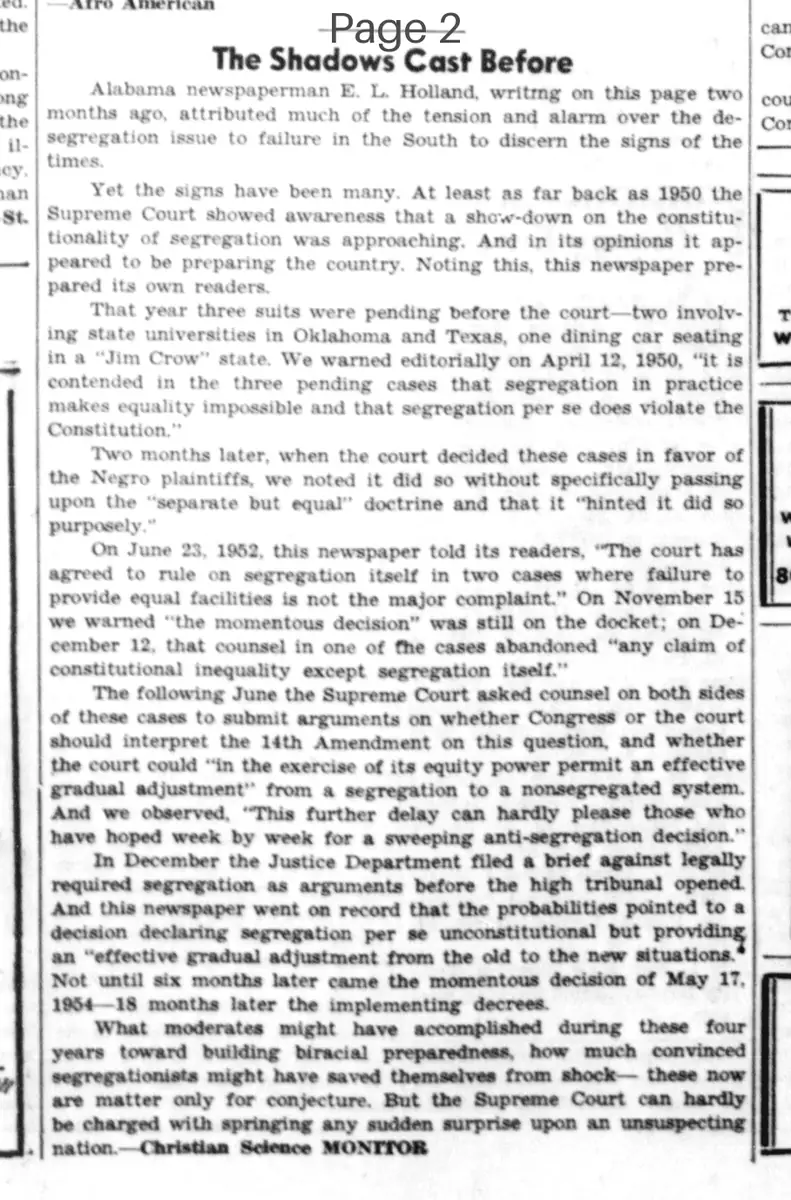
The Shadows Cast Before
Alabama newspaperman E. L. Holland, writing on this page two months ago. attributed much of the tension and alarm over the desegregation issue to failure in the South to discern the signs of the times.
Yet the signs have been many. At least as far back as 1950 the Supreme Court showed awareness that a show-down on the constitutionality of segregation was approaching. And in its opinions it appeared to be preparing the country. Noting this, this newspaper prepared its own readers.
That year three suits were pending before the court-two involving state universities in Oklahoma and Texas, one dining car seating in a "Jim Crow" state. We warned editorially on April 12, 1950, "it is contended in the three pending cases that segregation in practice makes equality impossible and that segregation per se does violate the Constitution."
Two months later, when the court decided these cases in favor of the Negro plaintiffs. we noted it did so without specifically, passing upon the "separate but equal" doctrine and that it "hinted it did so purposely."
On June 23, 1952, this newspaper told its readers, "The court has agreed to rule on segregation itself in two cases where failure to provide equal facilities is not the major complaint." On November 15 we warned "the momentous decision" was still on the docket; on December 12, that counsel in one of the cases abandoned "any claim of constitutional inequality except segregation itself."
The following June the Supreme Court asked counsel on both sides of these cases to submit arguments on whether Congress or the court should interpret the 14th Amendment on this question. and whether the court could "in the exercise of its equity power permit an effective gradual adjustment" from a segregation to a nonsegregated system.
And we observed, "This further delay can hardly please those who have hoped week by week for a sweeping anti-segregation decision."
In December the Justice Department filed a brief against legally required segregation as arguments before the high tribunal opened.
And this newspaper went on record that the probabilities pointed to a decision declaring segregation per se unconstitutional but providing an "effective gradual adjustment from the old to the new situations.
Not until six months later came the momentous decision of May 17. 1954—it's months later the implementing decrees.
What moderates might have accomplished during these four years toward building biracial preparedness, how much convinced segregationists might have saved themselves from shock- these now are matter only for conjecture. But the Supreme Court can hardly be charged with springing any sudden surprise upon an unsuspecting nation.-Christian Science Monitor
Alabama newspaperman E. L. Holland, writing on this page two months ago. attributed much of the tension and alarm over the desegregation issue to failure in the South to discern the signs of the times.
Yet the signs have been many. At least as far back as 1950 the Supreme Court showed awareness that a show-down on the constitutionality of segregation was approaching. And in its opinions it appeared to be preparing the country. Noting this, this newspaper prepared its own readers.
That year three suits were pending before the court-two involving state universities in Oklahoma and Texas, one dining car seating in a "Jim Crow" state. We warned editorially on April 12, 1950, "it is contended in the three pending cases that segregation in practice makes equality impossible and that segregation per se does violate the Constitution."
Two months later, when the court decided these cases in favor of the Negro plaintiffs. we noted it did so without specifically, passing upon the "separate but equal" doctrine and that it "hinted it did so purposely."
On June 23, 1952, this newspaper told its readers, "The court has agreed to rule on segregation itself in two cases where failure to provide equal facilities is not the major complaint." On November 15 we warned "the momentous decision" was still on the docket; on December 12, that counsel in one of the cases abandoned "any claim of constitutional inequality except segregation itself."
The following June the Supreme Court asked counsel on both sides of these cases to submit arguments on whether Congress or the court should interpret the 14th Amendment on this question. and whether the court could "in the exercise of its equity power permit an effective gradual adjustment" from a segregation to a nonsegregated system.
And we observed, "This further delay can hardly please those who have hoped week by week for a sweeping anti-segregation decision."
In December the Justice Department filed a brief against legally required segregation as arguments before the high tribunal opened.
And this newspaper went on record that the probabilities pointed to a decision declaring segregation per se unconstitutional but providing an "effective gradual adjustment from the old to the new situations.
Not until six months later came the momentous decision of May 17. 1954—it's months later the implementing decrees.
What moderates might have accomplished during these four years toward building biracial preparedness, how much convinced segregationists might have saved themselves from shock- these now are matter only for conjecture. But the Supreme Court can hardly be charged with springing any sudden surprise upon an unsuspecting nation.-Christian Science Monitor
What sub-type of article is it?
Constitutional
Social Reform
What keywords are associated?
Desegregation
Segregation
Supreme Court
14th Amendment
Racial Equality
What entities or persons were involved?
Supreme Court
E. L. Holland
Christian Science Monitor
Editorial Details
Primary Topic
Preparation For Supreme Court Desegregation Ruling
Stance / Tone
Reflective Defense Of Gradual Preparation
Key Figures
Supreme Court
E. L. Holland
Christian Science Monitor
Key Arguments
Signs Of Desegregation Showdown Apparent Since 1950
Newspaper Editorials Warned Readers Of Impending Rulings
Court Decisions Hinted At Challenging Separate But Equal Doctrine
Gradual Adjustment From Segregation Anticipated
No Sudden Surprise In 1954 Decision