Thank you for visiting SNEWPapers!
Sign up free
The New York Herald
New York, New York County, New York
What is this article about?
A major fire destroyed the Manchester Print Works in Manchester, N.H., on the morning of the 22nd inst., causing $200,000–$250,000 in losses including machinery and $25,000 in delaines. The building was 300x80 ft with a 220 ft L-wing, six stories high. About 400 workers lost employment; insurance covered $150,000.
Clipping
OCR Quality
Full Text
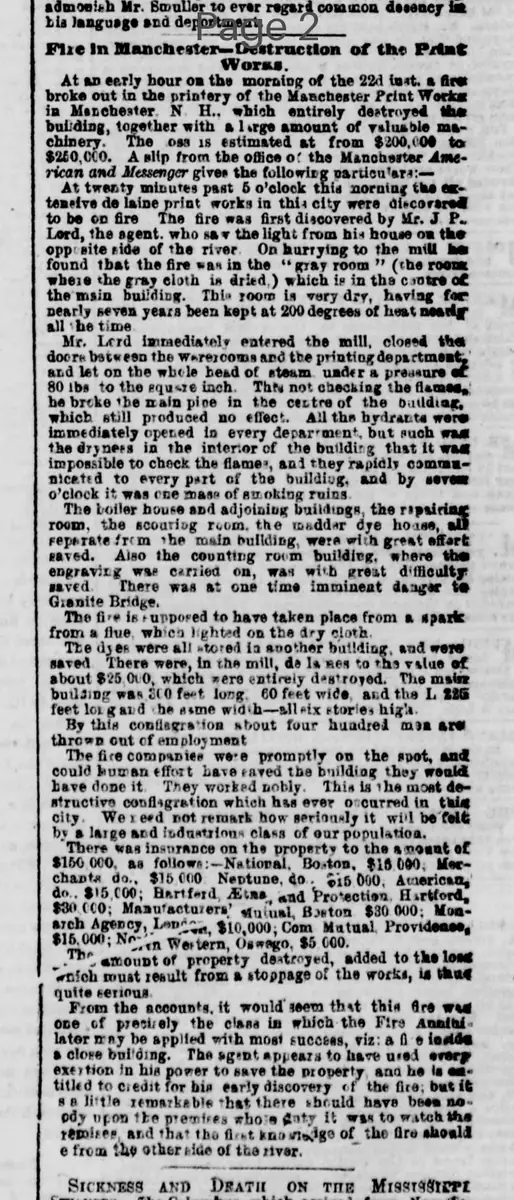
At an early hour on the morning of the 22d inst., a fire broke out in the printery of the Manchester Print Works in Manchester, N. H., which entirely destroyed the building, together with a large amount of valuable machinery. The loss is estimated at from $200,000 to $250,000. A slip from the office of the Manchester American and Messenger gives the following particulars:—
At twenty minutes past 6 o'clock this morning the extensive delaine print works in this city were discovered to be on fire. The fire was first discovered by Mr. J. P. Lord, the agent, who saw the light from his house on the opposite side of the river. On hurrying to the mill he found that the fire was in the "gray room" (the room where the gray cloth is dried,) which is in the centre of the main building. This room is very dry, having for nearly seven years been kept at 200 degrees of heat nearly all the time. Mr. Lord immediately entered the mill, closed the doors between the dryer rooms and the printing department and let on the whole head of steam under a pressure of 80 lbs to the square inch. This not checking the flames, he broke the main pipe in the centre of the building, which still produced no effect. All the hydrants were immediately opened in every department, but such was the dryness in the interior of the building that it was impossible to check the flames, and they rapidly communicated to every part of the building. By 8 o'clock it was one mass of smoking ruins.
The boiler house and adjoining buildings, the repairing room, the scouring room, the wadding dye house, all separate from the main building, were with great effort saved. Also the counting room building, where the engraving was carried on, was with great difficulty saved. There was at one time imminent danger to Granite Bridge.
The fire is supposed to have taken place from a spark from a flue, which lighted on the dry cloth. The dyes were all stored in another building, and were saved. There were, in the mill, delaines to the value of about $25,000, which were entirely destroyed. The main building was 300 feet long, 80 feet wide, and the L 220 feet long same width—all six stories high.
By this conflagration about four hundred men are thrown out of employment. The fire companies were promptly on the spot, and could human effort have saved the building they would have done it. They worked nobly.
This is the most destructive conflagration which has ever occurred in this city. We need not remark how seriously it will be felt by a large and industrious class of our population.
There was insurance on the property to the amount of $150,000, as follows:—National, Boston, $16,000. Merchants do., $15,000 Neptune, do. $15,000, American do., $15,000; Hartford, Etna and Protection, Hartford $30,000; Manufacturers' Mutual, Boston $30,000; Monarch Agency, London, $10,000; Com Mutual, Providence $15,000; No. in Western, Oswego, $5,000.
The amount of property destroyed, added to the loss which must result from a stoppage of the works, is thus quite serious. From the accounts, it would seem that this fire was one of precisely the class in which the Fire Annihilator may be applied with most success, viz: a fire in a close building. The agent appears to have used every exertion in his power to save the property, and he is entitled to credit for his early discovery of the fire; but it is a little remarkable that there should have been nobody upon the premises whose duty it was to watch the premises, and that the first knowledge of the fire should come from the other side of the river.
What sub-type of article is it?
What keywords are associated?
What entities or persons were involved?
Where did it happen?
Domestic News Details
Primary Location
Manchester, N. H.
Event Date
Morning Of The 22d Inst.
Key Persons
Outcome
building and machinery destroyed, loss $200,000–$250,000 including $25,000 in delaines; 400 men thrown out of employment; insurance $150,000; no human casualties mentioned.
Event Details
Fire broke out at 6:20 AM in the gray room of the delaine print works, discovered by agent Mr. J. P. Lord. Despite efforts with steam, hydrants, and closing doors, the dry interior allowed flames to spread rapidly, reducing the main building to ruins by 8 AM. Cause suspected as spark from flue on dry cloth. Adjoining buildings saved with effort.