Thank you for visiting SNEWPapers!
Sign up free
Portland Gazette, And Maine Advertiser
Portland, Cumberland County, Maine
What is this article about?
During the Twelfth Congress First Session on Tuesday, June 9, the House of Representatives received an anti-war petition from 200-300 Pennsylvania citizens, rejected a resolution allowing cross-branch attendance at secret sessions, and obtained a presidential message with ongoing correspondence between Mr. Foster and Mr. Monroe debating French Decrees' status and British impressment policies toward American seamen.
Clipping
OCR Quality
Full Text
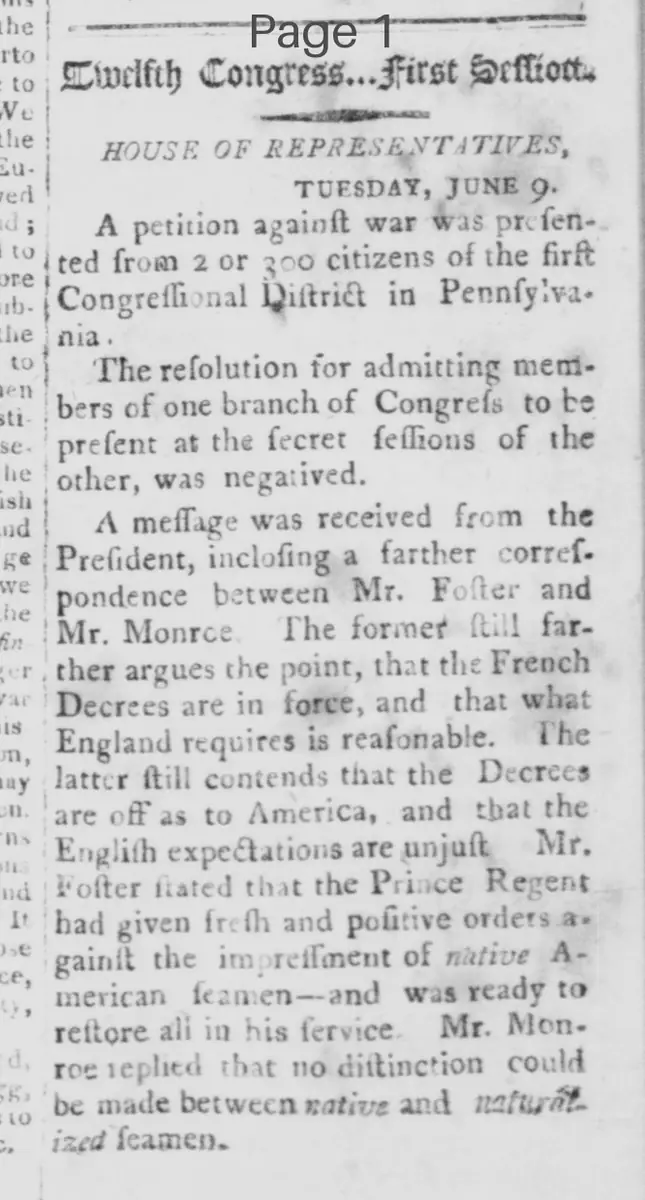
HOUSE OF REPRESENTATIVES,
TUESDAY, JUNE 9.
A petition against war was presented from 2 or 300 citizens of the first Congressional District in Pennsylvania.
The resolution for admitting members of one branch of Congress to be present at the secret sessions of the other, was negatived.
A message was received from the President, enclosing a farther correspondence between Mr. Foster and Mr. Monroe. The former still farther argues the point, that the French Decrees are in force, and that what England requires is reasonable. The latter still contends that the Decrees are off as to America, and that the English expectations are unjust. Mr. Foster stated that the Prince Regent had given fresh and positive orders against the imprisonment of native American seamen—and was ready to restore all in his service. Mr. Monroe replied that no distinction could be made between native and naturalized seamen.
What sub-type of article is it?
What keywords are associated?
What entities or persons were involved?
Domestic News Details
Event Date
Tuesday, June 9
Key Persons
Outcome
resolution negatived; correspondence reveals british orders against imprisoning native american seamen and readiness to restore them, countered by monroe's insistence on no distinction between native and naturalized seamen.
Event Details
The House received a petition against war from 2 or 300 citizens of Pennsylvania's first Congressional District; a resolution to allow members of one congressional branch to attend secret sessions of the other was rejected; a presidential message enclosed further correspondence where Foster argued French Decrees remain in force and British demands reasonable, while Monroe asserted Decrees revoked for America and British expectations unjust.