Thank you for visiting SNEWPapers!
Sign up free
Richmond Enquirer
Richmond, Richmond County, Virginia
What is this article about?
Virginia Board of Public Works reports on connecting James River to Kanawha via canal, road, and river improvements to enhance trade in coal, salt, and agriculture. Estimates $2.38M cost, fundable by tolls yielding surplus, boosting population and commerce without financial strain. (248 characters)
Merged-components note: Merged the report on internal improvements and western communication across pages 2, 3, and 4, including embedded tables, as it forms a single coherent news article on government and economic matters. Relabeled from mixed 'commercial', 'domestic_news', 'table', and 'story' to 'domestic_news' for consistency with content on domestic policy and infrastructure.
Clippings
1 of 3
OCR Quality
Full Text
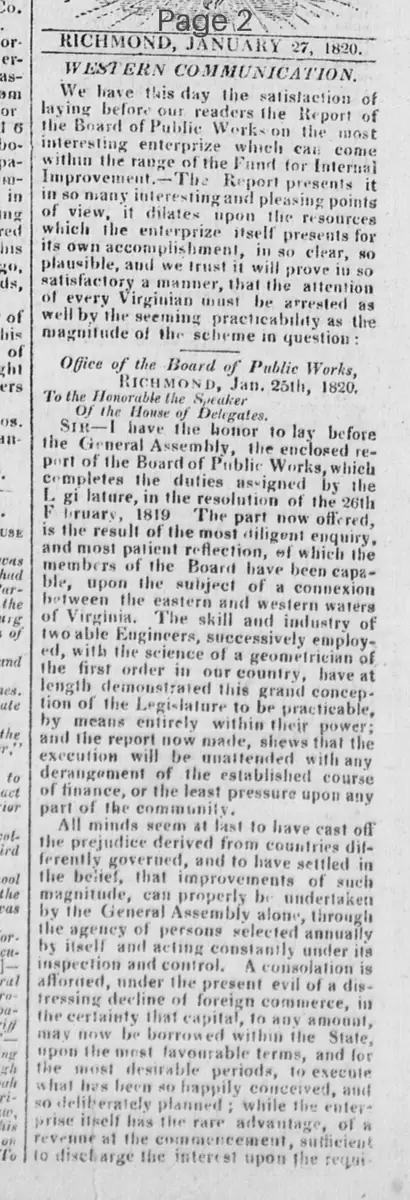
WESTERN COMMUNICATION
We have this day the satisfaction of laying before our readers the Report of the Board of Public Works on the most interesting enterprize which can come within the range of the Fund for Internal Improvement.—The Report presents it in so many interesting and pleasing points of view, it dilates upon the resources which the enterprize itself presents for its own accomplishment, in so clear, so plausible, and we trust it will prove in so satisfactory a manner, that the attention of every Virginian must be arrested as well by the seeming practicability as the magnitude of the scheme in question:
Office of the Board of Public Works,
RICHMOND, Jan. 25th, 1820.
To the Honorable the Speaker Of the House of Delegates.
Sir—I have the honor to lay before the General Assembly, the enclosed report of the Board of Public Works, which completes the duties assigned by the Legislature, in the resolution of the 26th February, 1819. The part now offered, is the result of the most diligent enquiry, and most patient reflection, of which the members of the Board have been capable, upon the subject of a connexion between the eastern and western waters of Virginia. The skill and industry of two able Engineers, successively employed, with the science of a geometrician of the first order in our country, have at length demonstrated this grand conception of the Legislature to be practicable, by means entirely within their power; and the report now made, shews that the execution will be unattended with any derangement of the established course of finance, or the least pressure upon any part of the community.
All minds seem at last to have cast off the prejudice derived from countries differently governed, and to have settled in the belief, that improvements of such magnitude, can properly be undertaken by the General Assembly alone, through the agency of persons selected annually by itself and acting constantly under its inspection and control. A consolation is afforded, under the present evil of a distressing decline of foreign commerce, in the certainty that capital, to any amount, may now be borrowed within the State, upon the most favourable terms, and for the most desirable periods, to execute what has been so happily conceived, and so deliberately planned; while the enterprize itself has the rare advantage, of a revenue at the commencement, sufficient to discharge the interest upon the requisite loans. said loans. and certain to increase as the work advances.
The competition with other States of the Union, so honourable and useful when confined to such objects, is encouraged, and supported, by the consideration of the peculiarly advantageous circumstances which a more happy climate, and more favorable approach from the sea, manifestly afford to Virginia. The inland navigation contemplated, will be suspended by ice, the only possible obstruction, not every year: and then one fourth of the time only which must be experienced every year, by our less fortunate rival; besides the sea-risk upon the tempestuous lakes which her commerce must pass, before it can meet ours in the markets of the western States.
The passage from Europe to the Chesapeake, now as safe, as constant and as certain in time, as any wide ferry; with the security to merchandize, and perishable products afforded by decked boats moving on a still canal, are advantages to which the trade of New Orleans, having always to encounter a dangerous navigation from the entrance of the Gulf stream to that of the Mississippi, and afterwards to overcome the resistance of a rapid and steady current, not affording depth enough all the year for vessels of burthen, must ultimately yield.
The subject is now mature for the decision of the Legislature; and upon that depends what Virginia shall be twenty years hence: Whether as now; or with a great and flourishing commerce, populous and wealthy cities, re-occupied plains on the east, and peopled mountains on the west, a connexion founded on mutual interests, with the great population of the western states, for the most part driven originally by want of profitable employment, from her own territory; and the mighty influence such advantages cannot fail to create, for the preservation of order, free principles, and union in the confederacy.
I have the honor to be, with great respect, yours, &c. &c.
TH: M. RANDOLPH,
Pres't of the Board of P. Works.
REPORT.
The President and Directors of the Board of Public Works, in obedience to the resolution of the General Assembly of the 26th of February last; requesting them "to report to the (then) next General Assembly, the best practicable communication, for the purposes of trade between the waters of James river and those of the great Kanawha: together with an estimate of the probable expense of such plan or plans as they may suggest," having caused surveys of those water courses and the intermediate country; and estimates of the expense of making a communication between the Basin at Richmond and the Ohio, which might be convenient for the purposes of commerce : to be carefully made by their Principal Engineer and Isaac Briggs, as suggested in the last Annual Report; and having received the report of the former on the 14th day of this month, and of the latter on the 1st instant, now submit those reports to the consideration of the General Assembly ; together with the result of their reflections and deliberations thereupon.
It is deemed superfluous to insist in detail, upon the many weighty political, commercial and local considerations, which ought to influence the public councils of the Commonwealth, in giving every practicable facility to the accomplishment of this great internal improvement. Those details may be found, in part, in the Report of John Marshall and his associate commissioners made to the Legislature of Virginia in the year 1812; in the several reports of the Board of Public Works heretofore made to the General Assembly : in the report of Samuel Blackburn made to the present Assembly ; and in the reports of the Engineers accompanying this. To all which the General Assembly are respectfully referred. The Board of Public Works however, in looking as they do to the profits which will speedily accrue upon the proposed works as they progress, as the means, and if they are not greatly mistaken, ample means of completing by far the greater portion of those works; are necessarily led to the examination of the present state of the agricultural and mineral products of that part of Virginia which is naturally and necessarily connected with the proposed improvement; and the probable effects, of such improvement, on those subjects. The coal trade of James river labours under great disadvantages, for the want of a cheap mode of conveyance, which the present state of the navigation of James river does not afford: the coal comes into the market, not only charged with the burthen of 12 cents per bushel for carriage, but in consequence of the mode of transporting it, it is greatly deteriorated and disfigured. The effect of which is, that the English coal although charged with a heavy export duty in England : a heavy import duty in America; and a freight across the Atlantic, comes advantageously into competition with the James river coal, in the principal Atlantic sea port towns in the United States, and even in Norfolk; so as in a great measure to exclude the James river coal. The proposed improvement would not only release the coal of James river from two thirds of the charges of transportation to Rocketts. (for it would have a right to pass through the smaller locks of the Dock company without paying toll,) but would bring it into market uninjured by the transportation.; under such circumstances it is impossible but that the British coal must yield the American market to the James river coal. That market is already great, and is becoming daily more important. The stock of coal on James river is supposed to be inexhaustible: and it may be justly anticipated, that in ten years after the James river coal shall have come fairly into competition with the English coal, from five to ten millions of bushels of the former will pass the proposed canal. Such an anticipation, however, is not at all necessary, to justify the proposition which the Board of Public Works are about to submit for the improvement of James river. They disclaim all speculative views, and found themselves on the trade, which under existing circumstances, must necessarily pass through the canal in contemplation. The Board of Public Works are assured, and do not doubt the fact, that at present 500,000 bushels of salt, made upon the banks of the Kanawha, are annually exported by contract through that river: That much larger quantities would probably be made and transported through that channel, if the makers of salt were not prohibited by the terms of an existing contract, which is temporary, from doing so: and that the wells of the Kanawha would afford water of a quality much superior in strength to that of any other salt works which could come in competition with those of the Kanawha- onl wood for fuel, which daily becomes more scarce and dear, those works have an inexhaustible supply of fuel in beds of coal in their immediate vicinity. In addition to this great population of salt, a great commerce of the salt works, to wit : Lumber, provisions, groceries and various merchandise: but that, when the river is low, especially as it has been for many months past, that commerce is greatly interrupted. and the persons engaged in it suffer great loss and inconvenience ; which would be completely removed by the proposed improvement, With a good navigation on this river, it is hardly possible to anticipate the extent to which the commerce on it would be carried. A great extent of country upon the head waters of James river, and on the New and Greenbrier rivers, abounding with fine timber, iron ore, and other minerals, and well fitted for agricultural purposes, lies almost unoccupied, because the products of the country will not, under existing circumstances, bear the cost of transportation to market. The execution of the proposed improvement, would have the effect of bringing the whole of this extensive country as near to market, in respect to the price of transportation, as Albemarle county now is : would soon people and bring into cultivation this great extent of territory, and the produce drawn from them, together with that which would be drawn to the canal from a greatly increased distance on both sides of James river, might justly be expected at no distant period to double, treble, or quadruple the trade on the canal. If, therefore, nothing were due to the more enlarged political and commercial considerations, connected with this subject, it would seem that local considerations alone would afford a sufficient inducement to the undertaking of the work, if resources can be found for its execution. The Board of Public Works, therefore, whilst they are persuaded, that nothing, in the power of the General Assembly, can more largely contribute to the increase of the population, wealth and prosperity of Virginia, than the establishment of the commercial communication proposed; confine themselves to their more appropriate province of enquiring into the practicability of the scheme, and of raising the pecuniary funds necessary for carrying it into execution. To these objects, their attention has been specially devoted; and they are gratified in believing, that the work is not only practicable, but that the necessary resources can be commanded, without relying upon the precarious supplies, afforded by a subscription to a stock, depending for its profit upon contingencies; without calling in the aid of the public treasury in any event; without oppressing, but on the contrary, greatly benefiting those who will be more immediately affected by the payment of tolls, and probably without any aid from the fund for internal improvement; certainly with the aid of that fund to an extent so limited, as not to impair its capacity, to give due assistance to any other work of public utility which may present itself. This may be effected by applying the annual resources which may be commanded, (and which will hereafter be stated in detail,) to the payment of interest upon a capital to be employed in the execution of the work, rather than by applying such annual resources to the work itself. It is obvious that those who have the benefit of any work of internal improvement, must pay, in the shape of tolls, an interest upon the capital expended on it: and if those who have advanced such capital, have taken upon themselves any risk, such risk must also be compensated in tolls, and that liberally. Thus, if it were proposed to raise funds for the proposed work, by a subscription of stock in the usual mode, it would be necessary, in order to induce the individuals to embark their funds, that a fixed and unalterable tariff of tolls should be established, which should afford a reasonable prospect of producing to the stockholders a profit of ten, twelve or fifteen per cent. as a compensation for their risk, real or supposed, as well as for the use of their money: or to ensure some fixed profit, exceeding the rate of legal interest. It is therefore more beneficial to those who will avail themselves of the use of the proposed improvement, that the work shall be effected by a capital borrowed at six per centum per annum; in which case, tolls will only be required to the extent necessary to pay the interest; than by a sale of stock depending for its compensation upon fixed tolls. It is believed, that upon the pledge which will be hereafter suggested, money may be borrowed at the rate of six per centum per annum, as fast as it can be expended in the works. A canal from the basin at Richmond, to Covington, at the mouth of Dunlap's creek; a good graduated road from thence to the falls of the Kanawha, and the improvement of the navigation of that river, according to the suggestion of the Engineers, with a provision for the final completion of the road, when circumstances will permit, are preferred by the Board of Public Works, to any other improvement on an inferior scale, even as it relates to the transportation of the commodities and agricultural products of that part of Virginia naturally and necessarily connected with this line of communication. It appears by the estimates of the Principal Engineer, submitted to the Legislature by the Board of Public Works, in the course of the last winter: that, after allowing for such additional tolls, as the most improved navigation would require for its support, the difference in the whole cost of transportation would be greatly in favour of the most improved system of navigation. To those estimates, the Board of Public Works beg leave to refer. The collateral improvements spoken of in the Engineers reports, ought to be taken up as soon as circumstances will permit. By the report of the Principal Engineer, it appears that the whole works contemplated would cost $1,927,000: and by the report of Mr Briggs, the additional Engineer employed by the Board of Public Works, that they would cost $1,100,000. The Board of Public Works have the most confidence in the judgment and integrity of both of these gentlemen. and they have not the slightest ground to doubt of the verity of the data upon which their estimates are bottomed : on the contrary, they are inclined to think, that their estimates are liberal; since the price of provisions and labor has greatly fallen, and will probably continue low for many years : a circumstance deemed peculiarly favorable to the execution of the work in question, at this time. Yet in making estimates for a work of great magnitude, it is thought to be prudent to make liberal allowances for unforeseen contingencies. The estimate of Thomas Moore is therefore taken, as the basis of the estimates of the Board of Public Works, with an addition of twenty-five per cent, except as to the road. Upon these principles, the account would stand thus :
For the rivers,
$1,827,000
Add 25 per cent for unforeseen contingencies,
456,775
For the road,
100,000
Total,
$2,383,775
Of this sum it is probable that not more than $120,000 per annum could be advantageously expended. This sum would employ as many laborers as could probably be procured. At that rate the work would be completed, and the whole sum expended in the following manner, to wit: in the first year the Kanawha navigation would be completed, for the sake of getting immediate possession of the tolls on salt, and other articles transported on that river : and in the first year a part of the James river canal would also be cut : in the second year the James river canal would be completed to Pleasants' island : in the third and fourth years the road would be finished, and at the same time The James river canal would steadily progress to its final completion. The expenditure of $120,000 per annum, would, for the first ten years, (at the expiration of which the canal would be completed to Lynchburg,) require the following provision for the payment of interest, viz. :
How may this sum be provided for the annual payment of interest?
It is understood that the James river canal company are disposed, for the sake of promoting this important object, to come into any terms which shall effect it, whilst the value of their existing rights shall be secured to them. The Board of Public Works have supposed it to be beyond their province to negotiate any terms with the James river company; and if not beyond their province, yet that such a regulation would more properly belong to the General Assembly. But upon the presumption that some equitable arrangement may be made with that company, without which no step can be taken towards the contemplated improvement, it is supposed that the income of the company will be applicable to the aid of the works in contemplation, whenever they shall be commenced The income of that company has gradually increased, and now may be fairly stated at $35,000 per annum, although the annual income fluctuates, with the variations of the seasons, insomuch that the late dry season has reduced it the last year to $30,185 24 cents, from $38,820 51 cents, the amount in 1817, and $37,392 10 cents, the amount in 1818: as will appear by the annexed document marked (A). The present value of the shares of the company is $375: rating them at $400, their whole capital will be worth $250,000. The annual interest of which is $15,000, which deducted from the $35,000, leaves $20,000, for the collection of tolls, and the expenses of keeping the works in repair ; a further deduction of $8,000 per annum ought to be made ; leaving $12,000 nett per annum, for the payment of interest. The tolls upon the Kanawha, at two cents per bushel on salt, together with tolls on other articles, as proposed in the supplemental report of the last year, would probably amount to $15,000 per annum. But, not to hazard a miscalculation ; suppose them to nett $10,000 per annum, which is no more than the toll upon salt : leaving the residue of the tolls to meet the expenses of collection, &c.- The coal to pass the canal, anticipated by the engineer, from the information of a gentleman extensively engaged in the coal trade, to promise 2,500,000 bushels per annum, and assumed by the engineer at 2,000,000 bushels per annum, may, to avoid any hazard of miscalculation, be stated at 1,250,000 bushels per annum, which, at a toll of two cents per bushel, would yield $25,000 per annum. Upon these data, the resources for paying the interest for the first ten years, would stand thus :
To be raised in ten years, for the payment of interest,
$396,000
To be raised from the present tolls of the James River, 10 years, at $12,000 per annum, $120,000
To be raised from the Kanawha tolls, nine years, at $10,000 per annum,
90,000
To be raised from toll upon coal, 8 years, at $25,000 per annum.
200,000
410,000
Leaving a surplus of $14,000
These estimates are considered as safe, since no allowance is made for the increase of the ordinary trade upon the James river, or for the increase of salt and other trade on the Kanawha, or of the coal trade on the James river, in the course of ten years, all of which are morally certain; and that in respect to salt and coal to an indefinite extent. Nor is any allowance made for any increase of tolls on the ordinary trade of the James river, before the canal has reached Lynchburg: although the benefit derived from the canal to large and fruitful districts below Lynchburg, and even to the country above, would, in the event of its being necessary, in order to the completion of the work, render it just and proper that additional tolls should be imposed, in proportion as the canal shall progress. According to the foregoing estimates, there would be expended on the James river, in ten years, from Lynchburg, to the mouth of Dunlap's creek, $1,200,000, which including the continuing interest $196,000, before expended, would
To provide for the payment of which, the income of the improvements completed in the first ten years, may be assumed as follows:
James river tolls, as at present, after deducting the sums necessary to pay interest on the James river stock, and keep the works in repair, at $12,000 per annum,
$120,000
Kanawha tolls increased by the increased trade on the river, without increasing the rate of tolls, say increase 50 per cent; $15,000 for 10 years,
150,000
To tolls on coal, arising from increased quantity, say 50 per cent.: $37,500 per annum, for 10 years.
375,000
Additional tolls on James river, less than 150 per cent. advance on the present rate of tolls: $50,000 per annum for 10 years,
500,000
$1,145,000
In examining the foregoing statement, it is proper to observe, that no tolls from the road are brought into the estimate, although some, and probably to a considerable amount, will arise, in the course of the twenty years, and will make a part of the fund for the payment of interest ; that no allowance is made for tolls upon articles going up the river, which, in consequence of the facility of navigation, would probably be very great, upon articles necessary for the consumption of the neighboring country and East Tennessee: This resource would be applicable to the payment of interest, and would probably be very considerable. Nor is any allowance made for the natural and steady increase of the downward trade upon the James river, which, judging from past experience, will be great, and afford other funds for the payment of interest, and no more is allowed for the increase of the coal and salt trade in twenty years than 50 per cent.; whereas, in all probability, both would be quadrupled. All these considerations being weighed, it seems to be a reasonable conjecture, that the present rate of tolls on James river need never be raised. On the other hand, the present revenue on coal received by the James River Company, is not taken into the account, because it is inconsiderable - since they only receive toll on the coal boats, as on empty boats passing the canal. Upon the completion of the work, a tariff of tolls should be adjusted on equitable principles, which should insure an income amply sufficient to meet the interest on the capital expended, and all incidental expenses. And as upon any fixed rate of tolls, the income would continually increase, the surplus income should be reserved, to be applied as a sinking fund, to the extinguishment of the principal debt. The consideration, that upon the plan proposed, the whole subject will be continually in the power, and under the control of the General Assembly, so that they may progress to the completion of the work, or suspend it as it may be found expedient ; affords an additional reason, why this plan shall be adopted, rather than that of incorporating a company for the purpose of effecting this improvement. It is believed, that upon a pledge (for the payment of interest) of 2 cents per bushel upon the salt on the Kanawha, with other tolls on the same river, ac. cording to the tariff reported to the General Assembly, in the supplemental report of the last year ; and of 2 cents per bushel on coal on the James river ; and of the present James river tolls, after setting apart a sufficient fund thereout, to pay the ordinary expenses of collection and repairs, and for compensating the present stockholders; with a power reserved to the Legislature, to impose additional tolls on the James river, as the works may progress and become useful; and of the tolls on the road, together with a provision, that any deficiency in the payment of the interest, from the funds so pledged, shall be made good out of the income of the fund for internal improvement; the sums necessary for carrying the foregoing plans into execution, may from time to time, be borrowed as they may be wanted. The Board of Public Works do not recommend to the General Assembly, to provide for making good any deficiency in the funds appropriated for the payment of interest, out of the income of the fund for internal improvement, under the apprehension that any such deficiency will occur: but because they think that such a pledge will give unbounded confidence to those who may be disposed to lend money at six per centum per annum, upon an absolute assurance of the punctual payment of interest, and the security of the principal. And such an additional pledge may be indispensably necessary ; because the Board of Public Works are apprised, that those who are not roused by a sense of public duty to consider minutely the details of the plan of improvement under consideration, are not at all likely to examine into them: and those who do not examine them, will probably be alarmed at the magnitude of the subject, and condemn, without consideration, the enterprise as visionary and delusive. Such persons would of course demand an unquestionable security for their money, before they would advance it. However, contrary to the anticipations of the Board of Public Works, there should be any demand on the fund for internal improvement, by reason of such pledge, provision may be made that they shall be entitled to a six per cent stock to the amount advanced, but not to receive an interest thereon until the works shall have progressed to such a point as would justify the levying additional tolls for the payment of such interest. This would be in strict conformity with the principles of the act creating the fund for internal improvement, which contemplates in all cases that the Board of Public Works shall receive no dividends on the money advanced by them in aid of any company, until the works shall produce an income sufficient to pay to individuals an interest on the capital advanced by them, of six per centum per annum, from the time they advanced their money. And surely the aid of the fund for internal improvement, if necessary, should not be withheld from a work in which so great a portion of the people of Virginia are so deeply interested. In the foregoing review of the subject under consideration, the Board of Public Works have purposely founded their estimates upon the supposition that the contemplated works will require an expenditure greatly exceeding the estimates of the Engineers: and that the annual income from the works will, on an average of twenty years, be less than half of what there is just reason to believe will in fact accrue thereon: because it was thought that if they erred, it was better to err on the safe side.....It only remains to observe, that if the income should be found to be equal to the real expectations of the Board of Public Works, there will be no occasion to borrow any money for the execution of the work above Lynchburg: but that the surplus income, after providing for the payment of interest on the money borrowed for completing the work to Lynchburg, and for the payment of the incidental expenses of the collection of tolls and repairs, would be sufficient alone to complete the residue of the work within the time proposed: and thereafter form an active sinking fund, for the speedy extinguishment of the debt.
All which is respectfully submitted.
TH: N. RANDOLPH,
President of the Board of Public Works.
Bernard Peyton,
Secretary of the Board of Public Works.
Richmond, 21st Jan, 1820.
(A
A true copy.
(Signed) ROBERT POLLARD, Clerk.
| At the end of the 1st year, | $ 7,200 |
| do. | 14,400 |
| do. | 21,600 |
| do. | 28,800 |
| do. | 36,000 |
| do. | 43,200 |
| do. | 50,400 |
| do. | 57,600 |
| do. | 64,800 |
| do. | 72,000 |
| Total is | $ 396,000 |
| 11th year, | S 79,200 |
| 12th year, | 86,400 |
| 13th year, | 93,600 |
| 14th year, | 100,800 |
| 15th year, | 108,000 |
| 16th year, | 115,200 |
| 17th year, | 122,400 |
| 18th year, | 129,600 |
| 19th year, | 136,800 |
| 20th year, | 144,000 |
| Receipts on account of the James River Company, for the years 1816. For tolls, rent of water, rent of ground, | $27,880 613,890 00560 00 |
| $32,330 61 | |
| 1817. For tolls, rent of water, rent of ground, | $31,370 513,890 60560 00 |
| 38,820 51 | |
| 1818. For tolls, rent of water, rent of ground, | $32,902 103,890 00560 00 |
| 27,352 10 | |
| 1819. For tolls, rent of water, rent of ground, | $25,735 243,890 00560 00 |
| 30,185 24 | |
| $138 688 46 |
INTERNAL IMPROVEMENT
Mr. Moore's Report—(continued.)
Notwithstanding I have said thus much on the subject of the coal trade, from a desire that it might be well understood; yet I must request the indulgence of the Board to make a short quotation from an important document, corroborative of my views on the subject.
The document alluded to, is a letter from Joshua Gilpin, dated Philadelphia, January the 1st, 1808, on behalf of a committee of the Chesapeake and Delaware canal company, to Albert Gallatin, Secretary of the Treasury of the United States, in answer to certain queries, put by the latter, relative to that canal.
My colleague is well acquainted with the writer, he knows him to be a man of talents, and this letter proves him to be a man of information. Speaking on the articles of traffic that would probably pass the canal when made, he thus notices the article of coal:
"The only place where this production is now found, so near the Atlantic waters, as to be capable of immediate transport, is on James river. The quality is excellent for all manufacturing purposes; and, if properly selected, equal to any foreign coal, for domestic uses.
The increasing price of fuel in all the maritime towns must soon create a dependence on it for both purposes; and it is daily so much increasing in use, that it must command an immense carriage, in which a minute saving of expense will be of the utmost consequence."
"I shall indulge a calculation on this article which may serve for many others: There is now brought to the city of Philadelphia nearly 500,000 bushels per annum, great part of which is from Europe. This city is ascertained to require a supply of at least 200,000 cords of wood per annum; equal, at 20 bushels of coals per cord, to 4,000,000 bushels, which at 50 dollars per ton, (the weight of the best English coals,) is 133,333 tons. This would require 2,667 cargoes of 50 tons each: hence the revenue of the canal for this article only, at 50 cents per ton, would be 66,666 dollars."
"The coal of James river was regularly supplied at Philadelphia, before the present advance of labor, arising from the war in Europe, in large quantities, by vessels regularly employed in the trade, at 20 cents per bushel at which price the carriers made a decent freight: coals cost in England, including all charges on ship-board, nearly 20 cents per bushel, and pay a duty of five cents, so that they are sold to a loss under 50 cents per bushel."
It will be seen that this was written twelve years ago. since when I believe there has been an additional duty laid on our England, and also an import duty in this country. I shall make no further comment on this letter, than just to observe, that it proves the estimation in which good Virginia coal is held in Philadelphia; that they look towards it for a supply of fuel; and also the quantity that it will require to supply the demand, when coal becomes cheaper than wood; which time has very nearly, if not quite arrived, at this moment.
We will now return to the subject of raising funds, for defraying the expense of making another section of canal, (say,) to the Rivanna river. This section, according to the estimates, will cost $171,531; a balance of 40,000, it is supposed, would be on hand on the completion of the first section; and tolls to the amount of 30,000 dollars, pledged for the payment of the interest on the capital then obtained.
From what has been said, it would appear, that a very large quantity of coal might be expected to pass down the canal the first year; but I will not rely entirely on my own judgment, for information relative to this point. An intelligent and highly respectable collier, who is perhaps more largely engaged in the business than any other person, has been consulted on the occasion, who gives it as his opinion, that it will be quite safe to calculate on 2,500,000 bushels being transported by water, the first year after the navigation shall be so far completed as to admit of the passage of boats carrying one thousand bushels to Rocketts, and being there unloaded without detention: and that, if the business can be prosecuted successfully, 4,000,000 per annum may confidently be calculated on.
We will, however, for the first year, make our estimate on 2,000,000.
The tolls on this quantity, at 2 cents per bushel, is $50,000
But as the tolls which are already appropriated include the toll on that quantity of coal which now goes down by water, this amount must be deducted from this sum. That quantity is certainly under 500,000 bushels: but we will suppose it be that quantity, which at the mouth of the Rivanna, and for a short distance above, may be said to be now enjoying the full benefit of the canal. A boat carrying 200 barrels of flour, will make a trip (that is to go down and return,) from Columbia, in six days; the expense of which would not exceed 18 dollars, or 7 cents per barrel. The present cost of transportation from the same port, I believe does not average less than 38 cents, including the present toll, which is ten cents. Then, giving the agriculturists and manufacturers more than half the saving in transportation, it cannot be considered too much to levy an additional toll of ten cents per barrel for using the canal.
In the lower district, large quantities of a great variety of articles will find their way to market by way of the canal, that at present do not pay carriage, except for a few miles into the city; amongst which may be enumerated produce under of every description, wood for fuel, bark for tanners, building stone and brick, and probably many others. The quantity of lumber from the Rivanna will also be much increased, as the cost of transportation would be proportionally diminished; and at present it amounts to something like one third of its value when at market. Perhaps it would not be good policy to lay a heavy toll on these articles, but still they could well afford to pay something. These, added to the mass of such agricultural products as are now constantly sent to the Richmond market, would certainly be equal in amount, as regards the productions of tolls, according to the distance carried on the canal, to one-third or four-twelfths of the articles exported from the stage Joan of Lynchburg. It was last year ascertained, that the amount of these exports was equal in value, and capacity for paying tolls, to 130,000 barrels flour. For the sake of convenience, that article was then assumed as the basis for calculation. If we adopt the same in the present calculation, we have in coal-paying products in this district, exclusive of coal, equal to 43,333 barrels of flour.
And if we now add the tolls on an additional 500,000 bushels of coal, (which it is certain will be safe to calculate on,) at 2 cents, which is $12,500
The amount of tolls free from appropriation will be $16,833
The capital of which this sum would be the interest at 6 per cent is 280,560
Add to this the balance on hand 221,502
And the amount will be $502,062
To be applied to the improvement of the next section. The amount of tolls now pledged, is 90,833
Let this section extend to the mouth of the James river, about fifty three miles above Columbia. The cost of which, as extracted from the estimates, will be $273,873
This sum taken from the sum on hand leaves a balance of $228,189
From the best information obtained last year, it was believed, that the whole of the products which went to Richmond market, from below Lynchburg, was at least equal to what was sent from that town. Then pursuing that idea we have given to the section below Rivanna four twelfths of that quantity; and I believe about five twelfths might be a fair proportion to be allotted to the one now under consideration, and three to the next above.
Five twelfths of 130,000 is 54,166 I am not acquainted with the average cost of transportation from this part of the river; but it is ascertained to be about ninety cents for a barrel of flour from Lynchburg. I should suppose it might be stated at sixty, including present toll, (10 cents) for this section. By the canal it may be done for nineteen cents, including present toll It then we lay an additional toll of twenty cents per barrel, for this section, the owners of the property will still be the gainers by twenty one cents per barrel.
This section extends to within thirty nine miles of Lynchburg, and above the worst falls. If therefore, the products from Lynchburg, were brought by the bed of the river, to the upper end of this section, twenty cents per barrel would be gladly paid for the use of the canal, the remainder of the distance; because, there would be a saving of more than that sum per barrel. And this applies also, to every article brought down the river, from above Lynchburg; but, as I am not in possession of sufficient data, for estimating the quantity that passes Lynchburg, we will leave it out of the calculation altogether.
Twenty cents per barrel, on 54,166 barrels, for the middle section, is 10,833
Twenty cents per barrel, for the whole of the trade from Lynchburg, equal to 130,000 barrels, is, 26,000
The sum is $36,833
The capital of which this sum is the interest is 613,883
Balance on hand 588,089
The sum is $1,201,972
Which is applicable to the extension of the canal to Lynchburg.
This by the estimates will cost $215,975
Which taken from the last mentioned sum leaves 986,097
The amount of tolls now pledged, in 127,666
Thus far, we have calculated nothing for the advantage to be derived on the canal, by back freights; neither as they relate to the increase of tolls, nor, as they operate to diminish the cost of the descending trade. It is however, very well known, that immense quantities of merchandise are taken up the James river to Lynchburg, and to places above And if the freight was reduced to one-third or a fourth of the present rates, it is highly probable the quantity would be vastly increased; and if the article of plaster of paris, was taken to Lynchburg for three dollars per ton, instead of twelve, and in proportion for other distances, the quantity that would be carried, would be great indeed; and the effects on the products of the country, incalculable. It will then, certainly be reasonable in our calculations, for the cost of transportation from Lynchburg, to allow something for the item of back freight. If we say for every return boat, three tons of merchandise, at four dollars, and three tons of plaster, at three dollars, the amount will be $21. Then the account for a trip will stand thus:
For one man, a boy and horse, 16 days, at $3, 48
As we are now availing ourselves of the advantage of some back freight, we will add a reasonable allowance for the boat, say, 10 58
From which, deduct for back freight 21
$37
This is equal to 14 cents 2 mills per barrel, say, 15 cents; and 10 cents for the present toll, will make 25 cents.
The average Cost of transport by the river Is 90 cents, the saving in favour of the canal 65 cents. Therefore, if we lay an additional toll of 25 cents per barrel, the freight will still be the gainers by 40 cents per barrel; besides the great advantage of having every article completely secured from damage, by rain or danger from the river and say, from loss by pilfering, &c. added to the certainty of the navigation at all seasons, except when closed by ice as the canal boats will be well roofed or enclosed, and it is to be presumed will be in the charge of a respectable man.
Twenty cents per barrel for the 130,000 barrels from Lynchburg, has been already pledged in our last estimate; we then have 5 cents per barrel, toward the next.
5 cents on 130,000 barrels, is $6,500
To which add, for the tolls of the last section, that have not yet been taken into account, and which, on the same principles, will amount to 7000
$13,500
The capital of which this sum is the interest is $225,000
To which add the balance on hand, 956,097
The sum is, $1,181,097
Which will be more than sufficient to complete the remainder of the whole line of improvements, to the Ohio river.
The amount of tolls pledged for this object, will be 111,166 dollars.
The result of these estimates and calculations cannot fail to excite astonishment, in the mind of every person not familiarized to this great subject. Let them, then, be subjected to the severest scrutiny. If a result less favorable to the object, is produced by other estimates and calculations, the difference must arise, either from these estimates being too low to effect the improvements; from a deficiency in the quantity of products that would be transported on the canal; or from the impracticability of raising the capital, by paying for its use an annual interest, at the rate of six per cent. pledging the tolls for the security of the payment." With regard to the first, it will be found on a close inspection, that the estimates are considerably higher for the same kinds of work, than they are now executed for in New York. The line of this Canal, passing down the ravine of a river, and elevated but a few feet above the mouths of the tributary streams, partakes only in a very small degree of the most expensive kinds of operations incident to canals carried over high grounds; which are the forming of those high embankments, and the erection of elevated aqueducts, necessary for the purpose of passing deep ravines. This circumstance, with the great difference in the dimensions of the two canals, will account for the difference of the cost per mile. I must either have done violence to my judgment, or departed from the plain rules of measurement and arithmetic, to have given higher estimates.
The quantity of products, it will be observed, is estimated from the exports from Lynchburg, in the years 1817 and 1818. It was ascertained, that there was tobacco, equal in weight to three fifths of 130,000 barrels of flour, taken in boats from that town, per year; and it was believed that flour and all other articles would be more than equal to the other fifth. The whole trade of the river below, and of its branches, is only considered as equal to the trade of that single town: and the rates of tolls apportioned to the distances. The coal trade is not included in this estimate. The amount of tolls calculated on from that article, I should suppose could not be doubted.
And with regard to raising the necessary Capital, by means of the tolls: If it was made a State concern, as I think it ought to be, for several reasons, I believe any desired amount of capital might be had at six per cent; but, if it could not, I would say at once, let the rate be higher. The sum resulting from the calculation of six per cent, is more than is wanted for the object; and if it were not, adding a little more to the tolls, (diminishing thereby, in a small degree, the benefits of those concerned,) will make them adequate to the payment of any reasonable rate of interest.
But, it may be asked, how is this large capital to be redeemed? I would say, if the state is annually deriving great advantages from the use of it, and a fund cannot be conveniently created from the work it has effectuated, let it remain unredeemed.
But let us consider the subject a little further; perhaps we may discover the means for the establishment of a sinking fund for the purpose.
In the first place, then, from the views which have been taken of the subject, is it reasonable to expect an increase of the coal trade, to the extent, or exceeding the extent, contemplated by the very respectable collier before mentioned? If it is, that trade will furnish a large item for the purpose.
Secondly, is it reasonable to expect, that by diminishing the transportation nearly one half, greatly increasing the security from damage, and the certainty of getting the articles of transportation to market, at the time desired, with the additional advantage of having the article of plaster of paris, at a price very little higher than in Richmond, the quantity of produce within the district that now uses the present navigation, will increase? and that that district will be very much widened on both sides of the river? If it is, then a large item will be afforded for the purpose, from this increase of trade, before we arrive at the town of Lynchburg.
And, thirdly, the tolls above Lynchburg may form another item. We are to remember, that we have not yet laid hand on a cent of the tolls on the produce from above this place, except the ten cents per barrel, levied by the James River Company.
We will therefore enquire what prospects we have for additional support to our fund, from that quarter.
The present trade on this part of the river is already respectable. The average prices of transportation, from the country above Lynchburg, I believe, is not less than $1 25 per barrel, and other articles in proportion; but as we have assumed the article of flour for the basis of calculation, from Lynchburg, and thence downward; perhaps we may, with equal propriety, adopt it for that purpose, for all the descending trade of the section now under consideration.
The inhabitants of this part of the state, are extremely anxious for some improvement in their mode of transportation. It seems to be generally believed by them, that if the sluice navigation only was tolerably perfect, so as to afford a certainty of their getting their produce to market, and their merchandise brought up at all seasons, (a part of the winter excepted that, the trade on the river, even at the present prices, would very soon be doubled
But on the canal, by supposing the back freight to be something more in proportion to the distance than nearer the market, (and this will always be found to be the case,) (say) four tons of merchandise and four tons of plaster, by each returning boat, the former at four dollars and the latter at three dollars, the cost of transportation from Beale's bridge, or from the mouth of Craig's creek, may be reduced to sixty cents; and pay thirty-eight cents per barrel toll. This is placing the lands two hundred miles from market on the same footing as it relates to the cost of transportation, with those that lie within thirty to forty miles that transport their products by a common road.
Some part of the products of Amherst and Campbell counties, would reach the canal above Lynchburg; the whole of Rockbridge Botetourt and Bath counties, and a large proportion of Augusta, would largely partake of the benefit, and of course the increase of trade would be in proportion.
It is true that a considerable part of this country is mountainous, and not well adapted to the purposes of agriculture, but it is also true, that there are many large valleys of excellent land, and even some of the mountain sides very proper for the cultivation of wheat and tobacco. But do those mountainous tracts, which are not adapted to the plough or the scythe, afford no article that will bear a transport only equal to forty-five miles of land carriage? Let those who are best acquainted with the quality of the iron which that country affords, answer the question I am not myself acquainted with the quality of the bar iron, but with the metal of, which it is made. I am, and can say, that if the bar iron is not of an excellent quality, the cause must be sought for in the manufactory. The neatest castings for the purpose of machinery that I have ever seen, and I believe the most perfect that are made in the United States, are made in the city of Richmond, for James river metal I have seen bevel wheels from this foundery, overcoming a greater quantum of resistance than I have ever seen from any other of equal weight; but this metal cannot be procured, either in Richmond or at the foundery at the arsenal, in any thing like sufficient quantities for the demand; merely from the want of the means of transportation; for that cause and that cause only, the proprietor of the Richmond foundery told me a few days since, that he was importing fifty tons from Europe; and the proprietors of the foundery at the arsenal, for the same cause, are receiving their supplies from other states
The quantity of this excellent ore, is believed to be inexhaustible; every mountain and hill, is covered with wood, and the Cow-pasture, Jackson's river, and a number of other streams, afford the power of manufacturing to an extent Taking into consideration the circumstance of the fuel being very much exhausted every where near the tide water, where good iron ore abounds; and that the land carriage from the iron establishments in hand, is generally very considerable, can we point out a spot in the United States so favorable for the manufacture of the articles of bar iron and castings as on the upper branches of James River, when the transportation to market is so reduced as to amount to not more than from five to six dollars per ton, after paying a handsome toll to the state.
Ought not the immense masses of limestone in the counties of Rockbridge and Botetourt, when prepared by the surplus wood of the country, to banish the eastern lime from the markets of Richmond and Norfolk? And when the transportation is reduced so as to be only equal to a few miles of land carriage, ought we not to contemplate that an accession to our stock of materials for the building our cities on the tide water, and our ships for the ocean, will be derived from the fine forest trees of this upper country?
When we reflect that the tolls will be in some measure in proportion to the distance the canal is used, may we not, from all these sources, the products of the soil, of the mines, of the quarries and the forests situated between the Blue Ridge and Alleghany mountain, calculate on deriving a revenue that will form a handsome item in our list for the establishment of a sinking fund?
But we are not yet at the bottom of our list. The counties of Greenbrier, Monroe, and a part of Giles, are not inconveniently situated with regard to this navigation. A large portion of the lands of the two former, may be considered of the first quality for the production of wheat. There are also some good lands in the latter. Such of the inhabitants of Greenbrier and Monroe as I conversed with on the subject, were of the opinion, that if the price of transportation could by any means be reduced to one dollar per barrel from Covington to Richmond, that their good lands would immediately be cultivated in wheat, instead of being used for the raising of stock; and that the quantity of flour, and other agricultural products, which would be taken to Covington in waggons, would be very considerable. But by the canal, supposing each return boat to bring only half a back load, at the low prices of three and four dollars per ton, the downward transportation may be reduced to sixty cents per barrel, including a toll of thirty eight cents.
The road from Covington to these counties are at present tolerable; If they be made good, and flour may be taken from some of the mills in these counties to Richmond, by way of the canal, for about the same price per barrel, as is paid from the upper part of Loudoun and Fauquier counties, to Alexandria.
The upper part of Giles county : and the counties of Montgomery, Wythe and Grayson are situated on New river, above the mouth of Sinking Creek. As our survey up the river terminated at the last mentioned point. I had no opportunity of seeing the river higher; neither have I ever been in either of the large last mentioned counties, therefore, all the knowledge I possess, relative to the upper part of this river, and the lands and products of those counties, I have derived from the information of others. I have already stated in another part of this report, that from such information, the river is not more difficult to improve, for many miles, above the mouth of Sinking creek, than below, to the mouth of Greenbrier; and that the counties of Montgomery and Wythe, though mountainous in part, are notwithstanding considered rich counties; and are capable of producing large quantities of Agricultural products, of various kinds, as well as the mineral productions, of lead and iron.
But few of these will at present, pay the cost of transportation to market. I am told the present price for hemp, (and probably for other articles) is three cents per pound, or $60 per ton. If a good sluice navigation was procured from these counties, to the mouth of Greenbrier; and up the Greenbrier, to the mouth of Howard's creek ; the cost of transporting a barrel of flour, and other articles in proportion, from the lead mines to Howard's creek, counting on half a back load, would probably be about 75 cents per barrel; or, $7.50 per ton. From thence to Covington, a little over 20 miles, by the best description of road, and the best waggon arrangement, 25 cents per barrel; or, $2.50 per ton— Thence to Richmond, sixty cents per barrel; or $6 per ton, including the toll; making in the whole, $1 60 cents per barrel; or, $16 per ton.
It is possible, that at some seasons, the route from the mouth of Sinking creek, by land to the mouth of John's creek, and thence down Craig's creek, to the canal, might be more eligible. If both routes were improved, an alternative would be presented. The article of hemp, would probably form an exception to these rates, from the inconvenience of bulk; unless it were taken in small quantities, as a top stowage on lead, iron, or some other heavy article.
Whether this reduction in transport, will be so inviting as to induce the inhabitants of these counties, to change their habits so far as to become grain, instead of stock, Farmers, is not for me to say; but certainly, beef, and pork in barrels, butter, bacon and such of her products, as are of considerable value in proportion to their bulk and weight, will take one of the routes mentioned to market; in either case, the State will receive the tolls which they will pay for using the canal.
In addition to what has been already stated, relative to the revenue to be derived from below the Alleghany mountain, here are six western counties, before we arrive at the falls of Kanawha, which appear to be interested, and some of them very deeply, in the completion of the work under consideration. Will not the revenue derived from these, afford another additional sum, to be placed to the account of the sinking fund?
But there is still another very important question to be considered relative to this subject. That is, will this canal, command any considerable trade from the country west of the falls of Kanawha? from whence a land carriage of nearly 90 miles must be encountered
The western trade appears to be considered an object of immense value: to which the States of New York, Pennsylvania, Maryland and Virginia each have their pretensions.- And these are all opposed by the state of Louisiana. The first mentioned of these States, under the influence of a policy, adopted by her legislative councils, that will long be marked for its wisdom, is acting with vigor and effect whist the writers of the second and third, are engaged in disputing the validity of their pretensions to the prize. These writers, discover a laudable zeal for the improvement of the states of which they are respectively the advocates; and as it does not appear to me, that my duty lays me under the obligation, of entering the lists with them, in favor of Virginia, I will not therefore, damp the ardour of inquirers, by noticing their vulnerable points; But content myself, with stating a few facts; leaving those writers, and every other person to draw their inferences.
It is said that the Steam-boat business, between New Orleans and the falls of Ohio, is already overdone; yet the very lowest rate of freight that I have heard of after repeated enquiries, from the former to the latter place, is two and a half cents per pound ; or $50 per ton. The present average price from Philadelphia to Pittsburg, is, about $140 per ton. And from Baltimore to the same place, $100
Great exertions are making in Pennsylvania, to reduce the transport, by improving the roads, and the establishment of a regular line of waggons, to be supported on the most economical terms. But I do not find that the most sanguine supporters of these plans calculate on ever reducing it below $80 per ton.
The supporters of the Maryland line, calculate, that by using the national road, and by purchasing the Baltimore and Frederick turnpike which cost $96,000; and the road from Conococheague or Hagerstown, to Cumberland, which will cost $460,000; and uniting the two by another section of Turnpike, in all amounting to more than $1,100,000; and by carrying the waggon system, to the greatest extent of economy, that they will be able to transport a ton of merchandise from Baltimore, to the bank of the Ohio, at Wheeling, for $50.
In account of a small current which will probably exist in the canal if we calculate on only eighteen tons being drawn by one horse in ascending, we shall find by a fair calculation, we cannot make the actual cost of labor more than at the rate of two dollars twenty-five cents per ton from Richmond to Covington ; but, for the interest of the capital vested in the horse-boat, &c. say two dollars fifty cents ; and this will nearly correspond with the sum that is now considered in New York as the fair price of canal transportation, independent of revenue, that is, one cent per ton per mile.
Taking the Baltimore price for land transportation, that is, fifty dollars per ton, for two hundred and fifty two miles, we have for ninety miles, from Covington to the falls of the Kanawha, rather less than eighteen dollars per ton
When the few improvements are made in the Kanawha which are now in contemplation, boats of any desired burden, for inland trade, will always find sufficient depth of water, with a current not more rapid than the Ohio from Pittsburgh to one hundred miles below Wheeling. On such a navigation, two dollars fifty cents per ton is certainly an ample allowance for ninety four miles down stream. We have then,
For the transport on the canal......2 50
For ditto on the portage......18 00
ditto on the Kanawha........2 50
$23 00
But to put to rest any difficulties that may be started, relative to the two changes in the manner of transportation, which necessarily takes place on this route, we will add the large sum of two dollars per ton on this account,
$25 00
Thus, when the line of improvements is completed, if the state of Virginia, for the double purpose of encouraging the western trade, and inviting by that means an increase of descending trade on the canal, should conclude to suffer merchandise to the western Country to pass the canal toll free, she can land a ton of merchandise at Point Pleasant on the banks of the Ohio river, for..........$25 00
From New Orleans to the falls of Ohio, there does not appear, (according to my information,) a prospect of the freight per ton, becoming lower than..........$50 00
From Philadelphia to Pittsburgh, after carrying the economising plan to the greatest possible extent.........$80 00
From Baltimore to Wheeling, after the same exertions.................$50 00
Is Point Pleasant a less favorable point from whence to distribute merchandise into the various districts of the western country, than Pittsburgh, Wheeling, or Louisville? Let those acquainted with the country determine this question
The state of New York richly deserves, and she certainly will command, the trade of the lakes; and probably to the summit of the high ground which divides the waters of the lakes from those of the Mississippi.— But if other states improve the advantages which nature holds up to their acceptance, I believe the commerce of New York will not pass the dividing ground Because, to effect this, portages must be encountered, and probably of a considerable length or as other alternative adopted, which is not better; that is a dependence on comparatively small streams, for a stream or sluice navigation, which will fail in dry seasons. The same may be said with regard to the routes proposed, through Pennsylvania, by means of the branches of the Susquehanna and Alleghany rivers.
This description of navigation never can bear any kind of competition with independent canals.
It therefore appears, that the benefits of the western trade, exclusive of the shares that will fall to the lot of New York and Louisiana, ought to be enjoyed by that state which can place a ton of merchandise on the banks of the Ohio river, at a suitable point, for the least money, and with the least detention, any season; either from the freezing of canals and rivers, or from the want of a sufficient supply of water at all times, for the description of navigation employed.
The amount of this trade may in some degree be estimated from the circumstance of its having been computed, that from the city of Philadelphia only, there is annually paid for the transportation of merchandise to Pittsburgh, the sum of $730,000, and that the value of the merchandise thus transported, amounts to a sum between 13 and $18,000,000. I will not vouch for the accuracy of this statement; it is the result of a calculation given in John E. Howard's remarks on the intercourse of Baltimore, with the western country.
Independent of the intercourse between the eastern and western states, which arises merely from the circumstance of the former supplying the latter with articles of merchandise, by means of waggons and boats; and these returning freighted with the products of the neighborhood, where the goods are deposited on the Western waters, there is another description of trade which is already of considerable importance, and is daily increasing.
Considerable exertions are now making, by the general government, to encourage, and to secure to the U. States, the advantages of the Missouri fur trade. The furs and peltries of this river are sold in the eastern markets, but it is found that they are not capable of supporting the heat of a long voyage in a southern climate, without sustaining great injury; they are therefore at a heavy expense boated up the Ohio river until they meet with the means of being transported across the mountains to the Atlantic tide water. If the Virginia canal presents the first conveyance, and also the cheapest, it seems natural to suppose the trade would pursue that route.
I have endeavored to give some views of the benefits that would result, from the completion of the great work under consideration, to several large districts of Country within the immediate range of its effects. Let these views be appreciated at their worth, and no more -let there be even deductions made from calculations that are universally certain to be realized, still it will appear that while these districts are enjoying peculiar benefits, the revenue to the state will be great, and must dissipate every fear relative to the ability of the improvement to redeem the capital by which it was brought into existence; particularly when we consider that a revenue of $20,000 per annum, or upwards, may be derived from the tolls on the Kanawha river, principally from articles peculiar to the trade of that river; which will be scarcely felt, and certainly not complained of, when the advantages derived from the general improvement is taken into consideration
It will be for the wisdom of the legislature to determine, at what time the capital stock shall be redeemable; and whether the surplus revenue, as far as it accrues, shall be from time to time appropriated as a sinking fund, to purchase up the stock, or to make such a provision in the creation of the stock, as will leave this revenue free to aid the fund for internal improvement in setting on foot such other important improvements, as will at the same time they enrich her citizens, yield an additional revenue to the state, and finally to hasten the time when all tolls, except for the purpose of repairs, may be removed. When that time arrives, hay may be brought from Alleghany mountain to Richmond, manures carried from the stables of Richmond to Buckingham and Albemarle, and the inhabitants of counties two hundred miles asunder feel like neighbors, in relation to the exchange of commodities.
There were many calculations, where there was no exercise of judgment, which were common to both of the reports: the largest share of these fell to the lot of my colleague; and supposing, on that account, his time would be limited, and probably make it necessary for him to confine himself to general remarks, I have gone more into detail in the latter part of this report than I had contemplated. If I have thereby rendered it more tedious, I hope the information has not been lessened.
There is one subject on which I omitted to make any remarks in the proper place, until the sheets were sent to the press: that is, in relation to damage sustained by the owners of land, in consequence of the canal being taken through their grounds. On this subject, I feel incompetent to judge; but, in my opinion, there will be cases, in which the benefit will overbalance the injury; others, where the damage will be light; and some, where it may be considerable. But there will be many places where water power may be spared from the canal, without injury to the navigation; and there is in the estimates a very large allowance for contingencies. The sale of the former, and what may be spared from the latter, I should suppose, ought nearly to meet every claim on this account: if they should not, the balance cannot sensibly affect the general result.
What sub-type of article is it?
What keywords are associated?
What entities or persons were involved?
Where did it happen?
Domestic News Details
Primary Location
Richmond, Virginia
Event Date
January 27, 1820
Key Persons
Outcome
the report recommends a canal from richmond to covington, a road to kanawha falls, and river improvements, estimated at $2,383,775 total cost, fundable through tolls on salt, coal, and other trade without treasury burden or stock subscription, projecting surplus revenues and economic growth.
Event Details
The Board of Public Works submits a report to the Virginia General Assembly detailing surveys and estimates by engineers Thomas Moore and Isaac Briggs for improving navigation between James River and Kanawha River to connect eastern and western Virginia waters. It highlights benefits for coal, salt, agriculture, minerals, and commerce, proposing state borrowing at 6% interest secured by tolls, with phased construction over 20 years starting with Kanawha navigation.