Thank you for visiting SNEWPapers!
Sign up free
Story
March 11, 1825
Constitutional Whig
Richmond, Virginia
What is this article about?
The Kentucky Court of Appeals addresses the public, declaring a recent legislative act unconstitutional for attempting to abolish the constitutionally established court and create a new one, arguing it violates separation of powers. Signed by Judges John Boyle, William Owsley, and B. Mills on January 29, 1825, in Frankfort.
Clipping
OCR Quality
95%
Excellent
Full Text
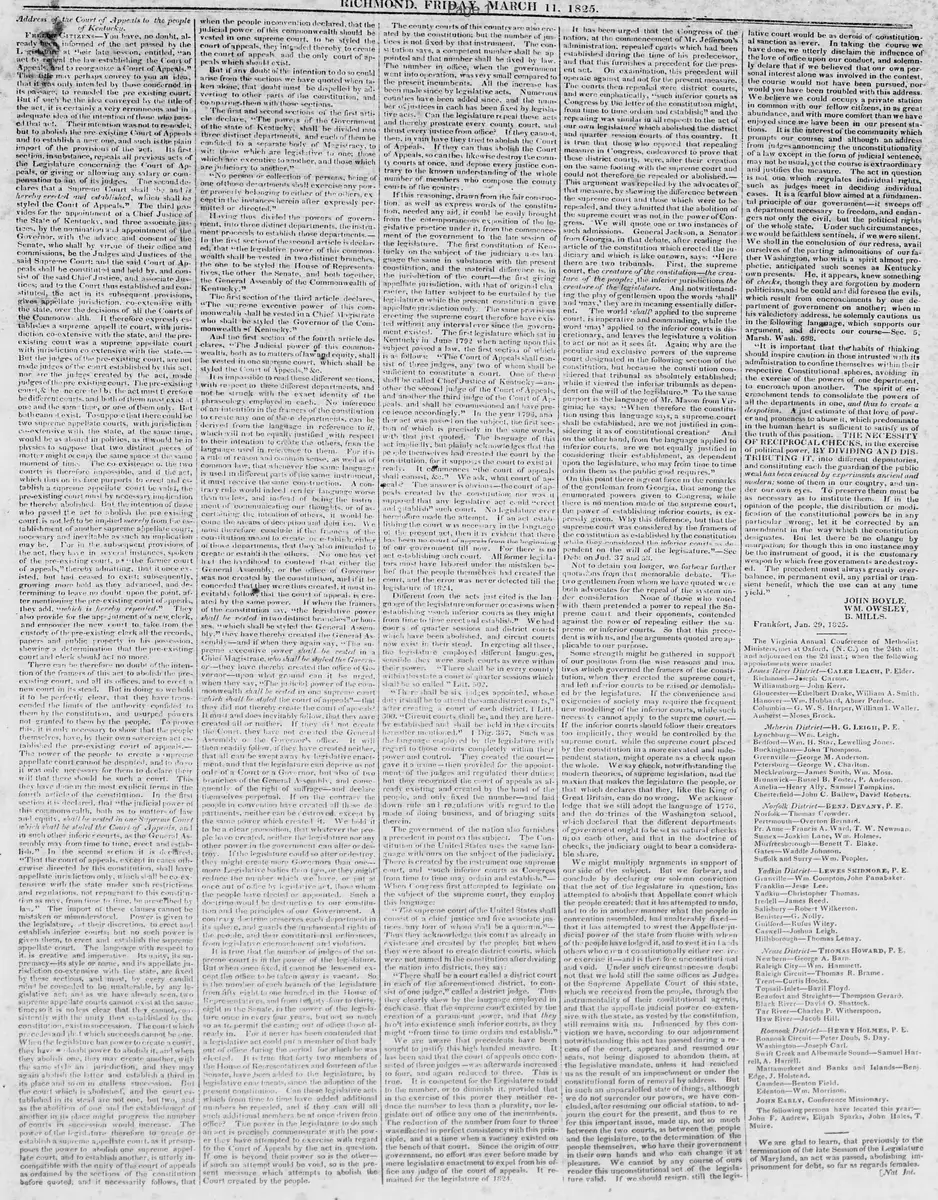
Address of the Court of Appeals to the people of Kentucky.
Fellow Citizens—You have, no doubt, already been informed of the act passed by the Legislature at their late session, entitled, "an act to repeal the law establishing the Court of Appeals, and to reorganize a Court of Appeals."
This title may perhaps convey to you an idea, that it was only intended by those concerned in its passage, to remodel the pre-existing court. But if such be the idea conveyed by the title of the act, it is certainly a very erroneous and inadequate idea of the intention of those who passed that act. Their intention was not to remodel, but to abolish the pre-existing Court of Appeals and to establish a new one, and such is the plain import of the provisions of the act. Its first section, in substance, repeals all previous acts of the Legislature concerning the Court of Appeals, or giving or allowing any salary or compensation to any of its judges. The second declares that a Supreme Court shall be and is hereby erected and established, which shall be styled the Court of Appeals." The third provides for the appointment of a Chief Justice of the State of Kentucky, and three associate justices, by the nomination and appointment of the Governor, with the advice and consent of the Senate, who shall by virtue of their office and commissions, be the Judges and Justices of the said Supreme Court: and the said Court of Appeals shall be constituted and held by, and consist of the said Chief Justice, and associate Justices; and to the Court thus established and constituted, the act in its subsequent provisions, gives appellate jurisdiction, co-extensive with the state, over the decisions of all the Courts of the Commonwealth. It therefore expressly establishes a supreme appellate court, with jurisdiction co-extensive with the state, and the pre-existing court was a supreme appellate court with jurisdiction co-extensive with the state. But the judges of the pre-existing court, are not made judges of the court established by this act, nor are the judges created by the act, made judges of the pre-existing court. The pre-existing court, and the new court created by the act must therefore be different courts, and both of them must exist at one and the same time, or one of them only. But both cannot exist. To suppose that there could be two supreme appellate courts, with jurisdiction co-extensive with the state, at the same time, would be as absurd in politics, as it would be in physics to suppose that two distinct pieces of matter might occupy the same space at the same moment of time. The co-existence of the two courts is therefore impossible, and if the act, which thus on its face purports to erect and establish a supreme appellate court be valid, the pre-existing court must by necessary implication be thereby abolished. But the intention of those who passed the act to abolish the pre-existing court, is not left to be implied merely from the establishment of another supreme appellate court, necessary and inevitable as such an implication may be. For in the subsequent provisions of the act, they have in several instances, spoken of the pre-existing court, as "the former court of appeals," thereby admitting, that it once existed, but had ceased to exist: subsequently, growing more bold as they advanced, and determining to leave no doubt upon the point, after mentioning the pre-existing court of appeals, they add, "which is hereby repealed." They also provide for the appointment of a new clerk, and empower the new court to take from the custody of the pre-existing clerk all the records, papers and public property in his possession, shewing a determination that the pre-existing court and clerk should act no more.
There can be therefore no doubt of the intention of the framers of this act to abolish the pre-existing court, and all its offices, and to erect a new court in its stead. But in doing so we hold it to be perfectly clear, that they have transcended the limits of the authority confided to them by the constitution, and usurped powers not granted to them by the people. To prove this, it is only necessary to show that the people themselves, have, by their own sovereign act established the pre-existing court of appeals.
The power of the people to create a supreme appellate court cannot be disputed, and to do so it was only necessary for them to declare their will that there should be such a court. This they have done in the most explicit terms in the fourth article of the constitution. In the first section it is declared, that "the judicial power of this commonwealth, both as to matters of law and equity, shall be vested in one Supreme Court which shall be styled the Court of Appeals, and in such other inferior courts, as the General Assembly may from time to time, erect and establish." In the second section it is declared, "That the court of appeals, except in cases otherwise directed by this constitution, shall have appellate jurisdiction only, which shall be co-extensive with the state under such restrictions and regulations, not repugnant to this constitution as may, from time to time, be prescribed by law." The import of these clauses cannot be mistaken or misunderstood. Power is given to the legislature, at their discretion, to erect and establish inferior courts; but no such power is given them, to erect and establish the supreme appellate court. The language with respect to it, is creative and imperative. Its unity, its supremacy—its style or name, and its appellate jurisdiction co-extensive with the state, are fixed by these sections, and must, by every candid mind be conceded to be unalterable, by any legislative act; and as we have already seen, two supreme appellate courts cannot exist at the same time: so it is no less clear that they cannot, consistently with the unity thus established by the constitution, exist in succession. The court which precedes and that which succeeds cannot be one. When the legislature has power to create a court, they have no doubt power to abolish it, and when they abolish one, they may create another, with the same style and jurisdiction, and they may again abolish the latter and establish a third in its place and so on in endless succession. But the court which is abolished, and the court established in its stead are not one, but two, and as the abolition of one and the establishment of another in its place might progress the number of courts in succession would increase. The power of the legislature therefore to create or establish a supreme appellate court, as it presupposes the power to abolish one supreme appellate court, and to establish another, is utterly incompatible with the unity of the court of appeals as ordained by the sections of the constitution before quoted, and it necessarily follows, that when the people in convention declared, that the judicial power of this commonwealth should be vested in one supreme court, to be styled the court of appeals, they intended thereby to create the court of appeals, and the only court of appeals which should exist.
But if any doubt of the intention to do so could arise from the sections we have quoted when taken alone, that doubt must be dispelled by adverting to other parts of the constitution, and comparing them with those sections. The first and second sections of the first article declare, "The powers of the Government of the state of Kentucky, shall be divided into three distinct departments, and each of them be confided to a separate body of Magistracy, to wit: those which are legislative to one; those which are executive to another, and those which are judiciary to another."
"No person or collection of persons, being of one of those departments shall exercise any power properly belonging to either of the others, except in the instances hereinafter expressly permitted or directed."
Having thus divided the powers of government, into three distinct departments, the instrument proceeds to establish those departments. In the first section of the second article is declared, that "the legislative power of this commonwealth shall be vested in two distinct branches, the one to be styled the House of Representatives, the other the Senate, and both together, the General Assembly of the Commonwealth of Kentucky."
The first section of the third article declares, "The supreme executive power of this commonwealth shall be vested in a Chief Magistrate who shall be styled the Governor of the Commonwealth of Kentucky."
And the first section of the fourth article declares, "The Judicial power of this commonwealth, both as to matters of law and equity, shall be vested in one supreme court, which shall be styled the Court of Appeals," &c.
It is impossible to read these different sections, with respect to these different departments, and not be struck with the exact identity of the phraseology employed in each. No inference of an intention in the framers of the constitution to create any one of these departments, can be derived from the language in reference to it, which will not be equally justified with respect to their intention to create the others, from the language used in reference to them. For it is a rule of reason and common sense, as well as of common law, that whenever the same language is used in different parts of the same instrument, it must receive the same construction. A contrary rule would indeed render language worse than useless, and instead of being the instrument of communicating our thoughts, or of ascertaining the intention of others, it would become the means of deception and delusion. We must therefore conclude if the framers of the constitution meant to create or establish, either of those departments, that they also intended to create or establish the others. No one has yet had the hardihood to contend that either the General Assembly, or the office of Governor was not created by the constitution, and if it be conceded that they were thus created, it must inevitably follow, that the court of appeals is created by the same power. It when the framers of the constitution say, "the legislative power shall be vested in two distinct branches" or houses, "which shall be styled the General Assembly," they have thereby created the General Assembly—and if when they again say, "The supreme executive power shall be vested in a Chief Magistrate, who shall be styled the Governor"—they have thereby created the office of Governor—upon what ground can it be argued, when they say, "The judicial power of the commonwealth shall be vested in one supreme court which shall be styled the court of appeals"—that they did not thereby create the court of appeals? It must and does inevitably follow, that they have created all or neither. If they did not create the Court, they have not created the General Assembly or the Governor's office. It will then readily follow, if they have created neither, that all can be swept away by legislative enactment, and that the legislature can deprive us not only of a Court or a Governor, but also of two branches of the General Assembly, and consequently of the right of suffrage—and declare themselves perpetual. If on the contrary the people in convention have created all these departments, neither can be destroyed, except by the same power which created it. We hold it to be a clear proposition, that whatever the people have created, neither the legislature nor any other power in the government can alter or destroy. If the legislature could so alter or destroy, they might create more Governors than one—more Legislative bodies than two, or they might reduce the number which we have, or put at once out of office by legislative act, those whom the people have elected or appointed. Such a doctrine would be destructive to our constitution and the principles of our Government. A contrary doctrine preserves each department in its sphere, and guards the fundamental rights of the people, and their constitutional ordinances, from legislative encroachment and violation.
It is true that the number of judges of the supreme court is in the power of the legislature. But when once fixed, it cannot be lessened except the office to be taken away is vacant. So is the number of each branch of the Legislature from eight to one hundred in the House of Representatives, and from twenty-four to thirty-eight in the Senate, in the power of the legislature once in every four years, but not so much so as to permit the casting out of office those already in. For it never has been contended that a legislative act could put a member of that body out of office during the period for which he was elected. It is true that forty two members of the House of Representatives and fourteen of the Senate, have been added to the legislature, by legislative enactments, since the adoption of the present constitution. Can these legislative acts which from time to time have added additional members be repealed, and if they can will all such additional members be at once driven from office? The power in the legislature to do such an act is precisely commensurate with the power they have attempted to exercise with regard to the Court of Appeals by the act in question. If one is beyond their power so is the other—if such an attempt would be void, so is the present measure which attempts to abolish the Court created by the people.
The county courts of this country are also created by the constitution; but the number of justices is not fixed by that instrument. The constitution says, a competent number shall be appointed and that number shall be fixed by law. The number in office, when the government went into operation, was very small compared to the present incumbents. All the increase has been made since by legislative acts. Numerous counties have been added since, and the number of justices in each has been fixed by legislative acts. Can the legislature repeal these acts and thereby prostrate every county court, and thrust every justice from office? If they cannot, then, in vain have they tried to abolish the Court of Appeals. If they can thus abolish the Court of Appeals, so can they likewise destroy the county courts at once, and depose every justice contrary to the known understanding of the whole number of members who compose the county courts of the country.
If this reasoning, drawn from the fair construction, as well as express words of the constitution, needed any aid, it could be easily brought from the contemporaneous exposition of the legislative practice under it, from the commencement of the government to the late session of the legislature. The first constitution of Kentucky on the subject of the judiciary uses language the same in substance with the present constitution, and the material difference is, in the jurisdiction of the court—the first giving appellate jurisdiction, with that of original character, the latter subject to be curtailed by the legislature while the present constitution gave appellate jurisdiction only. The same provisions erecting the supreme court therefore have existed without any interval ever since the government existed. The first legislature which sat in Kentucky in June 1792 when acting upon this subject passed a law, the first section of which is as follows: "The Court of Appeals shall consist of three judges, any two of whom shall be sufficient to constitute a court. One of them shall be called Chief Justice of Kentucky—and another the second judge of the Court of Appeals, and another the third judge of the Court of Appeals, and shall be commissioned and have precedence accordingly." In the year 1796, another act was passed on the subject, the first section of which is precisely in the same words, with that just quoted. The language of this act implies, but plainly acknowledges that the people themselves had created the court by the constitution, for it supposes the court to exist already. It commences "the court of appeals shall consist, &c." We ask, what court of appeals? The answer is obvious—the court of appeals created by the constitution; nor was it supposed that any legislative act could "erect and establish" such court. No Legislature ever heretofore made the attempt. If an act establishing the court was necessary in the language of the present act, then it is evident that there has been no court of appeals from the beginning of our government till now. For there is no act establishing such court. All former legislators must have labored under the mistaken belief that the people themselves had created the court, and the error was never detected till the legislature of 1824.
Different from the acts just cited is the language of the legislature on former occasions when establishing "such inferior courts as they might from time to time erect and establish." We had courts of quarter sessions and district courts which, have been abolished, and circuit courts now exist in their stead. In erecting all these, the legislature employed different language, sensible they were such courts as were within their power. "There shall be in every county within this state a court of quarter sessions which shall be so called "Litt. 502.
"There shall be six judges appointed, whose duties it shall be to attend the same district courts." after creating a court of each district, 1 Litt. 300. "Circuit courts shall be, and they are hereby established and shall be held in the circuits hereafter mentioned." 1 Dig. 307. Such was the language employed by the legislature with regard to those courts completely within their power and control. They created the court—gave it a name—then provided for the appointment of the judges and regulated their duties; but they recognized the court of appeals as already existing and created by the hand of the people, and only fixed the number—and laid down rules and regulations with regard to the mode of doing business, and of bringing suits therein.
The government of the nation also furnishes a precedent in point on this subject. The Constitution of the United States uses the same language with ours on the subject of the judiciary. There is created by the instrument one supreme court, and "such inferior courts as Congress from time to time may ordain and establish."—When Congress first attempted to legislate on the subject of the supreme court, they employ this language:
"The supreme court of the United States shall consist of a chief justice and five associate justices, any four of whom shall be a quorum."—Thus they acknowledge this court as already in existence and created by the people: but when they were about to create district courts, which were not named in the constitution after dividing the nation into districts, they say:
"There shall be a court called a district court in each of the aforementioned district, to consist of one judge," called a district judge. Thus they clearly shew by the language employed in each case, that the supreme court existed by the creation of a paramount power, and that they brought into existence such inferior courts, as they might "from time to time ordain and establish."
We are aware that precedents have been sought to justify this high handed measure. It has been said that the court of appeals once consisted of three judges—was afterwards increased to four, and again reduced to three. This is true. It is competent for the Legislature to add to the number, or to diminish it, provided that in the exercise of this power they neither reduce the number to less than a plurality, nor legislate out of office any one of the incumbents. The reduction of the number from four to three was effected in perfect consistency with this principle, and at a time when a vacancy existed on the bench of that court. Since the origin of our government, no effort was ever before made by mere legislative enactment to expel from his office any judge of the court of appeals. It remained for the legislature of 1824.
It has been urged that the Congress of the nation, at the commencement of Mr. Jefferson's administration, repealed courts which had been established during the time of his predecessor, and that this furnishes a precedent for the present act. On examination, this precedent will operate against and not for the present measure. The courts then repealed were district courts, and were emphatically, "such inferior courts as Congress by the letter of the constitution might, from time to time ordain and establish;" and the repealing was similar in all respects to the act of our own legislature which abolished the district and quarter session courts of this country. It is true that those who opposed that repealing measure in Congress, endeavored to prove that these district courts, were, after their creation on the same footing with the supreme court and could not therefore be repealed or abolished.—This argument was repelled by the advocates of that measure, by showing the difference between the supreme court and those which were to be repealed, and they admitted that the abolition of the supreme court was not in the power of Congress. We will quote one or two instances of such admissions. General Jackson, a Senator from Georgia, in that debate, after reading the article of the constitution which erected the judiciary and which is like our own, says: "Here there are two tribunals. First, the supreme court, the creature of the constitution—the creature of the people: the inferior jurisdictions the creature of the legislature. And notwithstanding the play of gentlemen upon the words shall' and 'may,' they are in meaning essentially different. The word 'shall' applied to the supreme court, is imperative and commanding, while the word 'may' applied to the inferior courts is discretionary, and leaves the legislature a volition to act or not as it sees fit. Again; why are the peculiar and exclusive powers of the supreme court designated in the following section of the constitution, but because the constitution considered that tribunal as absolutely established; while it viewed the inferior tribunals as dependent on the will of the legislature." To the same purport is the language of Mr. Mason from Virginia; he says: "When therefore the constitution using this language says, a supreme court shall be established, are we not justified in considering it as of constitutional creation? And on the other hand, from the language applied to inferior courts, are we not equally justified in considering their establishment, as dependent upon the legislature, who may from time to time ordain them as the public good requires."
On this point there is great force in the remarks of the gentleman from Georgia, that among the enumerated powers given to Congress, while there is no mention made of the supreme court, the power of establishing inferior courts, is expressly given. Why this difference, but that the supreme court was considered by the framers of the constitution as established by the constitution while they considered the inferior courts as dependent on the will of the legislature." -See Deb: on Jud. 37 and 53.
Not to detain you longer, we forbear further quotations from that memorable debate. The two gentlemen from whom we have quoted were both advocates for the repeal of the system under consideration. None of those who voted with them pretended a power to repeal the Supreme court, and their opponents, contended against the power of repealing either the supreme or inferior courts. So that this precedent is with us, and the arguments quoted are applicable to our purpose.
Some strength might be gathered in support of our positions from the wise reasons and motives which governed the framers of the constitution, when they erected the supreme court, and left inferior courts to be raised or demolished by the legislature. If the convenience and exigencies of society may require the frequent new modelling of the inferior courts, while such necessity cannot apply to the supreme court.—If the inferior courts should follow their creators too implicitly, they would be controlled by the supreme court, while the supreme court placed by the constitution in a more elevated and independent station, might operate as a check upon the whole. We say check, notwithstanding the modern theories, of supreme legislation, and the maxim that makes the legislature the people, or that which declares that they, like the King of Great Britain, can do no wrong. We acknowledge that we still adopt the language of 1776, and the doctrines of the Washington school, which declared that the different departments of government ought to be set as natural checks upon each other, and that in the doctrine of checks, the judiciary ought to bear a considerable share.
We might multiply arguments in support of our side of the subject. But we forbear, and conclude by declaring our solemn conviction that the act of the legislature in question, has attempted to abolish that Appellate court which the people created; that it has attempted to undo, and to do in another manner what the people in convention assembled, had unalterably fixed—that it has attempted to wrest the Appellate judicial power of the state from those with whom the people have lodged it, and to vest it in hands others who can not constitutionally either receive or exercise it—and is therefore unconstitutional and void. Under such circumstances we doubt not that we hold still the same offices as Judges of the Supreme Appellate Court of this state, which we received from the people, through the instrumentality of their constitutional agents, and that the appellate judicial power co-extensive with the state, as vested by the constitution, still remains with us. Influenced by this conviction we have, according to our adjournment notwithstanding this act has passed during a recess of the court, appeared and resumed our seats, not being disposed to abandon them, at the legislative mandate, unless it had reached us as the result of an impeachment or under the constitutional form of removal by address. But in such an unparalleled state of things, although we do not surrender our powers, we have concluded, after resuming our official station, to adjourn the court for the present, and thus to refer this important issue, made up, not so much between the two courts, as between the people and the legislature, to the determination of the people themselves, who have their government in their own hands and who can change it at pleasure. We cannot by any course of ours render this unconstitutional act of the legislature valid. If we should resign, still the legislative court would be as devoid of constitutional sanction as ever. In taking the course we have done, we utterly disclaim the influence of the love of office upon our conduct, and solemnly declare that if we believed that our own personal interest alone was involved in the contest, the course would not have been pursued, nor would you have been troubled with this address. We believe we could occupy a private station in common with our fellow citizens, in as great abundance, and with more comfort than we have enjoyed since we have been in our present stations. It is the interest of the community which prompts our course; and although an address from judges announcing the unconstitutionality of a law except in the form of judicial sentence, may not be usual, yet the course is extraordinary and justifies the measure. The act in question is not one which regulates individual rights, such as judges meet in deciding individual cases. It is a fearful blow aimed at a fundamental principle of our government—it sweeps off a department necessary to freedom, and endangers not only the civil, but the political rights of the whole state. Under such circumstances, we would be faithless sentinels, if we were silent. We shall in the conclusion of our address, avail ourselves of the parting admonitions of our father Washington, who with a spirit almost prophetic, anticipated such scenes as Kentucky now presents. He, it appears, knew something of checks, though they are forgotten by modern politicians, and he could and did foresee the evils, which result from encroachments by one department of government on another; when in his valedictory address, he solemnly cautions us in the following language, which supports our argument, and directs our course—Sec. 5, Marsh. Wash. 698.
"It is important that the habits of thinking should inspire caution in those intrusted with its administration to confine themselves within their respective Constitutional spheres, avoiding in the exercise of the powers of one department, to encroach upon another. The spirit of encroachment tends to consolidate the powers of all the departments in one, and thus to create a despotism. A just estimate of that love of power and proneness to abuse it, which predominate in the human heart is sufficient to satisfy us of the truth of this position. THE NECESSITY OF RECIPROCAL CHECKS, in the exercise of political power, BY DIVIDING AND DISTRIBUTING IT, into different depositories, and constituting each the guardian of the public weal has been evinced by experiments ancient and modern; some of them in our country, and under our own eyes. To preserve them must be as necessary as to institute them. If in the opinion of the people, the distribution or modification of the constitutional powers be in any particular wrong, let it be corrected by an amendment in the way which the constitution designates. But let there be no change by usurpation; for though this in one instance may be the instrument of good, it is the customary weapon by which free governments are destroyed. The precedent must always greatly overbalance, in permanent evil, any partial or transient benefit, which the use can at any time yield."
JOHN BOYLE
WM. OWSLEY,
B. MILLS.
Frankfort, Jan. 29, 1825.
Fellow Citizens—You have, no doubt, already been informed of the act passed by the Legislature at their late session, entitled, "an act to repeal the law establishing the Court of Appeals, and to reorganize a Court of Appeals."
This title may perhaps convey to you an idea, that it was only intended by those concerned in its passage, to remodel the pre-existing court. But if such be the idea conveyed by the title of the act, it is certainly a very erroneous and inadequate idea of the intention of those who passed that act. Their intention was not to remodel, but to abolish the pre-existing Court of Appeals and to establish a new one, and such is the plain import of the provisions of the act. Its first section, in substance, repeals all previous acts of the Legislature concerning the Court of Appeals, or giving or allowing any salary or compensation to any of its judges. The second declares that a Supreme Court shall be and is hereby erected and established, which shall be styled the Court of Appeals." The third provides for the appointment of a Chief Justice of the State of Kentucky, and three associate justices, by the nomination and appointment of the Governor, with the advice and consent of the Senate, who shall by virtue of their office and commissions, be the Judges and Justices of the said Supreme Court: and the said Court of Appeals shall be constituted and held by, and consist of the said Chief Justice, and associate Justices; and to the Court thus established and constituted, the act in its subsequent provisions, gives appellate jurisdiction, co-extensive with the state, over the decisions of all the Courts of the Commonwealth. It therefore expressly establishes a supreme appellate court, with jurisdiction co-extensive with the state, and the pre-existing court was a supreme appellate court with jurisdiction co-extensive with the state. But the judges of the pre-existing court, are not made judges of the court established by this act, nor are the judges created by the act, made judges of the pre-existing court. The pre-existing court, and the new court created by the act must therefore be different courts, and both of them must exist at one and the same time, or one of them only. But both cannot exist. To suppose that there could be two supreme appellate courts, with jurisdiction co-extensive with the state, at the same time, would be as absurd in politics, as it would be in physics to suppose that two distinct pieces of matter might occupy the same space at the same moment of time. The co-existence of the two courts is therefore impossible, and if the act, which thus on its face purports to erect and establish a supreme appellate court be valid, the pre-existing court must by necessary implication be thereby abolished. But the intention of those who passed the act to abolish the pre-existing court, is not left to be implied merely from the establishment of another supreme appellate court, necessary and inevitable as such an implication may be. For in the subsequent provisions of the act, they have in several instances, spoken of the pre-existing court, as "the former court of appeals," thereby admitting, that it once existed, but had ceased to exist: subsequently, growing more bold as they advanced, and determining to leave no doubt upon the point, after mentioning the pre-existing court of appeals, they add, "which is hereby repealed." They also provide for the appointment of a new clerk, and empower the new court to take from the custody of the pre-existing clerk all the records, papers and public property in his possession, shewing a determination that the pre-existing court and clerk should act no more.
There can be therefore no doubt of the intention of the framers of this act to abolish the pre-existing court, and all its offices, and to erect a new court in its stead. But in doing so we hold it to be perfectly clear, that they have transcended the limits of the authority confided to them by the constitution, and usurped powers not granted to them by the people. To prove this, it is only necessary to show that the people themselves, have, by their own sovereign act established the pre-existing court of appeals.
The power of the people to create a supreme appellate court cannot be disputed, and to do so it was only necessary for them to declare their will that there should be such a court. This they have done in the most explicit terms in the fourth article of the constitution. In the first section it is declared, that "the judicial power of this commonwealth, both as to matters of law and equity, shall be vested in one Supreme Court which shall be styled the Court of Appeals, and in such other inferior courts, as the General Assembly may from time to time, erect and establish." In the second section it is declared, "That the court of appeals, except in cases otherwise directed by this constitution, shall have appellate jurisdiction only, which shall be co-extensive with the state under such restrictions and regulations, not repugnant to this constitution as may, from time to time, be prescribed by law." The import of these clauses cannot be mistaken or misunderstood. Power is given to the legislature, at their discretion, to erect and establish inferior courts; but no such power is given them, to erect and establish the supreme appellate court. The language with respect to it, is creative and imperative. Its unity, its supremacy—its style or name, and its appellate jurisdiction co-extensive with the state, are fixed by these sections, and must, by every candid mind be conceded to be unalterable, by any legislative act; and as we have already seen, two supreme appellate courts cannot exist at the same time: so it is no less clear that they cannot, consistently with the unity thus established by the constitution, exist in succession. The court which precedes and that which succeeds cannot be one. When the legislature has power to create a court, they have no doubt power to abolish it, and when they abolish one, they may create another, with the same style and jurisdiction, and they may again abolish the latter and establish a third in its place and so on in endless succession. But the court which is abolished, and the court established in its stead are not one, but two, and as the abolition of one and the establishment of another in its place might progress the number of courts in succession would increase. The power of the legislature therefore to create or establish a supreme appellate court, as it presupposes the power to abolish one supreme appellate court, and to establish another, is utterly incompatible with the unity of the court of appeals as ordained by the sections of the constitution before quoted, and it necessarily follows, that when the people in convention declared, that the judicial power of this commonwealth should be vested in one supreme court, to be styled the court of appeals, they intended thereby to create the court of appeals, and the only court of appeals which should exist.
But if any doubt of the intention to do so could arise from the sections we have quoted when taken alone, that doubt must be dispelled by adverting to other parts of the constitution, and comparing them with those sections. The first and second sections of the first article declare, "The powers of the Government of the state of Kentucky, shall be divided into three distinct departments, and each of them be confided to a separate body of Magistracy, to wit: those which are legislative to one; those which are executive to another, and those which are judiciary to another."
"No person or collection of persons, being of one of those departments shall exercise any power properly belonging to either of the others, except in the instances hereinafter expressly permitted or directed."
Having thus divided the powers of government, into three distinct departments, the instrument proceeds to establish those departments. In the first section of the second article is declared, that "the legislative power of this commonwealth shall be vested in two distinct branches, the one to be styled the House of Representatives, the other the Senate, and both together, the General Assembly of the Commonwealth of Kentucky."
The first section of the third article declares, "The supreme executive power of this commonwealth shall be vested in a Chief Magistrate who shall be styled the Governor of the Commonwealth of Kentucky."
And the first section of the fourth article declares, "The Judicial power of this commonwealth, both as to matters of law and equity, shall be vested in one supreme court, which shall be styled the Court of Appeals," &c.
It is impossible to read these different sections, with respect to these different departments, and not be struck with the exact identity of the phraseology employed in each. No inference of an intention in the framers of the constitution to create any one of these departments, can be derived from the language in reference to it, which will not be equally justified with respect to their intention to create the others, from the language used in reference to them. For it is a rule of reason and common sense, as well as of common law, that whenever the same language is used in different parts of the same instrument, it must receive the same construction. A contrary rule would indeed render language worse than useless, and instead of being the instrument of communicating our thoughts, or of ascertaining the intention of others, it would become the means of deception and delusion. We must therefore conclude if the framers of the constitution meant to create or establish, either of those departments, that they also intended to create or establish the others. No one has yet had the hardihood to contend that either the General Assembly, or the office of Governor was not created by the constitution, and if it be conceded that they were thus created, it must inevitably follow, that the court of appeals is created by the same power. It when the framers of the constitution say, "the legislative power shall be vested in two distinct branches" or houses, "which shall be styled the General Assembly," they have thereby created the General Assembly—and if when they again say, "The supreme executive power shall be vested in a Chief Magistrate, who shall be styled the Governor"—they have thereby created the office of Governor—upon what ground can it be argued, when they say, "The judicial power of the commonwealth shall be vested in one supreme court which shall be styled the court of appeals"—that they did not thereby create the court of appeals? It must and does inevitably follow, that they have created all or neither. If they did not create the Court, they have not created the General Assembly or the Governor's office. It will then readily follow, if they have created neither, that all can be swept away by legislative enactment, and that the legislature can deprive us not only of a Court or a Governor, but also of two branches of the General Assembly, and consequently of the right of suffrage—and declare themselves perpetual. If on the contrary the people in convention have created all these departments, neither can be destroyed, except by the same power which created it. We hold it to be a clear proposition, that whatever the people have created, neither the legislature nor any other power in the government can alter or destroy. If the legislature could so alter or destroy, they might create more Governors than one—more Legislative bodies than two, or they might reduce the number which we have, or put at once out of office by legislative act, those whom the people have elected or appointed. Such a doctrine would be destructive to our constitution and the principles of our Government. A contrary doctrine preserves each department in its sphere, and guards the fundamental rights of the people, and their constitutional ordinances, from legislative encroachment and violation.
It is true that the number of judges of the supreme court is in the power of the legislature. But when once fixed, it cannot be lessened except the office to be taken away is vacant. So is the number of each branch of the Legislature from eight to one hundred in the House of Representatives, and from twenty-four to thirty-eight in the Senate, in the power of the legislature once in every four years, but not so much so as to permit the casting out of office those already in. For it never has been contended that a legislative act could put a member of that body out of office during the period for which he was elected. It is true that forty two members of the House of Representatives and fourteen of the Senate, have been added to the legislature, by legislative enactments, since the adoption of the present constitution. Can these legislative acts which from time to time have added additional members be repealed, and if they can will all such additional members be at once driven from office? The power in the legislature to do such an act is precisely commensurate with the power they have attempted to exercise with regard to the Court of Appeals by the act in question. If one is beyond their power so is the other—if such an attempt would be void, so is the present measure which attempts to abolish the Court created by the people.
The county courts of this country are also created by the constitution; but the number of justices is not fixed by that instrument. The constitution says, a competent number shall be appointed and that number shall be fixed by law. The number in office, when the government went into operation, was very small compared to the present incumbents. All the increase has been made since by legislative acts. Numerous counties have been added since, and the number of justices in each has been fixed by legislative acts. Can the legislature repeal these acts and thereby prostrate every county court, and thrust every justice from office? If they cannot, then, in vain have they tried to abolish the Court of Appeals. If they can thus abolish the Court of Appeals, so can they likewise destroy the county courts at once, and depose every justice contrary to the known understanding of the whole number of members who compose the county courts of the country.
If this reasoning, drawn from the fair construction, as well as express words of the constitution, needed any aid, it could be easily brought from the contemporaneous exposition of the legislative practice under it, from the commencement of the government to the late session of the legislature. The first constitution of Kentucky on the subject of the judiciary uses language the same in substance with the present constitution, and the material difference is, in the jurisdiction of the court—the first giving appellate jurisdiction, with that of original character, the latter subject to be curtailed by the legislature while the present constitution gave appellate jurisdiction only. The same provisions erecting the supreme court therefore have existed without any interval ever since the government existed. The first legislature which sat in Kentucky in June 1792 when acting upon this subject passed a law, the first section of which is as follows: "The Court of Appeals shall consist of three judges, any two of whom shall be sufficient to constitute a court. One of them shall be called Chief Justice of Kentucky—and another the second judge of the Court of Appeals, and another the third judge of the Court of Appeals, and shall be commissioned and have precedence accordingly." In the year 1796, another act was passed on the subject, the first section of which is precisely in the same words, with that just quoted. The language of this act implies, but plainly acknowledges that the people themselves had created the court by the constitution, for it supposes the court to exist already. It commences "the court of appeals shall consist, &c." We ask, what court of appeals? The answer is obvious—the court of appeals created by the constitution; nor was it supposed that any legislative act could "erect and establish" such court. No Legislature ever heretofore made the attempt. If an act establishing the court was necessary in the language of the present act, then it is evident that there has been no court of appeals from the beginning of our government till now. For there is no act establishing such court. All former legislators must have labored under the mistaken belief that the people themselves had created the court, and the error was never detected till the legislature of 1824.
Different from the acts just cited is the language of the legislature on former occasions when establishing "such inferior courts as they might from time to time erect and establish." We had courts of quarter sessions and district courts which, have been abolished, and circuit courts now exist in their stead. In erecting all these, the legislature employed different language, sensible they were such courts as were within their power. "There shall be in every county within this state a court of quarter sessions which shall be so called "Litt. 502.
"There shall be six judges appointed, whose duties it shall be to attend the same district courts." after creating a court of each district, 1 Litt. 300. "Circuit courts shall be, and they are hereby established and shall be held in the circuits hereafter mentioned." 1 Dig. 307. Such was the language employed by the legislature with regard to those courts completely within their power and control. They created the court—gave it a name—then provided for the appointment of the judges and regulated their duties; but they recognized the court of appeals as already existing and created by the hand of the people, and only fixed the number—and laid down rules and regulations with regard to the mode of doing business, and of bringing suits therein.
The government of the nation also furnishes a precedent in point on this subject. The Constitution of the United States uses the same language with ours on the subject of the judiciary. There is created by the instrument one supreme court, and "such inferior courts as Congress from time to time may ordain and establish."—When Congress first attempted to legislate on the subject of the supreme court, they employ this language:
"The supreme court of the United States shall consist of a chief justice and five associate justices, any four of whom shall be a quorum."—Thus they acknowledge this court as already in existence and created by the people: but when they were about to create district courts, which were not named in the constitution after dividing the nation into districts, they say:
"There shall be a court called a district court in each of the aforementioned district, to consist of one judge," called a district judge. Thus they clearly shew by the language employed in each case, that the supreme court existed by the creation of a paramount power, and that they brought into existence such inferior courts, as they might "from time to time ordain and establish."
We are aware that precedents have been sought to justify this high handed measure. It has been said that the court of appeals once consisted of three judges—was afterwards increased to four, and again reduced to three. This is true. It is competent for the Legislature to add to the number, or to diminish it, provided that in the exercise of this power they neither reduce the number to less than a plurality, nor legislate out of office any one of the incumbents. The reduction of the number from four to three was effected in perfect consistency with this principle, and at a time when a vacancy existed on the bench of that court. Since the origin of our government, no effort was ever before made by mere legislative enactment to expel from his office any judge of the court of appeals. It remained for the legislature of 1824.
It has been urged that the Congress of the nation, at the commencement of Mr. Jefferson's administration, repealed courts which had been established during the time of his predecessor, and that this furnishes a precedent for the present act. On examination, this precedent will operate against and not for the present measure. The courts then repealed were district courts, and were emphatically, "such inferior courts as Congress by the letter of the constitution might, from time to time ordain and establish;" and the repealing was similar in all respects to the act of our own legislature which abolished the district and quarter session courts of this country. It is true that those who opposed that repealing measure in Congress, endeavored to prove that these district courts, were, after their creation on the same footing with the supreme court and could not therefore be repealed or abolished.—This argument was repelled by the advocates of that measure, by showing the difference between the supreme court and those which were to be repealed, and they admitted that the abolition of the supreme court was not in the power of Congress. We will quote one or two instances of such admissions. General Jackson, a Senator from Georgia, in that debate, after reading the article of the constitution which erected the judiciary and which is like our own, says: "Here there are two tribunals. First, the supreme court, the creature of the constitution—the creature of the people: the inferior jurisdictions the creature of the legislature. And notwithstanding the play of gentlemen upon the words shall' and 'may,' they are in meaning essentially different. The word 'shall' applied to the supreme court, is imperative and commanding, while the word 'may' applied to the inferior courts is discretionary, and leaves the legislature a volition to act or not as it sees fit. Again; why are the peculiar and exclusive powers of the supreme court designated in the following section of the constitution, but because the constitution considered that tribunal as absolutely established; while it viewed the inferior tribunals as dependent on the will of the legislature." To the same purport is the language of Mr. Mason from Virginia; he says: "When therefore the constitution using this language says, a supreme court shall be established, are we not justified in considering it as of constitutional creation? And on the other hand, from the language applied to inferior courts, are we not equally justified in considering their establishment, as dependent upon the legislature, who may from time to time ordain them as the public good requires."
On this point there is great force in the remarks of the gentleman from Georgia, that among the enumerated powers given to Congress, while there is no mention made of the supreme court, the power of establishing inferior courts, is expressly given. Why this difference, but that the supreme court was considered by the framers of the constitution as established by the constitution while they considered the inferior courts as dependent on the will of the legislature." -See Deb: on Jud. 37 and 53.
Not to detain you longer, we forbear further quotations from that memorable debate. The two gentlemen from whom we have quoted were both advocates for the repeal of the system under consideration. None of those who voted with them pretended a power to repeal the Supreme court, and their opponents, contended against the power of repealing either the supreme or inferior courts. So that this precedent is with us, and the arguments quoted are applicable to our purpose.
Some strength might be gathered in support of our positions from the wise reasons and motives which governed the framers of the constitution, when they erected the supreme court, and left inferior courts to be raised or demolished by the legislature. If the convenience and exigencies of society may require the frequent new modelling of the inferior courts, while such necessity cannot apply to the supreme court.—If the inferior courts should follow their creators too implicitly, they would be controlled by the supreme court, while the supreme court placed by the constitution in a more elevated and independent station, might operate as a check upon the whole. We say check, notwithstanding the modern theories, of supreme legislation, and the maxim that makes the legislature the people, or that which declares that they, like the King of Great Britain, can do no wrong. We acknowledge that we still adopt the language of 1776, and the doctrines of the Washington school, which declared that the different departments of government ought to be set as natural checks upon each other, and that in the doctrine of checks, the judiciary ought to bear a considerable share.
We might multiply arguments in support of our side of the subject. But we forbear, and conclude by declaring our solemn conviction that the act of the legislature in question, has attempted to abolish that Appellate court which the people created; that it has attempted to undo, and to do in another manner what the people in convention assembled, had unalterably fixed—that it has attempted to wrest the Appellate judicial power of the state from those with whom the people have lodged it, and to vest it in hands others who can not constitutionally either receive or exercise it—and is therefore unconstitutional and void. Under such circumstances we doubt not that we hold still the same offices as Judges of the Supreme Appellate Court of this state, which we received from the people, through the instrumentality of their constitutional agents, and that the appellate judicial power co-extensive with the state, as vested by the constitution, still remains with us. Influenced by this conviction we have, according to our adjournment notwithstanding this act has passed during a recess of the court, appeared and resumed our seats, not being disposed to abandon them, at the legislative mandate, unless it had reached us as the result of an impeachment or under the constitutional form of removal by address. But in such an unparalleled state of things, although we do not surrender our powers, we have concluded, after resuming our official station, to adjourn the court for the present, and thus to refer this important issue, made up, not so much between the two courts, as between the people and the legislature, to the determination of the people themselves, who have their government in their own hands and who can change it at pleasure. We cannot by any course of ours render this unconstitutional act of the legislature valid. If we should resign, still the legislative court would be as devoid of constitutional sanction as ever. In taking the course we have done, we utterly disclaim the influence of the love of office upon our conduct, and solemnly declare that if we believed that our own personal interest alone was involved in the contest, the course would not have been pursued, nor would you have been troubled with this address. We believe we could occupy a private station in common with our fellow citizens, in as great abundance, and with more comfort than we have enjoyed since we have been in our present stations. It is the interest of the community which prompts our course; and although an address from judges announcing the unconstitutionality of a law except in the form of judicial sentence, may not be usual, yet the course is extraordinary and justifies the measure. The act in question is not one which regulates individual rights, such as judges meet in deciding individual cases. It is a fearful blow aimed at a fundamental principle of our government—it sweeps off a department necessary to freedom, and endangers not only the civil, but the political rights of the whole state. Under such circumstances, we would be faithless sentinels, if we were silent. We shall in the conclusion of our address, avail ourselves of the parting admonitions of our father Washington, who with a spirit almost prophetic, anticipated such scenes as Kentucky now presents. He, it appears, knew something of checks, though they are forgotten by modern politicians, and he could and did foresee the evils, which result from encroachments by one department of government on another; when in his valedictory address, he solemnly cautions us in the following language, which supports our argument, and directs our course—Sec. 5, Marsh. Wash. 698.
"It is important that the habits of thinking should inspire caution in those intrusted with its administration to confine themselves within their respective Constitutional spheres, avoiding in the exercise of the powers of one department, to encroach upon another. The spirit of encroachment tends to consolidate the powers of all the departments in one, and thus to create a despotism. A just estimate of that love of power and proneness to abuse it, which predominate in the human heart is sufficient to satisfy us of the truth of this position. THE NECESSITY OF RECIPROCAL CHECKS, in the exercise of political power, BY DIVIDING AND DISTRIBUTING IT, into different depositories, and constituting each the guardian of the public weal has been evinced by experiments ancient and modern; some of them in our country, and under our own eyes. To preserve them must be as necessary as to institute them. If in the opinion of the people, the distribution or modification of the constitutional powers be in any particular wrong, let it be corrected by an amendment in the way which the constitution designates. But let there be no change by usurpation; for though this in one instance may be the instrument of good, it is the customary weapon by which free governments are destroyed. The precedent must always greatly overbalance, in permanent evil, any partial or transient benefit, which the use can at any time yield."
JOHN BOYLE
WM. OWSLEY,
B. MILLS.
Frankfort, Jan. 29, 1825.
What sub-type of article is it?
Historical Event
What themes does it cover?
Justice
Moral Virtue
What keywords are associated?
Court Of Appeals
Kentucky Constitution
Legislative Act
Judicial Independence
Separation Of Powers
Unconstitutional Repeal
What entities or persons were involved?
John Boyle
Wm. Owsley
B. Mills
Where did it happen?
Kentucky, Frankfort
Story Details
Key Persons
John Boyle
Wm. Owsley
B. Mills
Location
Kentucky, Frankfort
Event Date
Jan. 29, 1825
Story Details
The Court of Appeals issues a public address declaring the legislature's act to repeal and reorganize the court unconstitutional, as the court was created by the people via the constitution, not the legislature, emphasizing separation of powers and judicial independence.