Thank you for visiting SNEWPapers!
Sign up free
Literary
December 8, 1876
Buchanan County Bulletin
Independence, Buchanan County, Iowa
What is this article about?
Essay by A. Bush, read at Madison Township Fair on September 20, 1876, praising pioneer farming hardships overcome, rural development, agriculture's superiority, farm economy, and detailing his visit to the 1876 Centennial Exposition in Philadelphia, describing exhibits from various nations.
Clipping
OCR Quality
98%
Excellent
Full Text
Agricultural
The reading columns on this page will be devoted, mainly, to topics pertaining to Farm and HouseHOLD. The farmer readers of the BULLETIN are requested to write for it.
ESSAY.
Read at the Madison Township Fair.
September 20th, 1876.
BY A. BUSH.
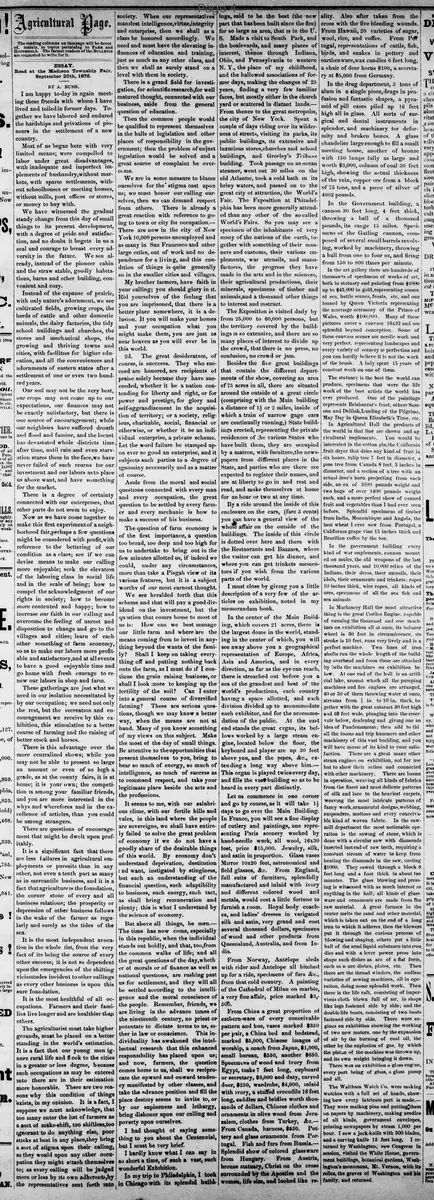
I am happy to-day in again meeting these friends with whom I have lived and toiled in former days. Together we have labored and endured the hardships and privations of pioneers in the settlement of a new country.
Most of us began here with very limited means; were compelled to labor under great disadvantages, with inadequate and imperfect implements of husbandry, without markets, with sparse settlements, without schoolhouses or meeting houses, without mills, post offices or stores, or money to buy with.
We have witnessed the gradual steady change from this day of small things to its present development with a degree of pride and satisfaction, and no doubt it begets in us a zeal and courage to breast every adversity in the future. We see already, instead of the pioneer cabin and the straw stable, goodly habitations, barns and other buildings, convenient and cozy.
Instead of the expanse of prairie with only nature's adornment, we see cultivated fields, growing crops, the herds of cattle and other domestic animals, the dairy factories, the tidy school buildings and churches, the stores and mechanical shops, the growing and thriving towns and cities, with facilities for higher education. and all the conveniences and adornments of eastern states after a settlement of one or even two hundred years.
Our soil may not be the very best, our crops may not come up to our expectations, our finances may not be exactly satisfactory, but there is one source of encouragement; while our neighbors have suffered drouth and flood and famine, and the locust has devastated whole districts time after time, until ruin and even starvation stares them in the face, we have never failed of such returns for our investment and our labors as to place us above want, and have something for the market.
There is a degree of certainty connected with our enterprises, that other parts do not seem to enjoy.
Now as we have come together to make this first experiment of a neighborhood fair, perhaps a few questions might be considered with profit, with reference to the bettering of our condition as a class; see if we can devise means to make our calling more enjoyable; seek the elevation of the laboring class in social life and in the scale of being; how to compel the acknowledgment of our rights in society; how to become more contented and happy; how to increase our faith in our calling and overcome the feeling of unrest and disposition to change and go to the villages and cities; learn of each other something of farm economy so as to make our labors more profitable and satisfactory, and at all events to have a good enjoyable time and go home with fresh courage to renew our labors in shop and farm.
These gatherings are just what we need in our isolation necessitated by our occupation; we need not only the rest, but the recreation and encouragement we receive by this exhibition, this stimulation to a better course of farming and the raising of better stock and horses.
There is this advantage over the more centralized shows; while you may not be able to present so large an amount or even of so high a grade, as at the county fairs, it is at home; it is your own; the competition is among your familiar friends and you are more interested in the whys and wherefores and in the excellence of articles, than you could be among strangers.
There are questions of encouragement that might be dwelt upon profitably.
It is a significant fact that there are less failures in agricultural employments or pursuits than in any other, not even a tenth part as many as in mercantile business, and it is a fact that agriculture is the foundation, the corner stone of every and all business relations; the prosperity or depression of other business follows in the wake of the farmer as regularly and surely as the tides of the sea.
It is the most independent avocation in the whole list, from the very fact of its being the source of every other success; it is not so dependent upon the emergencies of the shifting vicissitudes incident to other callings as every other business is upon this sure foundation.
It is the most healthful of all occupations. Farmers and their families live longer and are healthier than others.
The agriculturist must take higher grounds, must be placed on a better standing in the world's estimation.
It is a fact that our young men ignore rural life and flock to the cities in a greater or less degree, because such occupations as may be entered into there are in their estimation more honorable. There are two reasons why this condition of things exists, in my opinion. It is a fact, I suppose we must acknowledge, that too many enter the list of farmers as a sort of make-shift, too shiftless, too ignorant to do anything else, poor sticks at best in any place, they bring a sort of stigma upon their calling as they would upon any other occupation they might attach themselves to; as every calling will be judged more or less by its own adherents, by the representatives sent forth into society. When our representatives manifest intelligence, virtue, integrity and enterprise, then we shall as a class be honored accordingly. We need and must have the elevating influences of education and training just as much as any other class, and then we shall as surely stand on a level with them in society.
There is a grand field for investigation, for scientific research, for well matured thought, connected with our business, aside from the general question of education.
Then the common people would be qualified to represent themselves in the halls of legislation and other places of responsibility in the government; then the problem of unjust legislation would be solved and a great source of complaint be overcome.
We are in some measure to blame ourselves for the stigma cast upon us; we must honor our calling ourselves, then we can demand respect from others. There is already a great reaction with reference to going to town or city for occupation. There are now in the city of New York 10,000 persons unemployed and as many in San Francisco and other large cities, out of work and no dependence for a living, and this condition of things is quite generally so in the smaller cities and villages.
My brother farmers, have faith in your calling; you should glory in it. Rid yourselves of the feeling that you are imprisoned, that there is a better place somewhere, it is a delusion. If you will make your homes and your occupation what you might make them, you are just as near heaven as you will ever be in this world.
2d. The great desideratum, of course, is success. They who succeed are honored, are recipients of praise solely because they have succeeded, whether it be a nation contending for liberty and right, or for power and prestige, for glory and self-aggrandizement in the acquisition of territory; or a society, religious, charitable, social, financial or otherwise, or whether it be an individual enterprise, a private scheme.
Let the word failure be stamped upon ever so good an enterprise, and it subjects such parties to a degree of ignominy necessarily and as a matter of course.
Aside from the moral and social questions connected with every man and every occupation, the great question to be settled by every farmer and every mechanic is how to make a success of his business.
The question of farm economy is of the first importance, a question too broad, too deep and too high for us to undertake to bring out in the few minutes allotted us, if indeed we could, under any circumstances, more than take a Pisgah view of its various features, but it is a subject worthy of our most earnest thought.
We see heralded forth that this scheme and that will pay a good dividend on the investment, but the question that comes home to most of us is: How can we best manage our little farm and where are the means coming from to invest in anything beyond the wants of the family? Shall I keep on taking everything off and putting nothing back onto the farm, as I must do if I continue the grain raising business, or shall I look more to keeping up the fertility of the soil? Can I enter into a general course of diversified farming? These are serious questions, though we may know a better way, when the means are not at hand. Many of you know something of my views on this subject. Make the most of the day of small things. Be attentive to the opportunities that present themselves to you, bring to bear so much of energy, so much of intelligence, so much of success as to command respect, and take your legitimate place beside the arts and the professions.
It seems to me, with our salubrious clime. with our fertile hills and vales, in this land where the people are sovereigns, we shall have entirely failed to solve the great problem of economy if we do not have a goodly share of the desirable things of this world. By economy don't understand deprivation, destitution and want, instigated by stinginess. but such an understanding of the financial question, such adaptability to business, such energy, such tact as shall bring remuneration and plenty; this is what I understand by the science of economy.
But above all things, be men. The time has now come, especially in this republic, when the individual stands out boldly, and that, too, from the common walks of life: and all the great questions of the day, whether of morals or of finance as well as national questions, are rushing past us for settlement, and they will all be settled according to the intelligence and the moral conscience of the people. Remember, friends. we are living in the advance times of the nineteenth century, no priest or potentate to dictate terms to us, either in law or conscience. This individuality has awakened the intellectual research that this enhanced responsibility has placed upon us; and now, farmers, the question comes home to us, shall we reciprocate the upward and onward tendency manifested by other classes, and take the advance position and fill the place destiny seems to invite to, or by our supineness and lethargy, bring dishonor upon our calling and poverty upon ourselves.
I had thought of saying something to you about the Centennial but I must be very brief.
I hardly know what I can say in so short a time, of such a vast, such wonderful Exhibition.
In my trip to Philadelphia, I took in Chicago with its splendid buildings, said to be the best (tho new part that has been built since the fire) for so large an area, that is in the U. S. Made a visit to South Park, and the boulevards, and many places of interest, thence through Indiana, Ohio, and Pennsylvania to western N. Y., the place of my childhood, and the hallowed associations of former days, making the changes of 25 years, finding a very few familiar faces, but mostly either in the church yard or scattered in distant lands.
From thence to the great metropolis, the city of New York. Spent a couple of days riding over its wilderness of streets, visiting its parks, its public buildings, its extensive and luxurious stores, churches and school buildings, and Greeley's Tribune building. Took passage on an ocean steamer, went out 30 miles on the old Atlantic, took a cold bath in its briny waters, and passed on to the great city of attraction, the World's Fair. The Exposition at Philadelphia has been more generally attended than any other of the so-called World's Fairs. So you may see a specimen of the inhabitants of very many of the nations of the earth, together with something of their manners and customs, their various implements, war utensils, and manufactures, the progress they have made in the arts and in the sciences, their agricultural productions, their minerals. specimens of timber and animals, and a thousand other things to interest and instruct.
The Exposition is visited daily by from 25,000 to 60,000 persons, but the territory covered by the buildings is so extensive, and there are so many places of interest to divide up the crowd, that there is no press, no confusion, no crowd or jam.
Besides the five great buildings that contain the different departments of the show, covering an area of 75 acres in all, there are situated around the outside of a great circle (comprising with the Main building distance of 1 or 2 miles. inside of which a train of narrow gage cars are continually running,) State buildings erected, representing the private residences of the various States who have built them, they are occupied by a matron, with furniture, the newspapers from different places in the State, and parties who are there are expected to register their names, and are at liberty to go in and rest and read, and make themselves at home for an hour or two at any time.
By a ride around the inside of this enclosure on the cars, (fare 5 cents) you can have a general view of the whole affair on the outside of the buildings. The inside of this circle is dotted over here and there with the Restaurants and Bazaars, where the visitor can get his dinner, and where you can get trinkets mementoes if you wish from the various parts of the world.
I must close by giving you a little description of a very few of the articles on exhibition, noted in my memorandum book.
In the center of the Main Building, which covers 21 acres, there is the largest dome in the world, standing in the center of which, you will see away above you a geographical representation of Europe, Africa Asia and America, and in every direction, as far as the eye can reach, there is stretched out before you a sea of the grandest and best of the world's productions, each country having a space allotted, and each division divided up to accommodate each exhibitor, and for the accommodation of the public. At the east end stands the great organ, its bellows worked by a large steam engine, located below the floor, the keyboard and player are up 30 feet above you, and the pipes, &c., extending a long way above him. This organ is played twice every day. and fills the vast building so as to be heard in every part distinctly.
Let us commence in one corner and go by course, as it will take 1 days to go over the Main Building In France, you will see a fine display of cutlery and paintings, one representing Paris scenery worked by hand-needle work, all wool, 16x30 feet, price $15,000. Jewelry, silk. and satin in proportion. Glass vases Mirror 10x20 feet, astronomical and field glasses, &c. From England. full suits of furniture, splendidly manufactured and inlaid with ivory and different colored wood and metals, would cost a little fortune to furnish a room. Royal body coaches, and ladies' dresses in varigated silk and satin, very grand and cost several thousand dollars, specimens of wood and other products from Queensland, Australia, and from India.
From Norway, Antelope sleds with rider and Antelope all hitched up for a ride, specimens of furs &c., from that cold country. A painting of the Cathedral of Milan on marble, a very fine affair, price marked $3,500.
From China a great proportion of earthen-ware of every conceivable pattern and size, vases marked $350 per pair, a China bed and bedstead, marked $5,000, Chinese images of worship, a coach from Japan, $1,000, small bureau, $550, another $650. Specimens of wood and ivory from Egypt, tusks 7 feet long, cupboard or secretary, $3,000 and duty, carved door, 250, wardrobe, 4,000, inlaid with ivory, a stuffed crocodile 16 feet long, saddles and bridles worth thousands of dollars, Chinese clothes and ornaments in olive wood from Jerusalem, clothes from Turkey, &c.
From Canada, harness, $550. Pottery and glass ornaments from Portugal. Fish and furs from Russia. Splendid show of colored glassware from Hungary. From Austria, bronze statuary, Christ on the cross surrounded by the Apostles and the women, life size, and looked like reality. Also after taken from the cross with the five bleeding wounds.
From Hawaii, 20 varieties of sugar, wool, rice, and coffee. From Portugal, representations of cattle, fish, birds, and snakes in pottery and earthenware, wax candles 6 feet long. a chair of deer horns $100, a secretary at $5,000 from Germany.
In the drug department, 3 tons of alum in a single piece, drugs in profusion and fantastic shapes, a pyramid of pill cases piled up 16 feet high all in glass. All sorts of surgical and dental instruments in splendor, and machinery for deformity and broken bones. A glass chandelier large enough to fill a small meeting house, another of bronze with 150 lamps fully as large and worth $3,000, column of coal 30 feet high, showing the actual thickness of the vein, copper ore from a block of 75 tons, and a piece of silver of 4002 pounds.
In the Government building, a cannon 30 feet long, 4 feet thick, throwing a ball of a thousand pounds, its range 15 miles. Specimens or the Gatling cannon, composed of several small barrels revolving, worked by machinery, throwing a ball from one to four oz, and firing from 150 to 800 times per minute.
In the art gallery there are hundreds of thousands of specimens of works of art both in statuary and painting from $1000 up to $45,000 in gold, representing scenes of sea, battle scenes, feasts, etc, and one loaned by Queen Victoria representing the marriage ceremony of the Prince of Wales, worth $100,000. Many of these pictures cover a canvass 16x32 and are splendid beyond conception. Some of these canvass scenes are needle work and very perfect, representing landscapes and every variety of scenery in perfection and you can hardly believe it is not the work of the brush. A lady spent 15 years of constant work on one of them.
The statuary is the best the world can produce, specimens that were the life work of the best artists the world has ever produced. One of the paintings represents Belshazzar's feast, others Samson and Delilah, Landing of the Pilgrims, May Day in Queen Elizabeth's Time, etc.
In Agricultural Hall the products of the world in that line are shown and agricultural implements. You would be interested in the cotton gin, the California fruit dryer that dries any kind of fruit in six hours, tulip tree 7 feet in diameter, a pine tree from Canada 8 feet. 5 inches in diameter, and a section of a tree with an actual deer's horn projecting from each side, an ox of 3100 pounds weight and two hogs of over 1400 pounds weight each, and a more perfect show of canned fruit and vegetables than I had ever seen before. Splendid specimens of timber from India, Mozambique and Angola, the best wheat I ever saw from Portugal, a California grape vine 15 inches thick and Brazilian coffee by the ton.
In the government building every kind of war implements, cannon mounted on mules, the old weapons of the last thousand years, and 10,000 relics of the Indians, their dress, their utensils, their idols, their ornaments and trinkets; ropes 10 inches thick. wire ropes. all kinds of ores, specimens of all the sea fish and sea animals.
In Machinery Hall the most attractive thing is the great Corliss Engine. capable of running the thousand and one machines on exhibition all at once, its balance wheel is 30 feet in circumference, its stroke is 10 feet, runs very lively and is a perfect machine. Two lines of iron shafts run the whole length of the building overhead and from these are attached by belts the machines on exhibition below. At one end of the hall is an artificial lake, around which all the pumping machines and fire engines are arranged, 40 or 50 of them throwing water at once, streams from 1/2 in. to 10 in. thick. together with the great cataract 30 feet high and 40 feet wide. plunging into the reservoir below, deafening and giving one an idea of Pandemonium: then add to this all the looms and trip hammers and other machinery of this vast building, and you will have music of its kind to your satisfaction.
There are a great many other steam engines on exhibition, not for use but to show their action and connected with other machinery. There are looms in operation, weaving all kinds of fabrics from the finest and most delicate patterns of silk and lace to the heaviest carpets. weaving the most intricate patterns of fancy work, ornamental designs, webbing, suspenders, mottoes and every conceivable kind of woven fabric. In the saw mill department the most noticeable operation is the sawing of stone, which is done with a circular saw with diamonds inserted instead of saw teeth, requiring a constant stream of water to keep from heating the diamonds in the saw, costing $1000. They sawed through a block 8 feet long and a foot thick in about ten minutes. The glass blowing and pressing is witnessed with as much interest as anything in the hall; all kinds of glass-ware and ornaments are made from the raw material. A great furnace in the center melts the sand and other material, which is taken out on the end of a long iron to which it adheres. then the blowers put it through the curious process of blowing and shaping, others put a little ball of the semi liquid substance into molds and with a lever power press into shape such dishes as are of a flat form, such as sauce dishes, plates, etc. Then there are the thread winders, the endless varieties of sewing machines, all in operation, doing some splendid work. Then there is the life raft, consisting of impervious cloth blown full of air, in shape like logs fastened side by side; and the double life boats, consisting of two boats fastened side by side. There were engines on exhibition showing the working of two new motors, one by the expansion of air by the burning of coal oil, the other by the explosion of gas, by which the piston of the machine was thrown up, and its own weight bringing it down.
There was on exhibition a glass engine, every part being of glass, a glass pump and all. The Waltham Watch Co. were making watches with a full set of hands, showing how every intricate part is made. They were making pins and putting them on papers by machinery, making needles of all kinds, government envelopes, printing newspapers by steam 1,000 per hour. I saw a jack-knife with 500 blades, and a carving knife 15 feet long. I returned by Washington, saw Congress in session, visited the White House. government buildings, botanical gardens, Washington's monument, Mt. Vernon, with its relics, the graves of Washington and his family, and returned.
The reading columns on this page will be devoted, mainly, to topics pertaining to Farm and HouseHOLD. The farmer readers of the BULLETIN are requested to write for it.
ESSAY.
Read at the Madison Township Fair.
September 20th, 1876.
BY A. BUSH.
I am happy to-day in again meeting these friends with whom I have lived and toiled in former days. Together we have labored and endured the hardships and privations of pioneers in the settlement of a new country.
Most of us began here with very limited means; were compelled to labor under great disadvantages, with inadequate and imperfect implements of husbandry, without markets, with sparse settlements, without schoolhouses or meeting houses, without mills, post offices or stores, or money to buy with.
We have witnessed the gradual steady change from this day of small things to its present development with a degree of pride and satisfaction, and no doubt it begets in us a zeal and courage to breast every adversity in the future. We see already, instead of the pioneer cabin and the straw stable, goodly habitations, barns and other buildings, convenient and cozy.
Instead of the expanse of prairie with only nature's adornment, we see cultivated fields, growing crops, the herds of cattle and other domestic animals, the dairy factories, the tidy school buildings and churches, the stores and mechanical shops, the growing and thriving towns and cities, with facilities for higher education. and all the conveniences and adornments of eastern states after a settlement of one or even two hundred years.
Our soil may not be the very best, our crops may not come up to our expectations, our finances may not be exactly satisfactory, but there is one source of encouragement; while our neighbors have suffered drouth and flood and famine, and the locust has devastated whole districts time after time, until ruin and even starvation stares them in the face, we have never failed of such returns for our investment and our labors as to place us above want, and have something for the market.
There is a degree of certainty connected with our enterprises, that other parts do not seem to enjoy.
Now as we have come together to make this first experiment of a neighborhood fair, perhaps a few questions might be considered with profit, with reference to the bettering of our condition as a class; see if we can devise means to make our calling more enjoyable; seek the elevation of the laboring class in social life and in the scale of being; how to compel the acknowledgment of our rights in society; how to become more contented and happy; how to increase our faith in our calling and overcome the feeling of unrest and disposition to change and go to the villages and cities; learn of each other something of farm economy so as to make our labors more profitable and satisfactory, and at all events to have a good enjoyable time and go home with fresh courage to renew our labors in shop and farm.
These gatherings are just what we need in our isolation necessitated by our occupation; we need not only the rest, but the recreation and encouragement we receive by this exhibition, this stimulation to a better course of farming and the raising of better stock and horses.
There is this advantage over the more centralized shows; while you may not be able to present so large an amount or even of so high a grade, as at the county fairs, it is at home; it is your own; the competition is among your familiar friends and you are more interested in the whys and wherefores and in the excellence of articles, than you could be among strangers.
There are questions of encouragement that might be dwelt upon profitably.
It is a significant fact that there are less failures in agricultural employments or pursuits than in any other, not even a tenth part as many as in mercantile business, and it is a fact that agriculture is the foundation, the corner stone of every and all business relations; the prosperity or depression of other business follows in the wake of the farmer as regularly and surely as the tides of the sea.
It is the most independent avocation in the whole list, from the very fact of its being the source of every other success; it is not so dependent upon the emergencies of the shifting vicissitudes incident to other callings as every other business is upon this sure foundation.
It is the most healthful of all occupations. Farmers and their families live longer and are healthier than others.
The agriculturist must take higher grounds, must be placed on a better standing in the world's estimation.
It is a fact that our young men ignore rural life and flock to the cities in a greater or less degree, because such occupations as may be entered into there are in their estimation more honorable. There are two reasons why this condition of things exists, in my opinion. It is a fact, I suppose we must acknowledge, that too many enter the list of farmers as a sort of make-shift, too shiftless, too ignorant to do anything else, poor sticks at best in any place, they bring a sort of stigma upon their calling as they would upon any other occupation they might attach themselves to; as every calling will be judged more or less by its own adherents, by the representatives sent forth into society. When our representatives manifest intelligence, virtue, integrity and enterprise, then we shall as a class be honored accordingly. We need and must have the elevating influences of education and training just as much as any other class, and then we shall as surely stand on a level with them in society.
There is a grand field for investigation, for scientific research, for well matured thought, connected with our business, aside from the general question of education.
Then the common people would be qualified to represent themselves in the halls of legislation and other places of responsibility in the government; then the problem of unjust legislation would be solved and a great source of complaint be overcome.
We are in some measure to blame ourselves for the stigma cast upon us; we must honor our calling ourselves, then we can demand respect from others. There is already a great reaction with reference to going to town or city for occupation. There are now in the city of New York 10,000 persons unemployed and as many in San Francisco and other large cities, out of work and no dependence for a living, and this condition of things is quite generally so in the smaller cities and villages.
My brother farmers, have faith in your calling; you should glory in it. Rid yourselves of the feeling that you are imprisoned, that there is a better place somewhere, it is a delusion. If you will make your homes and your occupation what you might make them, you are just as near heaven as you will ever be in this world.
2d. The great desideratum, of course, is success. They who succeed are honored, are recipients of praise solely because they have succeeded, whether it be a nation contending for liberty and right, or for power and prestige, for glory and self-aggrandizement in the acquisition of territory; or a society, religious, charitable, social, financial or otherwise, or whether it be an individual enterprise, a private scheme.
Let the word failure be stamped upon ever so good an enterprise, and it subjects such parties to a degree of ignominy necessarily and as a matter of course.
Aside from the moral and social questions connected with every man and every occupation, the great question to be settled by every farmer and every mechanic is how to make a success of his business.
The question of farm economy is of the first importance, a question too broad, too deep and too high for us to undertake to bring out in the few minutes allotted us, if indeed we could, under any circumstances, more than take a Pisgah view of its various features, but it is a subject worthy of our most earnest thought.
We see heralded forth that this scheme and that will pay a good dividend on the investment, but the question that comes home to most of us is: How can we best manage our little farm and where are the means coming from to invest in anything beyond the wants of the family? Shall I keep on taking everything off and putting nothing back onto the farm, as I must do if I continue the grain raising business, or shall I look more to keeping up the fertility of the soil? Can I enter into a general course of diversified farming? These are serious questions, though we may know a better way, when the means are not at hand. Many of you know something of my views on this subject. Make the most of the day of small things. Be attentive to the opportunities that present themselves to you, bring to bear so much of energy, so much of intelligence, so much of success as to command respect, and take your legitimate place beside the arts and the professions.
It seems to me, with our salubrious clime. with our fertile hills and vales, in this land where the people are sovereigns, we shall have entirely failed to solve the great problem of economy if we do not have a goodly share of the desirable things of this world. By economy don't understand deprivation, destitution and want, instigated by stinginess. but such an understanding of the financial question, such adaptability to business, such energy, such tact as shall bring remuneration and plenty; this is what I understand by the science of economy.
But above all things, be men. The time has now come, especially in this republic, when the individual stands out boldly, and that, too, from the common walks of life: and all the great questions of the day, whether of morals or of finance as well as national questions, are rushing past us for settlement, and they will all be settled according to the intelligence and the moral conscience of the people. Remember, friends. we are living in the advance times of the nineteenth century, no priest or potentate to dictate terms to us, either in law or conscience. This individuality has awakened the intellectual research that this enhanced responsibility has placed upon us; and now, farmers, the question comes home to us, shall we reciprocate the upward and onward tendency manifested by other classes, and take the advance position and fill the place destiny seems to invite to, or by our supineness and lethargy, bring dishonor upon our calling and poverty upon ourselves.
I had thought of saying something to you about the Centennial but I must be very brief.
I hardly know what I can say in so short a time, of such a vast, such wonderful Exhibition.
In my trip to Philadelphia, I took in Chicago with its splendid buildings, said to be the best (tho new part that has been built since the fire) for so large an area, that is in the U. S. Made a visit to South Park, and the boulevards, and many places of interest, thence through Indiana, Ohio, and Pennsylvania to western N. Y., the place of my childhood, and the hallowed associations of former days, making the changes of 25 years, finding a very few familiar faces, but mostly either in the church yard or scattered in distant lands.
From thence to the great metropolis, the city of New York. Spent a couple of days riding over its wilderness of streets, visiting its parks, its public buildings, its extensive and luxurious stores, churches and school buildings, and Greeley's Tribune building. Took passage on an ocean steamer, went out 30 miles on the old Atlantic, took a cold bath in its briny waters, and passed on to the great city of attraction, the World's Fair. The Exposition at Philadelphia has been more generally attended than any other of the so-called World's Fairs. So you may see a specimen of the inhabitants of very many of the nations of the earth, together with something of their manners and customs, their various implements, war utensils, and manufactures, the progress they have made in the arts and in the sciences, their agricultural productions, their minerals. specimens of timber and animals, and a thousand other things to interest and instruct.
The Exposition is visited daily by from 25,000 to 60,000 persons, but the territory covered by the buildings is so extensive, and there are so many places of interest to divide up the crowd, that there is no press, no confusion, no crowd or jam.
Besides the five great buildings that contain the different departments of the show, covering an area of 75 acres in all, there are situated around the outside of a great circle (comprising with the Main building distance of 1 or 2 miles. inside of which a train of narrow gage cars are continually running,) State buildings erected, representing the private residences of the various States who have built them, they are occupied by a matron, with furniture, the newspapers from different places in the State, and parties who are there are expected to register their names, and are at liberty to go in and rest and read, and make themselves at home for an hour or two at any time.
By a ride around the inside of this enclosure on the cars, (fare 5 cents) you can have a general view of the whole affair on the outside of the buildings. The inside of this circle is dotted over here and there with the Restaurants and Bazaars, where the visitor can get his dinner, and where you can get trinkets mementoes if you wish from the various parts of the world.
I must close by giving you a little description of a very few of the articles on exhibition, noted in my memorandum book.
In the center of the Main Building, which covers 21 acres, there is the largest dome in the world, standing in the center of which, you will see away above you a geographical representation of Europe, Africa Asia and America, and in every direction, as far as the eye can reach, there is stretched out before you a sea of the grandest and best of the world's productions, each country having a space allotted, and each division divided up to accommodate each exhibitor, and for the accommodation of the public. At the east end stands the great organ, its bellows worked by a large steam engine, located below the floor, the keyboard and player are up 30 feet above you, and the pipes, &c., extending a long way above him. This organ is played twice every day. and fills the vast building so as to be heard in every part distinctly.
Let us commence in one corner and go by course, as it will take 1 days to go over the Main Building In France, you will see a fine display of cutlery and paintings, one representing Paris scenery worked by hand-needle work, all wool, 16x30 feet, price $15,000. Jewelry, silk. and satin in proportion. Glass vases Mirror 10x20 feet, astronomical and field glasses, &c. From England. full suits of furniture, splendidly manufactured and inlaid with ivory and different colored wood and metals, would cost a little fortune to furnish a room. Royal body coaches, and ladies' dresses in varigated silk and satin, very grand and cost several thousand dollars, specimens of wood and other products from Queensland, Australia, and from India.
From Norway, Antelope sleds with rider and Antelope all hitched up for a ride, specimens of furs &c., from that cold country. A painting of the Cathedral of Milan on marble, a very fine affair, price marked $3,500.
From China a great proportion of earthen-ware of every conceivable pattern and size, vases marked $350 per pair, a China bed and bedstead, marked $5,000, Chinese images of worship, a coach from Japan, $1,000, small bureau, $550, another $650. Specimens of wood and ivory from Egypt, tusks 7 feet long, cupboard or secretary, $3,000 and duty, carved door, 250, wardrobe, 4,000, inlaid with ivory, a stuffed crocodile 16 feet long, saddles and bridles worth thousands of dollars, Chinese clothes and ornaments in olive wood from Jerusalem, clothes from Turkey, &c.
From Canada, harness, $550. Pottery and glass ornaments from Portugal. Fish and furs from Russia. Splendid show of colored glassware from Hungary. From Austria, bronze statuary, Christ on the cross surrounded by the Apostles and the women, life size, and looked like reality. Also after taken from the cross with the five bleeding wounds.
From Hawaii, 20 varieties of sugar, wool, rice, and coffee. From Portugal, representations of cattle, fish, birds, and snakes in pottery and earthenware, wax candles 6 feet long. a chair of deer horns $100, a secretary at $5,000 from Germany.
In the drug department, 3 tons of alum in a single piece, drugs in profusion and fantastic shapes, a pyramid of pill cases piled up 16 feet high all in glass. All sorts of surgical and dental instruments in splendor, and machinery for deformity and broken bones. A glass chandelier large enough to fill a small meeting house, another of bronze with 150 lamps fully as large and worth $3,000, column of coal 30 feet high, showing the actual thickness of the vein, copper ore from a block of 75 tons, and a piece of silver of 4002 pounds.
In the Government building, a cannon 30 feet long, 4 feet thick, throwing a ball of a thousand pounds, its range 15 miles. Specimens or the Gatling cannon, composed of several small barrels revolving, worked by machinery, throwing a ball from one to four oz, and firing from 150 to 800 times per minute.
In the art gallery there are hundreds of thousands of specimens of works of art both in statuary and painting from $1000 up to $45,000 in gold, representing scenes of sea, battle scenes, feasts, etc, and one loaned by Queen Victoria representing the marriage ceremony of the Prince of Wales, worth $100,000. Many of these pictures cover a canvass 16x32 and are splendid beyond conception. Some of these canvass scenes are needle work and very perfect, representing landscapes and every variety of scenery in perfection and you can hardly believe it is not the work of the brush. A lady spent 15 years of constant work on one of them.
The statuary is the best the world can produce, specimens that were the life work of the best artists the world has ever produced. One of the paintings represents Belshazzar's feast, others Samson and Delilah, Landing of the Pilgrims, May Day in Queen Elizabeth's Time, etc.
In Agricultural Hall the products of the world in that line are shown and agricultural implements. You would be interested in the cotton gin, the California fruit dryer that dries any kind of fruit in six hours, tulip tree 7 feet in diameter, a pine tree from Canada 8 feet. 5 inches in diameter, and a section of a tree with an actual deer's horn projecting from each side, an ox of 3100 pounds weight and two hogs of over 1400 pounds weight each, and a more perfect show of canned fruit and vegetables than I had ever seen before. Splendid specimens of timber from India, Mozambique and Angola, the best wheat I ever saw from Portugal, a California grape vine 15 inches thick and Brazilian coffee by the ton.
In the government building every kind of war implements, cannon mounted on mules, the old weapons of the last thousand years, and 10,000 relics of the Indians, their dress, their utensils, their idols, their ornaments and trinkets; ropes 10 inches thick. wire ropes. all kinds of ores, specimens of all the sea fish and sea animals.
In Machinery Hall the most attractive thing is the great Corliss Engine. capable of running the thousand and one machines on exhibition all at once, its balance wheel is 30 feet in circumference, its stroke is 10 feet, runs very lively and is a perfect machine. Two lines of iron shafts run the whole length of the building overhead and from these are attached by belts the machines on exhibition below. At one end of the hall is an artificial lake, around which all the pumping machines and fire engines are arranged, 40 or 50 of them throwing water at once, streams from 1/2 in. to 10 in. thick. together with the great cataract 30 feet high and 40 feet wide. plunging into the reservoir below, deafening and giving one an idea of Pandemonium: then add to this all the looms and trip hammers and other machinery of this vast building, and you will have music of its kind to your satisfaction.
There are a great many other steam engines on exhibition, not for use but to show their action and connected with other machinery. There are looms in operation, weaving all kinds of fabrics from the finest and most delicate patterns of silk and lace to the heaviest carpets. weaving the most intricate patterns of fancy work, ornamental designs, webbing, suspenders, mottoes and every conceivable kind of woven fabric. In the saw mill department the most noticeable operation is the sawing of stone, which is done with a circular saw with diamonds inserted instead of saw teeth, requiring a constant stream of water to keep from heating the diamonds in the saw, costing $1000. They sawed through a block 8 feet long and a foot thick in about ten minutes. The glass blowing and pressing is witnessed with as much interest as anything in the hall; all kinds of glass-ware and ornaments are made from the raw material. A great furnace in the center melts the sand and other material, which is taken out on the end of a long iron to which it adheres. then the blowers put it through the curious process of blowing and shaping, others put a little ball of the semi liquid substance into molds and with a lever power press into shape such dishes as are of a flat form, such as sauce dishes, plates, etc. Then there are the thread winders, the endless varieties of sewing machines, all in operation, doing some splendid work. Then there is the life raft, consisting of impervious cloth blown full of air, in shape like logs fastened side by side; and the double life boats, consisting of two boats fastened side by side. There were engines on exhibition showing the working of two new motors, one by the expansion of air by the burning of coal oil, the other by the explosion of gas, by which the piston of the machine was thrown up, and its own weight bringing it down.
There was on exhibition a glass engine, every part being of glass, a glass pump and all. The Waltham Watch Co. were making watches with a full set of hands, showing how every intricate part is made. They were making pins and putting them on papers by machinery, making needles of all kinds, government envelopes, printing newspapers by steam 1,000 per hour. I saw a jack-knife with 500 blades, and a carving knife 15 feet long. I returned by Washington, saw Congress in session, visited the White House. government buildings, botanical gardens, Washington's monument, Mt. Vernon, with its relics, the graves of Washington and his family, and returned.
What sub-type of article is it?
Essay
What themes does it cover?
Agriculture Rural
Moral Virtue
Political
What keywords are associated?
Agriculture
Rural Life
Farm Economy
Centennial Exposition
Philadelphia Fair
Pioneer Settlement
Moral Elevation
What entities or persons were involved?
By A. Bush.
Literary Details
Author
By A. Bush.
Subject
Read At The Madison Township Fair. September 20th, 1876.
Form / Style
Prose Essay On Agriculture And The Centennial Exposition
Key Lines
It Is A Significant Fact That There Are Less Failures In Agricultural Employments Or Pursuits Than In Any Other, Not Even A Tenth Part As Many As In Mercantile Business, And It Is A Fact That Agriculture Is The Foundation, The Corner Stone Of Every And All Business Relations; The Prosperity Or Depression Of Other Business Follows In The Wake Of The Farmer As Regularly And Surely As The Tides Of The Sea.
My Brother Farmers, Have Faith In Your Calling; You Should Glory In It. Rid Yourselves Of The Feeling That You Are Imprisoned, That There Is A Better Place Somewhere, It Is A Delusion.
The Exposition At Philadelphia Has Been More Generally Attended Than Any Other Of The So Called World's Fairs.
In The Center Of The Main Building, Which Covers 21 Acres, There Is The Largest Dome In The World...
In Machinery Hall The Most Attractive Thing Is The Great Corliss Engine.