Thank you for visiting SNEWPapers!
Sign up free
Domestic News
March 20, 1794
Gazette Of The United States & Evening Advertiser
Philadelphia, Philadelphia County, Pennsylvania
What is this article about?
In the U.S. House of Representatives on March 14, Mr. Sedgwick concluded his speech opposing Mr. Madison's resolutions for trade restrictions on Great Britain, warning of economic harm, retaliation, and potential war escalation involving allies.
Clipping
OCR Quality
98%
Excellent
Full Text
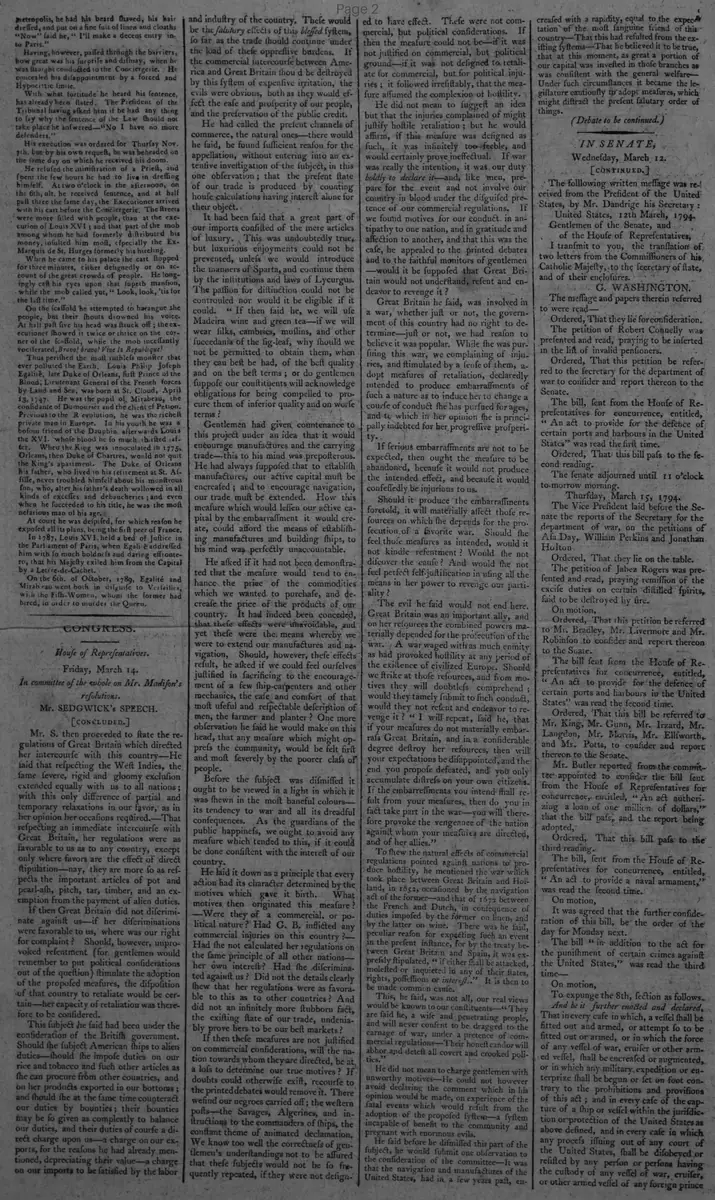
CONGRESS.
House of Representatives.
Friday, March 14.
In committee of the whole on Mr. Madison's resolutions.
Mr. SEDGWICK's SPEECH.
CONCLUDED.
Mr. S. then proceeded to state the regulations of Great Britain which directed her intercourse with this country--He said that respecting the West Indies, the same severe, rigid and gloomy exclusion extended equally with us to all nations; with this only difference of partial and temporary relaxations in our favor, as in her opinion her occasions required.—That respecting an immediate intercourse with Great Britain, her regulations were as favorable to us as to any country, except only where favors are the effect of direct stipulation-nay, they are more so as respects the important articles of pot and pearl-ash, pitch, tar, timber, and an exemption from the payment of alien duties.
If then Great Britain did not discriminate against us-if her discriminations were favorable to us, where was our right for complaint? Should, however, unprovoked resentment (for gentlemen would remember to put political considerations out of the question) stimulate the adoption of the proposed measures, the disposition of that country to retaliate would be certain-her capacity of retaliation was therefore to be considered.
This subject he said had been under the consideration of the British government. Should the subject American ships to alien duties-should she impose duties on our rice and tobacco and such other articles as she can procure from other countries, and on her products exported in our bottoms; and should she at the same time counteract our duties by bounties; their bounties may be so given as completely to balance our duties, and their duties of course a direct charge upon us-a charge on our exports, for the reasons he had already mentioned, depreciating their value-a charge on our imports to be satisfied by the labor and industry of the country. These would be the salutary effects of this blessed system, so far as the trade should continue under the load of these oppressive burdens. If the commercial intercourse between America and Great Britain should be destroyed by this system of expensive irritation, the evils were obvious, both as they would affect the ease and prosperity of our people, and the preservation of the public credit.
He had called the present channels of commerce, the natural ones--there would he said, be found sufficient reason for the appellation, without entering into an extensive investigation of the subject, in this one observation; that the present state of our trade is produced by counting house calculations having interest alone for their object.
It had been said that a great part of our imports consisted of the mere articles of luxury. This was undoubtedly true, but luxurious enjoyments could not be prevented, unless we would introduce the manners of Sparta, and continue them by the institutions and laws of Lycurgus. The passion for distinction could not be controlled nor would it be eligible if it could. "If then said he, we will use Madeira wine and green tea—if we will wear silks, cambrics, muslins, and other succedanea of the fig-leaf, why should we not be permitted to obtain them, when they can best be had, of the best quality and on the best terms; or do gentlemen suppose our constituents will acknowledge obligations for being compelled to procure them of inferior quality and on worse terms?"
Gentlemen had given countenance to this project under an idea that it would encourage manufactures and the carrying trade- this to his mind was preposterous. He had always supposed that to establish manufactures, our active capital must be increased; and to encourage navigation, our trade must be extended. How this measure which would lessen our active capital by the embarrassment it would create, could afford the means of establishing manufactures and building ships, to his mind was perfectly unaccountable.
He asked if it had not been demonstrated that the measure would tend to enhance the price of the commodities which we wanted to purchase, and decrease the price of the products of our country. It had indeed been conceded, that these effects were unavoidable, and yet these were the means whereby we were to extend our manufactures and navigation. Should, however, these effects result, he asked if we could feel ourselves justified in sacrificing to the encouragement of a few ship-carpenters and other mechanics, the ease and comfort of that most useful and respectable description of men, the farmer and planter? One more observation he said he would make on this head, that any measure which might oppress the community, would be felt first and most severely by the poorer class of people.
Before the subject was dismissed it ought to be viewed in a light in which it was shewn in the most baneful colours- its tendency to war and all its dreadful consequences. As the guardians of the public happiness, we ought to avoid any measure which tended to this, if it could be done consistent with the interest of our country.
He laid it down as a principle that every action had its character determined by the motives which gave it birth. What motives then originated this measure? Were they of a commercial or political nature? Had G. B. inflicted any commercial injuries on this country? Had she not calculated her regulations on the same principle of all other nations— her own interest? Had she discriminated against us? Did not the details clearly shew that her regulations were as favorable to this as to other countries? And did not an infinitely more stubborn fact, the existing state of our trade, undeniably prove hers to be our best markets?
If then these measures are not justified on commercial considerations, will the nation towards whom they are directed, be at a loss to determine our true motives? If doubts could otherwise exist, recourse to the printed debates would remove it. There we find our negroes carried off; the western posts-the Savages, Algerines, and instructions to the commanders of ships, the constant theme of animated declamation. We know too well the correctness of gentlemen's understandings not to be assured that these subjects would not be so frequently repeated, if they were not designed to have effect. These were not commercial, but political considerations. If then the measure could not be—if it was not justified on commercial, but political ground—if it was not designed to retaliate for commercial, but for political injuries; it followed irresistably, that the measure assumed the complexion of hostility.
He did not mean to suggest an idea but that the injuries complained of might justify hostile retaliation; but he would affirm, if this measure was designed as such, it was infinitely too feeble, and would certainly prove ineffectual. If war was really the intention, it was our duty boldly to declare it—and, like men, prepare for the event and not involve our country in blood under the disguised pretence of our commercial regulations. If we found motives for our conduct in antipathy to one nation, and in gratitude and affection to another, and that this was the case, he appealed to the printed debates and to the faithful monitors of gentlemen -would it be supposed that Great Britain would not understand, resent and endeavor to revenge it?
Great Britain he said, was involved in a war, whether just or not, the government of this country had no right to determine-just or not, we had reason to believe it was popular. While she was pursuing this war, we complaining of injuries, and stimulated by a sense of them, adopt measures of retaliation, declaredly intended to produce embarrassments of such a nature as to induce her to change a course of conduct she has pursued for ages, and to which in her opinion she is principally indebted for her progressive prosperity.
If serious embarrassments are not to be expected, then ought the measure to be abandoned, because it would not produce the intended effect, and because it would confessedly be injurious to us.
Should it produce the embarrassments foretold, it will materially affect those resources on which she depends for the prosecution of a favorite war. Should she feel those measures as intended, would it not kindle resentment? Would she not discover the cause? And would she not feel perfect self-justification in using all the means in her power to revenge our partiality?
The evil he said would not end here. Great Britain was an important ally, and on her resources the combined powers materially depended for the prosecution of the war. A war waged with as much enmity as had provoked hostility at any period of the existence of civilized Europe. Should we strike at those resources, and from motives they will doubtless comprehend; would they tamely submit to such conduct, would they not resent and endeavor to revenge it? "I will repeat, said he, that if your measures do not materially embarrass Great Britain, and in a considerable degree destroy her resources, then will your expectations be disappointed, and the end you propose defeated, and you only accumulate distress on your own citizens.
If the embarrassments you intend shall result from your measures, then do you in fact take part in the war you will therefore provoke the vengeance of the nation against whom your measures are directed, and of her allies."
To shew the natural effects of commercial regulations pointed against nations to produce hostility, he mentioned the war which took place between Great Britain and Holland, in 1652, occasioned by the navigation act of the former—and that of 1672 between the French and Dutch, in consequence of duties imposed by the former on linen, and by the latter on wine. There was he said, peculiar reason for expecting such an event in the present instance, for by the treaty between Great Britain and Spain, it was expressly stipulated, "if either shall be attacked, molested or inquieted in any of their states, rights, possessions or interest.." It is then to be made common cause.
This, he said, was not all, our real views would be known to our constituents—"They are said he, a wise and penetrating people, and will never consent to be dragged to the carnage of war, under a pretence of commercial regulations-Their honest candor will abhor and detest all covert and crooked politics."
He did not mean to charge gentlemen with unworthy motives-He could not however avoid declaring the comment which in his opinion would be made, on experience of the fatal events which would result from the adoption of the proposed system--a system incapable of benefit to the community and pregnant with enormous evils.
He said before he dismissed this part of the subject, he would submit one observation to the consideration of the committee-It was that the navigation and manufactures of the United States, had in a few years past, increased with a rapidity, equal to the expectation of the most sanguine friend of this country-That this had resulted from the existing systems--That he believed it to be true, that at this moment, as great a portion of our capital was invested in those branches as was consistent with the general welfare— Under such circumstances it became the legislature cautiously to adopt measures, which might distract the present salutary order of things.
(Debate to be continued.)
House of Representatives.
Friday, March 14.
In committee of the whole on Mr. Madison's resolutions.
Mr. SEDGWICK's SPEECH.
CONCLUDED.
Mr. S. then proceeded to state the regulations of Great Britain which directed her intercourse with this country--He said that respecting the West Indies, the same severe, rigid and gloomy exclusion extended equally with us to all nations; with this only difference of partial and temporary relaxations in our favor, as in her opinion her occasions required.—That respecting an immediate intercourse with Great Britain, her regulations were as favorable to us as to any country, except only where favors are the effect of direct stipulation-nay, they are more so as respects the important articles of pot and pearl-ash, pitch, tar, timber, and an exemption from the payment of alien duties.
If then Great Britain did not discriminate against us-if her discriminations were favorable to us, where was our right for complaint? Should, however, unprovoked resentment (for gentlemen would remember to put political considerations out of the question) stimulate the adoption of the proposed measures, the disposition of that country to retaliate would be certain-her capacity of retaliation was therefore to be considered.
This subject he said had been under the consideration of the British government. Should the subject American ships to alien duties-should she impose duties on our rice and tobacco and such other articles as she can procure from other countries, and on her products exported in our bottoms; and should she at the same time counteract our duties by bounties; their bounties may be so given as completely to balance our duties, and their duties of course a direct charge upon us-a charge on our exports, for the reasons he had already mentioned, depreciating their value-a charge on our imports to be satisfied by the labor and industry of the country. These would be the salutary effects of this blessed system, so far as the trade should continue under the load of these oppressive burdens. If the commercial intercourse between America and Great Britain should be destroyed by this system of expensive irritation, the evils were obvious, both as they would affect the ease and prosperity of our people, and the preservation of the public credit.
He had called the present channels of commerce, the natural ones--there would he said, be found sufficient reason for the appellation, without entering into an extensive investigation of the subject, in this one observation; that the present state of our trade is produced by counting house calculations having interest alone for their object.
It had been said that a great part of our imports consisted of the mere articles of luxury. This was undoubtedly true, but luxurious enjoyments could not be prevented, unless we would introduce the manners of Sparta, and continue them by the institutions and laws of Lycurgus. The passion for distinction could not be controlled nor would it be eligible if it could. "If then said he, we will use Madeira wine and green tea—if we will wear silks, cambrics, muslins, and other succedanea of the fig-leaf, why should we not be permitted to obtain them, when they can best be had, of the best quality and on the best terms; or do gentlemen suppose our constituents will acknowledge obligations for being compelled to procure them of inferior quality and on worse terms?"
Gentlemen had given countenance to this project under an idea that it would encourage manufactures and the carrying trade- this to his mind was preposterous. He had always supposed that to establish manufactures, our active capital must be increased; and to encourage navigation, our trade must be extended. How this measure which would lessen our active capital by the embarrassment it would create, could afford the means of establishing manufactures and building ships, to his mind was perfectly unaccountable.
He asked if it had not been demonstrated that the measure would tend to enhance the price of the commodities which we wanted to purchase, and decrease the price of the products of our country. It had indeed been conceded, that these effects were unavoidable, and yet these were the means whereby we were to extend our manufactures and navigation. Should, however, these effects result, he asked if we could feel ourselves justified in sacrificing to the encouragement of a few ship-carpenters and other mechanics, the ease and comfort of that most useful and respectable description of men, the farmer and planter? One more observation he said he would make on this head, that any measure which might oppress the community, would be felt first and most severely by the poorer class of people.
Before the subject was dismissed it ought to be viewed in a light in which it was shewn in the most baneful colours- its tendency to war and all its dreadful consequences. As the guardians of the public happiness, we ought to avoid any measure which tended to this, if it could be done consistent with the interest of our country.
He laid it down as a principle that every action had its character determined by the motives which gave it birth. What motives then originated this measure? Were they of a commercial or political nature? Had G. B. inflicted any commercial injuries on this country? Had she not calculated her regulations on the same principle of all other nations— her own interest? Had she discriminated against us? Did not the details clearly shew that her regulations were as favorable to this as to other countries? And did not an infinitely more stubborn fact, the existing state of our trade, undeniably prove hers to be our best markets?
If then these measures are not justified on commercial considerations, will the nation towards whom they are directed, be at a loss to determine our true motives? If doubts could otherwise exist, recourse to the printed debates would remove it. There we find our negroes carried off; the western posts-the Savages, Algerines, and instructions to the commanders of ships, the constant theme of animated declamation. We know too well the correctness of gentlemen's understandings not to be assured that these subjects would not be so frequently repeated, if they were not designed to have effect. These were not commercial, but political considerations. If then the measure could not be—if it was not justified on commercial, but political ground—if it was not designed to retaliate for commercial, but for political injuries; it followed irresistably, that the measure assumed the complexion of hostility.
He did not mean to suggest an idea but that the injuries complained of might justify hostile retaliation; but he would affirm, if this measure was designed as such, it was infinitely too feeble, and would certainly prove ineffectual. If war was really the intention, it was our duty boldly to declare it—and, like men, prepare for the event and not involve our country in blood under the disguised pretence of our commercial regulations. If we found motives for our conduct in antipathy to one nation, and in gratitude and affection to another, and that this was the case, he appealed to the printed debates and to the faithful monitors of gentlemen -would it be supposed that Great Britain would not understand, resent and endeavor to revenge it?
Great Britain he said, was involved in a war, whether just or not, the government of this country had no right to determine-just or not, we had reason to believe it was popular. While she was pursuing this war, we complaining of injuries, and stimulated by a sense of them, adopt measures of retaliation, declaredly intended to produce embarrassments of such a nature as to induce her to change a course of conduct she has pursued for ages, and to which in her opinion she is principally indebted for her progressive prosperity.
If serious embarrassments are not to be expected, then ought the measure to be abandoned, because it would not produce the intended effect, and because it would confessedly be injurious to us.
Should it produce the embarrassments foretold, it will materially affect those resources on which she depends for the prosecution of a favorite war. Should she feel those measures as intended, would it not kindle resentment? Would she not discover the cause? And would she not feel perfect self-justification in using all the means in her power to revenge our partiality?
The evil he said would not end here. Great Britain was an important ally, and on her resources the combined powers materially depended for the prosecution of the war. A war waged with as much enmity as had provoked hostility at any period of the existence of civilized Europe. Should we strike at those resources, and from motives they will doubtless comprehend; would they tamely submit to such conduct, would they not resent and endeavor to revenge it? "I will repeat, said he, that if your measures do not materially embarrass Great Britain, and in a considerable degree destroy her resources, then will your expectations be disappointed, and the end you propose defeated, and you only accumulate distress on your own citizens.
If the embarrassments you intend shall result from your measures, then do you in fact take part in the war you will therefore provoke the vengeance of the nation against whom your measures are directed, and of her allies."
To shew the natural effects of commercial regulations pointed against nations to produce hostility, he mentioned the war which took place between Great Britain and Holland, in 1652, occasioned by the navigation act of the former—and that of 1672 between the French and Dutch, in consequence of duties imposed by the former on linen, and by the latter on wine. There was he said, peculiar reason for expecting such an event in the present instance, for by the treaty between Great Britain and Spain, it was expressly stipulated, "if either shall be attacked, molested or inquieted in any of their states, rights, possessions or interest.." It is then to be made common cause.
This, he said, was not all, our real views would be known to our constituents—"They are said he, a wise and penetrating people, and will never consent to be dragged to the carnage of war, under a pretence of commercial regulations-Their honest candor will abhor and detest all covert and crooked politics."
He did not mean to charge gentlemen with unworthy motives-He could not however avoid declaring the comment which in his opinion would be made, on experience of the fatal events which would result from the adoption of the proposed system--a system incapable of benefit to the community and pregnant with enormous evils.
He said before he dismissed this part of the subject, he would submit one observation to the consideration of the committee-It was that the navigation and manufactures of the United States, had in a few years past, increased with a rapidity, equal to the expectation of the most sanguine friend of this country-That this had resulted from the existing systems--That he believed it to be true, that at this moment, as great a portion of our capital was invested in those branches as was consistent with the general welfare— Under such circumstances it became the legislature cautiously to adopt measures, which might distract the present salutary order of things.
(Debate to be continued.)
What sub-type of article is it?
Politics
Economic
What keywords are associated?
Congress Debate
Trade Resolutions
Great Britain Regulations
Sedgwick Speech
Madison Resolutions
Commercial Retaliation
What entities or persons were involved?
Mr. Sedgwick
Mr. Madison
Domestic News Details
Event Date
Friday, March 14.
Key Persons
Mr. Sedgwick
Mr. Madison
Event Details
Mr. Sedgwick concluded his speech in the committee of the whole on Mr. Madison's resolutions, arguing against proposed trade measures with Great Britain, highlighting favorable existing regulations, potential retaliation, economic burdens, and risks of provoking war.