Thank you for visiting SNEWPapers!
Sign up free
Editorial
September 22, 1823
New Hampshire Statesman
Concord, Merrimack County, New Hampshire
What is this article about?
Editorial from Salem Gazette denounces slander as a foul, cowardly vice that evades justice, targets the virtuous, and inflicts profound misery by ruining reputations, calling for repression through public moral sentiment.
Clipping
OCR Quality
95%
Excellent
Full Text
From the Salem Gazette.
SLANDER.
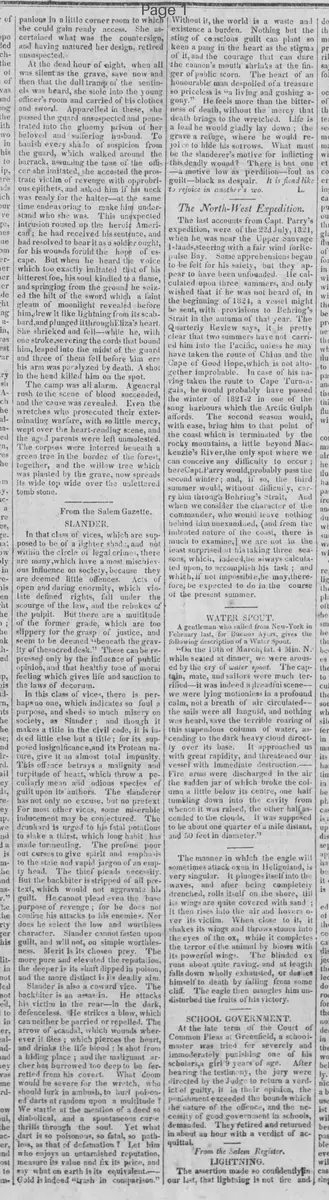
In that class of vices, which are supposed to be of a lighter shade, and not within the circle of legal crimes, there are many, which have a most mischievous influence on society, because they are deemed little offences. Acts of open and daring enormity, which violated defined rights, fall under the scourge of the law, and the rebukes of the pulpit. But there are a multitude of the former grade, which are too slippery for the grasp of justice, and seem to be deemed "beneath the gravity of the sacred desk." These can be repressed only by the influence of public opinion, and that healthy tone of moral feeling which gives life and sanction to the laws of decorum.
In this class of vices, there is perhaps no one, which indicates so foul a purpose, and sheds so much misery on society, as Slander; and though it makes a title in the civil code, it is indeed little else but a title; for its supposed insignificance, and its Protean nature, give it an almost total impunity. This offence betrays a malignity and turpitude of heart, which throw a peculiarly mean and odious species of guilt upon its authors. The slanderer has not only no excuse, but no pretext. For most other vices, some miserable inducement may be conjectured. The drunkard is urged to his fatal potations to slake a thirst, which long habit has made tormenting. The profane pour out curses to give spirit and emphasis to the stale and vapid jargon of an empty head. The thief pleads necessity. But the backbiter is stripped of all pretext, which would not aggravate his guilt. He cannot plead even the base purpose of revenge; for he does not confine his attacks to his enemies. Nor does he select the low and worthless character. Slander cannot fasten upon guilt, and will not, on simple worthlessness. Merit is its chosen prey. The more pure and elevated the reputation, the deeper is its shaft dipped in poison, and the more distinct is its deadly aim.
Slander is also a coward vice. The backbiter is an assassin. He attacks his victim in the rear—in the dark—defenceless. He strikes a blow, which can neither be parried or repelled. The arrow of scandal, which wounds wherever it flies; which pierces the heart, and drinks the life blood; is shot from a hiding place: and the malignant archer has burrowed too deep to be retrieved from his covert. What doom would be severe for the wretch, who should lurk in ambush, to hurl poisoned darts at random upon a multitude? We startle at the mention of a deed so diabolical, and a spontaneous curse thrills through the soul. Yet what dart is so poisonous, so fatal, so pathless, as that of defamation? Let him who enjoys an untarnished reputation, measure its value and fix its price, and say what on earth is its equivalent. Gold is indeed "trash in comparison." Without it, the world is a waste and existence a burden. Nothing but the sting of conscious guilt can plant so keen a pang in the heart as the stigma of it, and the courage that can dare the cannon's mouth shrinks at the finger of public scorn. The heart of an honourable man despoiled of a treasure so priceless is "a living and gushing agony." He feels more than the bitterness of death, without the mercy that death brings to the wretched. Life is a load he would gladly lay down; the grave a refuge, where he would rejoice to hide his sorrows. What must be the slanderer's motive for inflicting this deadly wound? There is but one—a motive low as perdition—foul as guilt—black as despair. It is fiend like to rejoice in another's woe.
L.
SLANDER.
In that class of vices, which are supposed to be of a lighter shade, and not within the circle of legal crimes, there are many, which have a most mischievous influence on society, because they are deemed little offences. Acts of open and daring enormity, which violated defined rights, fall under the scourge of the law, and the rebukes of the pulpit. But there are a multitude of the former grade, which are too slippery for the grasp of justice, and seem to be deemed "beneath the gravity of the sacred desk." These can be repressed only by the influence of public opinion, and that healthy tone of moral feeling which gives life and sanction to the laws of decorum.
In this class of vices, there is perhaps no one, which indicates so foul a purpose, and sheds so much misery on society, as Slander; and though it makes a title in the civil code, it is indeed little else but a title; for its supposed insignificance, and its Protean nature, give it an almost total impunity. This offence betrays a malignity and turpitude of heart, which throw a peculiarly mean and odious species of guilt upon its authors. The slanderer has not only no excuse, but no pretext. For most other vices, some miserable inducement may be conjectured. The drunkard is urged to his fatal potations to slake a thirst, which long habit has made tormenting. The profane pour out curses to give spirit and emphasis to the stale and vapid jargon of an empty head. The thief pleads necessity. But the backbiter is stripped of all pretext, which would not aggravate his guilt. He cannot plead even the base purpose of revenge; for he does not confine his attacks to his enemies. Nor does he select the low and worthless character. Slander cannot fasten upon guilt, and will not, on simple worthlessness. Merit is its chosen prey. The more pure and elevated the reputation, the deeper is its shaft dipped in poison, and the more distinct is its deadly aim.
Slander is also a coward vice. The backbiter is an assassin. He attacks his victim in the rear—in the dark—defenceless. He strikes a blow, which can neither be parried or repelled. The arrow of scandal, which wounds wherever it flies; which pierces the heart, and drinks the life blood; is shot from a hiding place: and the malignant archer has burrowed too deep to be retrieved from his covert. What doom would be severe for the wretch, who should lurk in ambush, to hurl poisoned darts at random upon a multitude? We startle at the mention of a deed so diabolical, and a spontaneous curse thrills through the soul. Yet what dart is so poisonous, so fatal, so pathless, as that of defamation? Let him who enjoys an untarnished reputation, measure its value and fix its price, and say what on earth is its equivalent. Gold is indeed "trash in comparison." Without it, the world is a waste and existence a burden. Nothing but the sting of conscious guilt can plant so keen a pang in the heart as the stigma of it, and the courage that can dare the cannon's mouth shrinks at the finger of public scorn. The heart of an honourable man despoiled of a treasure so priceless is "a living and gushing agony." He feels more than the bitterness of death, without the mercy that death brings to the wretched. Life is a load he would gladly lay down; the grave a refuge, where he would rejoice to hide his sorrows. What must be the slanderer's motive for inflicting this deadly wound? There is but one—a motive low as perdition—foul as guilt—black as despair. It is fiend like to rejoice in another's woe.
L.
What sub-type of article is it?
Moral Or Religious
What keywords are associated?
Slander
Vice
Reputation
Morality
Public Opinion
Backbiting
Defamation
Editorial Details
Primary Topic
Condemnation Of Slander As A Social Vice
Stance / Tone
Strong Moral Condemnation
Key Arguments
Slander Is A Vice Deemed Minor But With Mischievous Influence On Society
It Evades Legal Punishment Due To Its Insignificance And Changeable Nature
Slander Reveals Deep Malignity And Lacks Any Pretext Or Excuse
It Targets The Meritorious Rather Than The Guilty Or Worthless
Slander Is Cowardly, Attacking Victims Secretly Like An Assassin
It Destroys Priceless Reputations, Causing Greater Agony Than Death
The Slanderer's Motive Is Fiend Like Joy In Others' Suffering