Thank you for visiting SNEWPapers!
Sign up free
Editorial
November 24, 1920
The Brattleboro Daily Reformer
Brattleboro, Windham County, Vermont
What is this article about?
Editorial advises Vermont legislators against pre-committing on restoring normal schools at Johnson and Castleton, urging them to gather full information from the education department on funding, training, and supervision before deciding on changes like reducing union superintendents.
Clipping
OCR Quality
95%
Excellent
Full Text
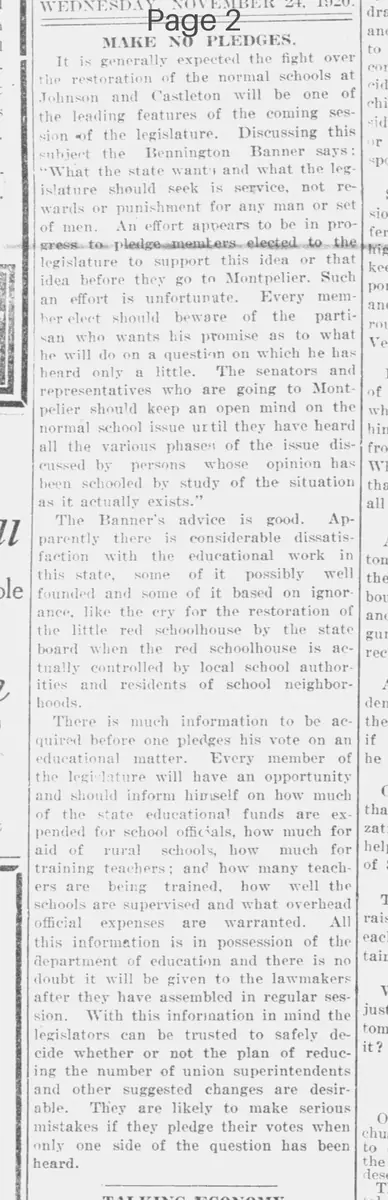
MAKE NO PLEDGES.
It is generally expected the fight over the restoration of the normal schools at Johnson and Castleton will be one of the leading features of the coming session of the legislature. Discussing this subject the Bennington Banner says:
"That the state wants and what the legislature should seek is service, not rewards or punishment for any man or set of men. An effort appears to be in progress to pledge members elected to the legislature to support this idea or that idea before they go to Montpelier. Such an effort is unfortunate. Every member elect should beware of the partisan who wants his promise as to what he will do on a question on which he has heard only a little. The senators and representatives who are going to Montpelier should keep an open mind on the normal school issue until they have heard all the various phases of the issue discussed by persons whose opinion has been schooled by study of the situation as it actually exists."
The Banner's advice is good. Apparently there is considerable dissatisfaction with the educational work in this state, some of it possibly well founded and some of it based on ignorance, like the cry for the restoration of the little red schoolhouse by the state board when the red schoolhouse is actually controlled by local school authorities and residents of school neighborhoods.
There is much information to be acquired before one pledges his vote on an educational matter. Every member of the legislature will have an opportunity and should inform himself on how much of the state educational funds are expended for school officials, how much for aid of rural schools, how much for training teachers; and how many teachers are being trained, how well the schools are supervised and what overhead official expenses are warranted. All this information is in possession of the department of education and there is no doubt it will be given to the lawmakers after they have assembled in regular session. With this information in mind the legislators can be trusted to safely decide whether or not the plan of reducing the number of union superintendents and other suggested changes are desirable. They are likely to make serious mistakes if they pledge their votes when only one side of the question has been heard.
It is generally expected the fight over the restoration of the normal schools at Johnson and Castleton will be one of the leading features of the coming session of the legislature. Discussing this subject the Bennington Banner says:
"That the state wants and what the legislature should seek is service, not rewards or punishment for any man or set of men. An effort appears to be in progress to pledge members elected to the legislature to support this idea or that idea before they go to Montpelier. Such an effort is unfortunate. Every member elect should beware of the partisan who wants his promise as to what he will do on a question on which he has heard only a little. The senators and representatives who are going to Montpelier should keep an open mind on the normal school issue until they have heard all the various phases of the issue discussed by persons whose opinion has been schooled by study of the situation as it actually exists."
The Banner's advice is good. Apparently there is considerable dissatisfaction with the educational work in this state, some of it possibly well founded and some of it based on ignorance, like the cry for the restoration of the little red schoolhouse by the state board when the red schoolhouse is actually controlled by local school authorities and residents of school neighborhoods.
There is much information to be acquired before one pledges his vote on an educational matter. Every member of the legislature will have an opportunity and should inform himself on how much of the state educational funds are expended for school officials, how much for aid of rural schools, how much for training teachers; and how many teachers are being trained, how well the schools are supervised and what overhead official expenses are warranted. All this information is in possession of the department of education and there is no doubt it will be given to the lawmakers after they have assembled in regular session. With this information in mind the legislators can be trusted to safely decide whether or not the plan of reducing the number of union superintendents and other suggested changes are desirable. They are likely to make serious mistakes if they pledge their votes when only one side of the question has been heard.
What sub-type of article is it?
Education
Partisan Politics
What keywords are associated?
Normal Schools
Legislative Pledges
Educational Reform
Teacher Training
School Supervision
Rural Schools
Union Superintendents
What entities or persons were involved?
Bennington Banner
Legislature
Department Of Education
State Board
Editorial Details
Primary Topic
Advising Legislators Against Pre Session Pledges On Normal School Restoration
Stance / Tone
Cautionary And Advisory
Key Figures
Bennington Banner
Legislature
Department Of Education
State Board
Key Arguments
State Needs Service, Not Rewards Or Punishment
Efforts To Pledge Members Before Session Are Unfortunate
Keep Open Mind On Normal School Issue Until Hearing All Sides
Acquire Information On State Educational Funds Expenditure
Inform On Teacher Training, School Supervision, And Overhead Expenses
Decide Based On Facts From Department Of Education
Avoid Mistakes By Not Pledging After Hearing Only One Side