Thank you for visiting SNEWPapers!
Sign up free
Editorial
October 30, 1916
The Daily Star Mirror
Moscow, Latah County, Idaho
What is this article about?
Editorial critiques recent legislation as not a genuine eight-hour law for railroad trainmen, as it only raises pay without shortening the workday. Includes Congressman A. P. Gardner's statement doubting the strike could not be averted if President Wilson intervened decisively.
Clipping
OCR Quality
98%
Excellent
Full Text
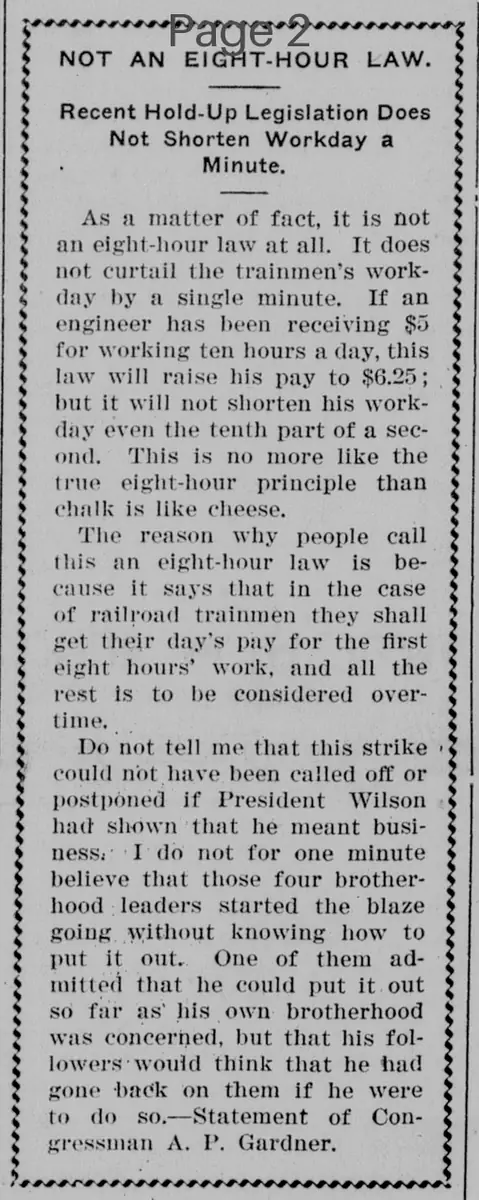
NOT AN EIGHT-HOUR LAW.
Recent Hold-Up Legislation Does Not Shorten Workday a Minute.
As a matter of fact, it is not an eight-hour law at all. It does not curtail the trainmen's workday by a single minute. If an engineer has been receiving $5 for working ten hours a day, this law will raise his pay to $6.25; but it will not shorten his workday even the tenth part of a second. This is no more like the true eight-hour principle than chalk is like cheese.
The reason why people call this an eight-hour law is because it says that in the case of railroad trainmen they shall get their day's pay for the first eight hours' work, and all the rest is to be considered overtime.
Do not tell me that this strike could not have been called off or postponed if President Wilson had shown that he meant business: I do not for one minute believe that those four brotherhood leaders started the blaze going without knowing how to put it out. One of them admitted that he could put it out so far as his own brotherhood was concerned, but that his followers would think that he had gone back on them if he were to do so.-Statement of Congressman A. P. Gardner.
Recent Hold-Up Legislation Does Not Shorten Workday a Minute.
As a matter of fact, it is not an eight-hour law at all. It does not curtail the trainmen's workday by a single minute. If an engineer has been receiving $5 for working ten hours a day, this law will raise his pay to $6.25; but it will not shorten his workday even the tenth part of a second. This is no more like the true eight-hour principle than chalk is like cheese.
The reason why people call this an eight-hour law is because it says that in the case of railroad trainmen they shall get their day's pay for the first eight hours' work, and all the rest is to be considered overtime.
Do not tell me that this strike could not have been called off or postponed if President Wilson had shown that he meant business: I do not for one minute believe that those four brotherhood leaders started the blaze going without knowing how to put it out. One of them admitted that he could put it out so far as his own brotherhood was concerned, but that his followers would think that he had gone back on them if he were to do so.-Statement of Congressman A. P. Gardner.
What sub-type of article is it?
Labor
Partisan Politics
What keywords are associated?
Eight Hour Law
Railroad Trainmen
Workday Length
Labor Strike
President Wilson
Brotherhood Leaders
What entities or persons were involved?
President Wilson
Four Brotherhood Leaders
Congressman A. P. Gardner
Railroad Trainmen
Editorial Details
Primary Topic
Critique Of Eight Hour Law For Railroad Trainmen And Railroad Strike
Stance / Tone
Critical Of The Law And Skeptical Of Strike Leaders
Key Figures
President Wilson
Four Brotherhood Leaders
Congressman A. P. Gardner
Railroad Trainmen
Key Arguments
The Law Does Not Shorten The Workday By Even A Minute
It Only Increases Pay For The Same Hours Worked
It Is Not A True Eight Hour Principle
The Strike Could Be Called Off If President Wilson Intervened Decisively
Brotherhood Leaders Know How To End The Strike But Fear Backlash