Thank you for visiting SNEWPapers!
Sign up free
Alexandria Daily Advertiser
Alexandria, Virginia
What is this article about?
From a Paris paper: Napoleon promulgates a comprehensive statute for the imperial house, outlining rules for family structure, marriages, education, discipline, property, civil acts, and a dedicated family council, binding on successors per the 1804 constitution. (Signed by Napoleon, Cambaceres, Maret.)
Merged-components note: Continuation of Napoleon's imperial statute across pages; text ends with 'To be continued' on page 2 and resumes on page 3.
Clippings
1 of 2
OCR Quality
Full Text
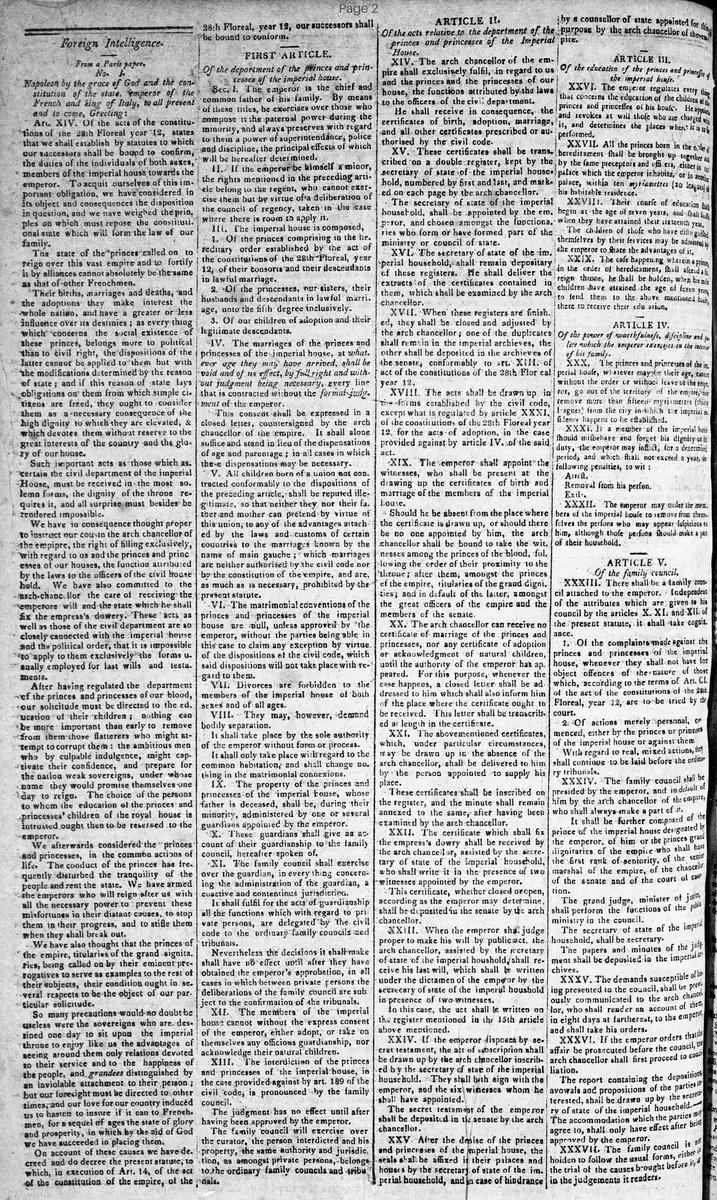
From a Paris paper.
No. I.
Napoleon by the grace of God and the constitution of the state, emperor of the French and king of Italy, to all present and to come, Greeting:
Art. XIV. Of the act of the constitutions of the 28th Floreal year 12, states that we shall establish by statutes to which our successors shall be bound to confirm, the duties of the individuals of both sexes, members of the imperial house towards the emperor. To acquit ourselves of this important obligation, we have considered in its object and consequences the disposition in question, and we have weighed the principles on which must repose the constitutional state which will form the law of our family.
This state of the princes called on to reign over this vast empire and to fortify it by alliances cannot absolutely be the same as that of other Frenchmen.
Their births, marriages and the adoptions they make interest the whole nation, and have a greater or less influence over its destinies; as every thing which concerns the social existence of these princes, belongs more to political than to civil right, the dispositions of the latter cannot be applied to them but with the modifications determined by the reason of state; and if this reason of state lays obligations on them from which simple citizens are freed, they ought to consider them as a necessary consequence of the high dignity to which they are elevated, & which devotes them without reserve to the great interests of the country and the glory of our house.
Such important acts as those which assure the civil department of the imperial house must be received in the most solemn forms, the dignity of the throne requires it, and all surprise must besides be rendered impossible.
We have in consequence thought proper to instruct our cousin the arch chancellor of the empire, with the right of filling exclusively, with regard to us and the princes and princesses of our house, the function attributed by the laws to the officers of the civil household. We have also committed to the arch-chancellor the care of receiving the emperor's will and the state which he shall fix the empress's dowry. These acts as well as those of the civil department are so closely connected with the imperial house and the political order, that it is impossible to apply to them exclusively the forms usually employed for last wills and testaments.
After having regulated the department of the princes and princesses of our blood, our solicitude must be directed to the education of their children; nothing can be more important than early to remove from them those flatterers who might attempt to corrupt them: the ambitious men who by culpable indulgence, might captivate their confidence, and prepare for the patria weak sovereigns, under whose name they would promise themselves one day to reign. The choice of the persons to whom the education of the princes and princesses' children of the royal house is intrusted ought then to be reserved to the emperor.
We afterwards considered the princes and princesses, in the common actions of life. The conduct of the princes has frequently disturbed the tranquility of the people and rent the state. We have armed the emperors who will reign after us with all the necessary power to prevent these misfortunes in their distant causes, to stop them in their progress, and to stifle them when they shall break out.
We have also thought that the princes of the empire, titularies of the grand signitories, being called on by their eminent prerogatives to serve as examples to the rest of their subjects, their condition ought in several respects to be the object of our particular solicitude.
So many precautions would no doubt be useless were the sovereigns who are destined one day to sit upon the imperial throne to enjoy like us the advantages of seeing around them only relations devoted to their service and to the happiness of the people, and grandees distinguished by an inviolable attachment to their person; but our foresight must be directed to other times, and our love for our country induced us to hasten to insure if it can to Frenchmen, for a sequel of ages the state of glory and prosperity, in which by the aid of God we have succeeded in placing them.
On account of these causes we have decreed and do decree the present statute, to which, in execution of Art. 14, of the act of the constitution of the empire, of the 28th Floreal, year 12, our successors shall be bound to conform.
FIRST ARTICLE.
Of the department of the princes and princesses of the imperial house.
Sec. I. The emperor is the chief and common father of his family. By means of these titles, he exercises over those who compose it the paternal power during the minority, and always preserves with regard to them a power of superintendence; police and discipline, the principal effects of which will be hereafter determined.
II. If the emperor be himself a minor, the rights mentioned in the preceding article belong to the regent, who cannot exercise them but by virtue of a deliberation of the council of regency, taken in the case where there is room to apply it.
III. The imperial house is composed,
1. Of the princes comprising in the hereditary order established by the act of the constitutions of the 28th Floreal, year 12, of their consorts and their descendants in lawful marriage.
2. Of the princesses, our sisters, their husbands and descendants in lawful marriage, unto the fifth degree inclusively.
3. Of our children of adoption and their legitimate descendants.
IV. The marriages of the princes and princesses of the imperial house, at whatever age they may have arrived, shall be null and of no effect, by full right and without judgment being necessary, every marriage that is contracted without the formal consent of the emperor.
This consent shall be expressed in a closed letter, countersigned by the arch chancellor of the empire. It shall alone suffice and stand in lieu of the dispensations of age and parentage; in all cases in which the dispensations may be necessary.
V. All children born of a union not contracted conformably to the dispositions of the preceding article, shall be reputed illegitimate, so that neither they nor their father and mother can pretend by virtue of this union; to any of the advantages attached by the laws and customs of certain countries to the marriages known by the name of main gauche: which marriages are neither authorized by the civil code nor by the constitution of the empire, and are, as much as is necessary, prohibited by the present statute.
VI. The matrimonial conventions of the princes and princesses of the imperial house are null, unless approved by the emperor, without the parties being able in this case to claim any exception by virtue of the dispositions of the civil code, which said dispositions will not take place with regard to them.
VII. Divorces are forbidden to the members of the imperial house of both sexes and of all ages.
VIII. They may, however, demand bodily separation.
It shall take place by the sole authority of the emperor without form or process.
It shall only take place with regard to the common habitation; and shall change nothing in the matrimonial connections.
IX. The property of the princes and princesses of the imperial house, whose father is deceased, shall be, during their minority, administered by one or several guardians appointed by the emperor.
X. These guardians shall give an account of their guardianship to the family council, hereafter spoken of.
XI. The family council shall exercise over the guardian, in every thing concerning the administration of the guardianship, a coactive and contentious jurisdiction.
It shall fulfil for the acts of guardianship all the functions which with regard to private persons, are delegated by the civil code to the ordinary family councils and tribunals.
Nevertheless the decisions it shall make shall have no effect until after they have obtained the emperor's approbation, in all cases in which between private persons the deliberations of the family council are subject to the confirmation of the tribunals.
XII. The members of the imperial house cannot without the express consent of the emperor, either adopt, or take on themselves any officious guardianship, nor acknowledge their natural children.
XIII. The interdiction of the princes and princesses of the imperial house, in the case provided against by art. 189 of the civil code; is pronounced by the family council.
The judgment has no effect until after having been approved by the emperor.
The family council will exercise over the curator, the person interdicted and his property, the same authority and jurisdiction, as amongst private persons, belongs to the ordinary family councils and tribunals.
ARTICLE II.
Of the acts relative to the department of the princes and princesses of the Imperial House.
XIV. The arch chancellor of the empire shall exclusively fulfil, in regard to us and the princes and the princesses of our house, the functions attributed by the laws to the officers of the civil department.
He shall receive in consequence, the certificates of birth, adoption, marriage, and all other certificates prescribed or authorised by the civil code.
XV. These certificates shall be transcribed on a double register, kept by the secretary of state of the imperial household, numbered by first and last, and marked on each page by the arch chancellor.
The secretary of state of the imperial household, shall be appointed by the emperor, and chosen amongst the functionaries who form or have formed part of the ministry or council of state.
XVI. The secretary of state of the imperial household, shall remain depositary of these registers. He shall deliver the extracts of the certificates contained in them, which shall be examined by the arch chancellor.
XVII. When these registers are finished, they shall be closed and adjusted by the arch chancellor: one of the duplicates shall remain in the imperial archives, the other shall be deposited in the archives of the senate, conformably to art. XIII. of act of the constitutions of the 28th Floreal year 12:
XVIII. The acts shall be drawn up in the forms established by the civil code, except what is regulated by article XXXI. of the constitutions of the 28th Floreal year 12. for the acts of adoption, in the case provided against by article IV. of the said act.
XIX. The emperor shall appoint the witnesses, who shall be present at the drawing up the certificates of birth and marriage of the members of the imperial house.
Should he be absent from the place where the certificate is drawn up, or should there be no one appointed by him, the arch chancellor shall be bound to take the witnesses among the princes of the blood, following the order of their proximity to the throne; after them, amongst the princes of the empire, titularies of the grand dignities; and in default of the latter, amongst the great officers of the empire and the members of the senate.
XX. The arch chancellor can receive no certificate of marriage of the princes and princesses, nor any certificate of adoption or acknowledgment of natural children, until the authority of the emperor has appeared. For this purpose, whenever the case happens, a closed letter shall be addressed to him which shall also inform him of the place where the certificate ought to be received. This letter shall be transcribed at length in the certificate.
XXI. The abovementioned certificates, which, under particular circumstances, may be drawn up in the absence of the arch chancellor, shall be delivered to him by the person appointed to supply his place.
These certificates shall be inscribed on the register, and the minute shall remain annexed to the same, after having been examined by the arch chancellor.
XXII. The certificate which shall fix the empress's dowry shall be received by the arch chancellor, assisted by the secretary of state of the imperial household, who shall write it in the presence of two witnesses appointed by the emperor.
This certificate, whether closed or open, according as the emperor may determine, shall be deposited in the senate by the arch chancellor.
XXIII. When the emperor shall judge proper to make his will by public act, the arch chancellor, assisted by the secretary of state of the imperial household shall receive his last will, which shall be written under the dictation of the emperor by the secretary of state of the imperial household in presence of two witnesses.
In this case, the act shall be written on the register mentioned in the 15th article above mentioned.
XXIV. If the emperor disposes by secret testament, the act of subscription shall be drawn up by the arch chancellor inscribed by the secretary of state of the imperial household. They shall both sign with the emperor, and the six witnesses whom he shall have appointed.
The secret testament of the emperor shall be deposited in the senate by the arch chancellor.
XXV. After the decease of the princes and princesses of the imperial house, the seals shall be affixed in their palaces and houses by the secretary of state of the imperial household, and in case of hindrance by a counsellor of state appointed for the purpose by the arch chancellor of the empire.
ARTICLE III.
Of the education of the princes and princesses of the imperial house.
XXVI. The emperor regulates every thing that concerns the education of the children of the princes and princesses of his house. He appoints and revokes at will those who are charged with it, and determines the places where it is to be performed.
XXVII. All the princes born in the order of hereditament shall be brought up together and by the same preceptors and others, either in the palace which the emperor inhabits, or in another palace, within ten myriametres (20 leagues) of his habitual residence.
XXVIII. Their course of education shall begin at the age of seven years, and shall finish when they have attained their sixteenth year.
The children of those who have distinguished themselves by their services may be admitted by the emperor to share the advantages of it.
XXIX. The case happening wherein a prince in the order of hereditament, shall ascend a foreign throne, he shall be holden, when his male children have attained the age of seven years to send them to the above mentioned house, there to receive their education.
ARTICLE IV.
Of the power of watchfulness, discipline and police which the emperor exercises in the interior of his family.
XXX. The princes and princesses of the imperial house, whatever may be their age, cannot without the order or without leave of the emperor, go out of the territory of the empire, nor remove more than fifteen myriametres (thirty leagues from the city in which the imperial residence happens to be established.
XXXI. If a member of the imperial house should misbehave and forget his dignity or duty, the emperor may inflict, for a determined period; and which shall not exceed a year, the following penalties, to wit:
Arrest.
Removal from his person.
Exile.
XXXII. The emperor may order the members of the imperial house to remove from themselves the persons who may appear suspicious to him, although those persons should make a part of their household.
ARTICLE V.
Of the family council.
XXXIII. There shall be a family council attached to the emperor, independent of the attributes which are given to his council by the articles X. XI. and XII. of the present statute; it shall take cognizance.
1. Of the complaints made against the princes and princesses of the imperial house, whenever they shall not have for object offences of the nature of those which, according to the terms of Art. 51. of the act of the constitutions of the 28th Floreal, year 12, are to be tried by any court.
2. Of actions merely personal, commenced, either by the princes or princesses of the imperial house or against them With regard to real. mixed actions, they shall continue to be laid before the ordinary tribunals.
XXXIV. The family council shall be presided by the emperor, and in default of him by the arch chancellor of the empire, who shall always make a part of it. It shall be further composed of the prince of the imperial house designated by the emperor, of the first rank of seniority, of the senior dignitaries of the empire who shall have the emperor, of him or the princes grand marshal of the empire, of the chancellor of the senate and of the court of cassation. The grand judge, minister of justice shall perform the functions of the public ministry in the council. The secretary of state of the imperial household, shall be secretary.
The papers and minutes of the judgments shall be deposited in the imperial archives.
XXXV. The demands susceptible of being previously communicated to the arch chancellor, who shall render an account of them, in eight days at farthest, to the emperor, and shall take his orders.
XXXVI. If the emperor orders that the affair be prosecuted before the council, the arch chancellor shall first proceed to conciliation. The report containing the depositions, avowals and propositions of the parties interested, shall be drawn up by the secretary of state of the imperial household. The accommodation which the parties may agree to, shall only have effect after being approved by the emperor.
XXXVII. The family council is holden to follow the usual forms, either in the trial of the causes brought before it, in the judgements it renders.
Nevertheless it must always hear the parties, either by themselves or by their attorneys, and must assign motives for its judgements.
It must also have been pronounced within a month.
They are signified to the parties, on being appealed from, to the court of cassation.
The judgements given by the family council are not susceptible of being appealed.
XXXVIII. The judgements given by [garbled text: ipstaffs of the ball or any other appointed y requisition of the grand judge, by the or the same.]
XXXIX. When the family council de- rmine on complaints, and thinks them ag that the person against whom they are. ell grounded, it contents itself to declare- id is reprehensible by the fact which the complaint specifies, and refers for the re- mainder to the emperor.
XL. If the emperor does not think fit to se indulgence, he pronounces one of the penalties decreed, by article 31, and even any of two years confinement in one of according to the gravity of the fact, the pe- e state prisons,
[garbled: vix"u Yeis: Y:]
ARTICLE VI.
the dispositions of the present statute which are applicable to the princes of the empire, grand dignitaries.
ukes are subjected to the dispositions of the a.
XLI. and XLII. The grand dignitaries and ove art. 31. in the cases specified by that ar- ticle,
(Signed)
NAPOLEON.
By the Emperor.
Seen by us, arch chancellor of the empire.
(Signed)
CAMBACERES
The secretary of state.
(Signed)
H. B. MARET.
[To be continued]
What sub-type of article is it?
What keywords are associated?
What entities or persons were involved?
Where did it happen?
Foreign News Details
Primary Location
Paris
Key Persons
Outcome
establishment of binding statutes for the imperial family, including regulations on marriages, education, discipline, property, and a family council.
Event Details
Napoleon issues a detailed imperial statute regulating the structure, duties, marriages, adoptions, education, discipline, property administration, and civil acts of the princes and princesses of the imperial house. It establishes the emperor's paternal authority, prohibits unauthorized marriages and divorces, mandates imperial approval for key family decisions, creates a family council for internal matters, and extends certain provisions to grand dignitaries. The statute is signed by Napoleon, Cambaceres as arch-chancellor, and H. B. Maret as secretary of state.