Thank you for visiting SNEWPapers!
Sign up free
Literary
August 11, 1869
The Elko Independent
Elko, Elko County, Nevada
What is this article about?
An essay from the British Quarterly Review on the 1866 nova in Corona Borealis, described as a world on fire. Discovered by Mr. Birmingham, it brightened then faded, with spectral lines indicating burning hydrogen. Speculates on cosmic catastrophe and parallels to biblical apocalypse in 2 Peter.
Clipping
OCR Quality
75%
Good
Full Text
Worlds on Fire.
[From the British Quarterly Review.]
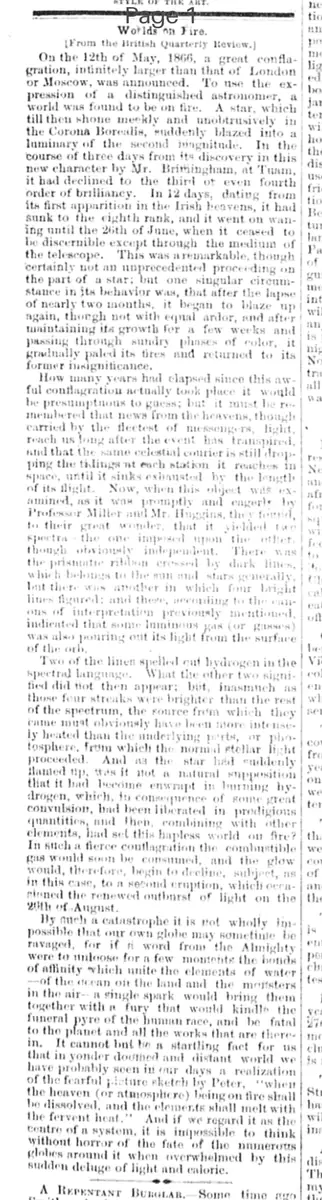
On the 12th of May, 1866, a great conflagration, infinitely larger than that of London or Moscow, was announced. To use the expression of a distinguished astronomer, a world was found to be on fire. A star, which till then shone meekly and unobtrusively in the Corona Borealis, suddenly blazed into a luminary of the second magnitude. In the course of three days from its discovery in this new character by Mr. Birmingham, at Tuam, it had declined to the third or even fourth order of brilliancy. In 12 days, dating from its first apparition in the Irish heavens, it had sunk to the eighth rank, and it went on waning until the 20th of June, when it ceased to be discernible except through the medium of the telescope. This was a remarkable, though certainly not an unprecedented proceeding on the part of a star; but one singular circumstance in its behavior was, that after the lapse of nearly two months, it began to blaze up again, though not with equal ardor, and after maintaining its growth for a few weeks and passing through sundry phases of color, it gradually paled its fires and returned to its former insignificance.
How many years had elapsed since this awful conflagration actually took place it would be presumptuous to guess: but it must be remembered that news from the heavens, though carried by the fleetest of messengers, light, reach us long after the event has transpired, and that the same celestial courier is still dropping the tidings at each station it reaches in space, until it sinks exhausted by the length of its flight. Now, when this object was examined, as it was promptly and eagerly by Professor Miller and Mr. Huggins, they felt, to their great wonder, that it spoke the language of the spectrum more superimposed upon the other than obviously independent. There was the prismatic spectrum crossed by dark lines, which belongs to the sun and stars generally, but there was another in which bright lines figured: and these, according to the canons of interpretation previously mentioned, indicated that some luminous gas (or gases) was also pouring out its light from the surface of the orb.
Two of the lines spelled out hydrogen in the spectral language. What the other two signified did not then appear: but, inasmuch as those four streaks were brighter than the rest of the spectrum, the source from which they came must obviously have been more intensely heated than the underlying parts, or photosphere, from which the normal stellar light proceeded. And as the star had suddenly flamed up, is it not a natural supposition that it had become enwrapped in burning hydrogen, which, in consequence of some great convulsion, had been liberated in prodigious quantities, and then, combining with other elements, had set this hapless world on fire?
In such a fierce conflagration the combustible gas would soon be consumed, and the glow would, therefore, begin to decline, subject, as in this case, to a second eruption, which occasioned the renewed outburst of light on the 20th of August.
By such a catastrophe it is not wholly impossible that our own globe may sometime be ravaged, for if a word from the Almighty were to unloose for a few moments the bonds of affinity which unite the elements of water—of the ocean on the land and the monsters in the air—a single spark would bring them together with a fury that would kindle the funeral pyre of the human race, and be fatal to the planet and all the works that are therein. It cannot but be a startling fact for us that in yonder doomed and distant world we have probably seen in our days a realization of the fearful picture sketched by Peter. "when the heaven (or atmosphere) being on fire shall be dissolved, and the elements shall melt with the fervent heat." And if we regard it as the centre of a system, it is impossible to think without horror of the fate of the numerous globes around it when overwhelmed by this sudden deluge of light and caloric.
[From the British Quarterly Review.]
On the 12th of May, 1866, a great conflagration, infinitely larger than that of London or Moscow, was announced. To use the expression of a distinguished astronomer, a world was found to be on fire. A star, which till then shone meekly and unobtrusively in the Corona Borealis, suddenly blazed into a luminary of the second magnitude. In the course of three days from its discovery in this new character by Mr. Birmingham, at Tuam, it had declined to the third or even fourth order of brilliancy. In 12 days, dating from its first apparition in the Irish heavens, it had sunk to the eighth rank, and it went on waning until the 20th of June, when it ceased to be discernible except through the medium of the telescope. This was a remarkable, though certainly not an unprecedented proceeding on the part of a star; but one singular circumstance in its behavior was, that after the lapse of nearly two months, it began to blaze up again, though not with equal ardor, and after maintaining its growth for a few weeks and passing through sundry phases of color, it gradually paled its fires and returned to its former insignificance.
How many years had elapsed since this awful conflagration actually took place it would be presumptuous to guess: but it must be remembered that news from the heavens, though carried by the fleetest of messengers, light, reach us long after the event has transpired, and that the same celestial courier is still dropping the tidings at each station it reaches in space, until it sinks exhausted by the length of its flight. Now, when this object was examined, as it was promptly and eagerly by Professor Miller and Mr. Huggins, they felt, to their great wonder, that it spoke the language of the spectrum more superimposed upon the other than obviously independent. There was the prismatic spectrum crossed by dark lines, which belongs to the sun and stars generally, but there was another in which bright lines figured: and these, according to the canons of interpretation previously mentioned, indicated that some luminous gas (or gases) was also pouring out its light from the surface of the orb.
Two of the lines spelled out hydrogen in the spectral language. What the other two signified did not then appear: but, inasmuch as those four streaks were brighter than the rest of the spectrum, the source from which they came must obviously have been more intensely heated than the underlying parts, or photosphere, from which the normal stellar light proceeded. And as the star had suddenly flamed up, is it not a natural supposition that it had become enwrapped in burning hydrogen, which, in consequence of some great convulsion, had been liberated in prodigious quantities, and then, combining with other elements, had set this hapless world on fire?
In such a fierce conflagration the combustible gas would soon be consumed, and the glow would, therefore, begin to decline, subject, as in this case, to a second eruption, which occasioned the renewed outburst of light on the 20th of August.
By such a catastrophe it is not wholly impossible that our own globe may sometime be ravaged, for if a word from the Almighty were to unloose for a few moments the bonds of affinity which unite the elements of water—of the ocean on the land and the monsters in the air—a single spark would bring them together with a fury that would kindle the funeral pyre of the human race, and be fatal to the planet and all the works that are therein. It cannot but be a startling fact for us that in yonder doomed and distant world we have probably seen in our days a realization of the fearful picture sketched by Peter. "when the heaven (or atmosphere) being on fire shall be dissolved, and the elements shall melt with the fervent heat." And if we regard it as the centre of a system, it is impossible to think without horror of the fate of the numerous globes around it when overwhelmed by this sudden deluge of light and caloric.
What sub-type of article is it?
Essay
What themes does it cover?
Religious
Death Mortality
Nature
What keywords are associated?
Nova
Corona Borealis
Astronomy
Spectrum Analysis
Hydrogen
Cosmic Catastrophe
Biblical Apocalypse
What entities or persons were involved?
From The British Quarterly Review.
Literary Details
Title
Worlds On Fire.
Author
From The British Quarterly Review.
Subject
The Conflagration Of A Star In Corona Borealis
Key Lines
To Use The Expression Of A Distinguished Astronomer, A World Was Found To Be On Fire.
Two Of The Lines Spelled Out Hydrogen In The Spectral Language.
Is It Not A Natural Supposition That It Had Become Enwrapped In Burning Hydrogen... Had Set This Hapless World On Fire?
By Such A Catastrophe It Is Not Wholly Impossible That Our Own Globe May Sometime Be Ravaged...
"When The Heaven (Or Atmosphere) Being On Fire Shall Be Dissolved, And The Elements Shall Melt With The Fervent Heat."