Thank you for visiting SNEWPapers!
Sign up free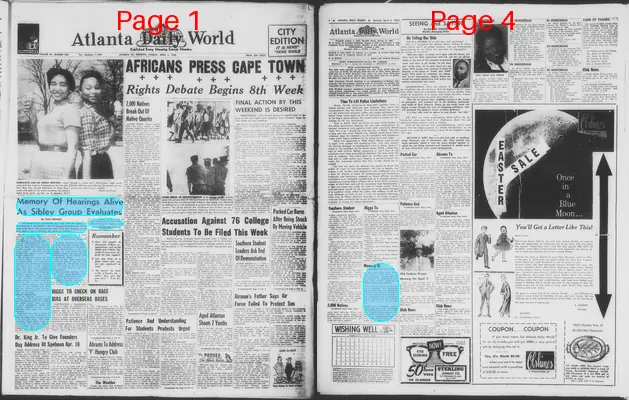
Atlanta Daily World
Atlanta, Fulton County, Georgia
What is this article about?
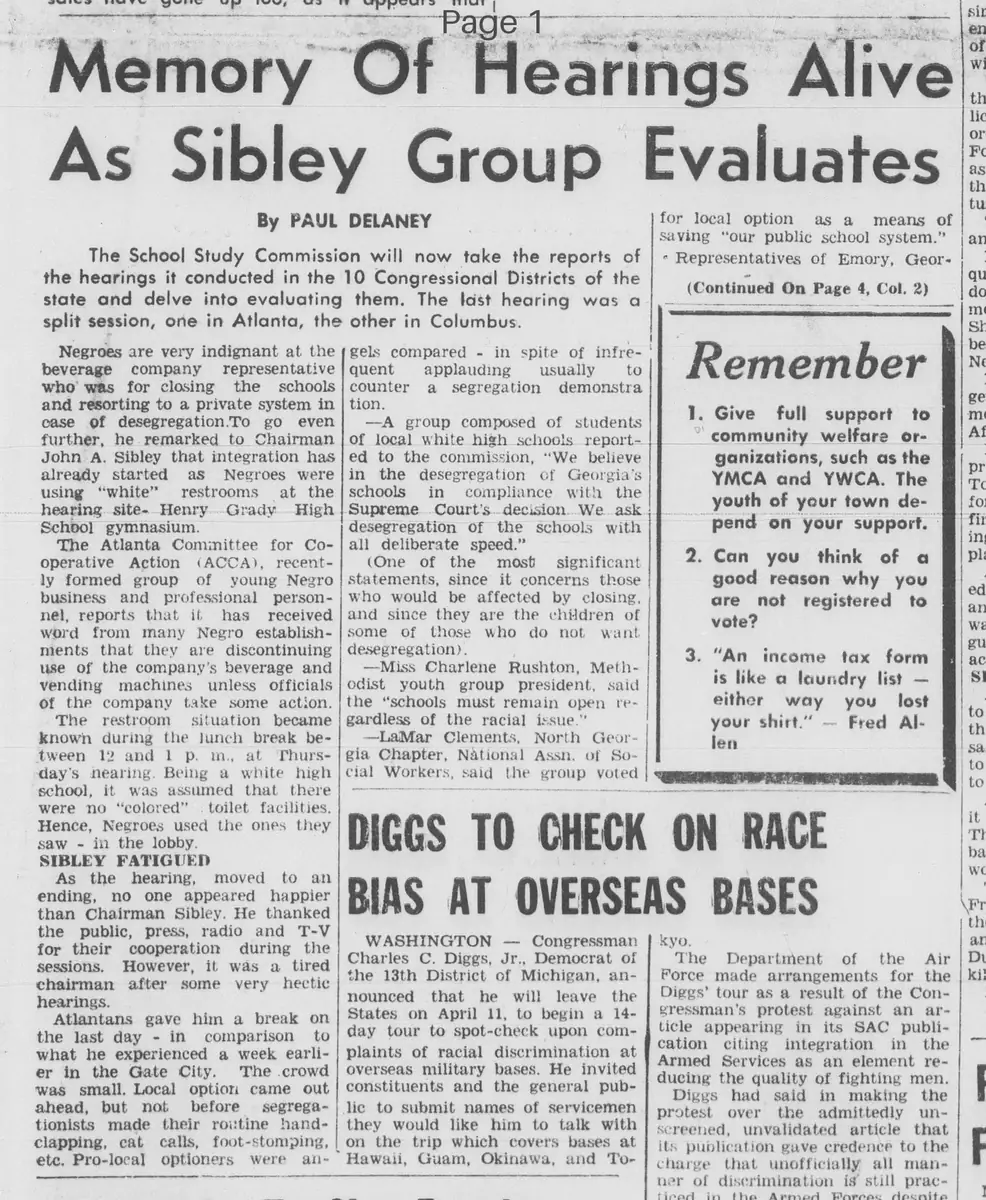
Memory Of Hearings Alive As Sibley Group Evaluates The School Study Commission will now take the reports of the hearings it conducted in the 10 Congressional Districts of the state and delve into evaluating them. The last hearing was a split session, one in Atlanta, the other in Columbus. Negroes are very indignant at the beverage company representative who was for closing the schools and resorting to a private system in case of desegregation. To go even further, he remarked to Chairman John A. Sibley that integration has already started as Negroes were using "white" restrooms at the hearing site—Henry Grady High School gymnasium. The Atlanta Committee for Cooperative Action (ACCA), recently formed group of young Negro business and professional personnel, reports that it has received word from many Negro establishments that they are discontinuing use of the company's beverage and vending machines unless officials of the company take some action. The restroom situation became known during the lunch break between 12 and 1 p.m. at Thursday's hearing. Being a white high school, it was assumed that there were no "colored" toilet facilities. Hence, Negroes used the ones they saw—in the lobby. SIBLEY FATIGUED As the hearing moved to an ending, no one appeared happier than Chairman Sibley. He thanked the public, press, radio and T-V for their cooperation during the sessions. However, it was a tired chairman after some very hectic hearings. Atlantans gave him a break on the last day—in comparison to what he experienced a week earlier in the Gate City. The crowd was small. Local option came out ahead, but not before segregationists made their routine hand-clapping, cat calls, foot-stomping, etc. Pro-local optioners were angels compared—in spite of infrequent applauding usually to counter a segregation demonstration. —A group composed of students of local white high schools reported to the commission, "We believe in the desegregation of Georgia's schools in compliance with the Supreme Court's decision. We ask desegregation of the schools with all deliberate speed." (One of the most significant statements, since it concerns those who would be affected by closing, and since they are the children of some of those who do not want desegregation). —Miss Charlene Rushton, Methodist youth group president, said the "schools must remain open regardless of the racial issue." —LaMar Clements, North Georgia Chapter, National Assn. of Social Workers, said the group voted for local option as a means of saving "our public school system." Representatives of Emory, Geor(Continued On Page 4, Col. 2) Memory Of (Continued from Page One) Georgia Tech and Agnes Scott joined other colleges of the state in asking the schools remain open. At the hearing in Washington students from Georgia presented a petition urging open schools. With the storehouse of information it collected, the commission now has until May 1 to compile its report for the General Assembly. It is still speculation as to what it will recommend. One of Atlanta's dailies reported that the commission is 10-1 in favor of local option. What the commission recommends and what the governing and legislating fathers do is even more speculative. The governor has maintained all along that there will be no desegregation while he is in office. And the majority sentiment in the legislature is against
Merged-components note: Continuation of story across pages based on explicit 'Continued On Page 4, Col. 2' and 'Continued from Page One' indicators.
Clippings
1 of 2
OCR Quality
Full Text
The School Study Commission will now take the reports of the hearings it conducted in the 10 Congressional Districts of the state and delve into evaluating them. The last hearing was a split session, one in Atlanta, the other in Columbus.
Negroes are very indignant at the beverage company representative who was for closing the schools and resorting to a private system in case of desegregation. To go even further, he remarked to Chairman John A. Sibley that integration has already started as Negroes were using "white" restrooms at the hearing site—Henry Grady High School gymnasium.
The Atlanta Committee for Cooperative Action (ACCA), recently formed group of young Negro business and professional personnel, reports that it has received word from many Negro establishments that they are discontinuing use of the company's beverage and vending machines unless officials of the company take some action.
The restroom situation became known during the lunch break between 12 and 1 p.m. at Thursday's hearing. Being a white high school, it was assumed that there were no "colored" toilet facilities. Hence, Negroes used the ones they saw—in the lobby.
SIBLEY FATIGUED
As the hearing moved to an ending, no one appeared happier than Chairman Sibley. He thanked the public, press, radio and T-V for their cooperation during the sessions. However, it was a tired chairman after some very hectic hearings.
Atlantans gave him a break on the last day—in comparison to what he experienced a week earlier in the Gate City. The crowd was small. Local option came out ahead, but not before segregationists made their routine hand-clapping, cat calls, foot-stomping, etc. Pro-local optioners were angels compared—in spite of infrequent applauding usually to counter a segregation demonstration.
—A group composed of students of local white high schools reported to the commission, "We believe in the desegregation of Georgia's schools in compliance with the Supreme Court's decision. We ask desegregation of the schools with all deliberate speed."
(One of the most significant statements, since it concerns those who would be affected by closing, and since they are the children of some of those who do not want desegregation).
—Miss Charlene Rushton, Methodist youth group president, said the "schools must remain open regardless of the racial issue."
—LaMar Clements, North Georgia Chapter, National Assn. of Social Workers, said the group voted for local option as a means of saving "our public school system."
Representatives of Emory, Geor(Continued On Page 4, Col. 2)
Memory Of
(Continued from Page One)
Georgia Tech and Agnes Scott joined other colleges of the state in asking the schools remain open. At the hearing in Washington students from Georgia presented a petition urging open schools.
With the storehouse of information it collected, the commission now has until May 1 to compile its report for the General Assembly.
It is still speculation as to what it will recommend. One of Atlanta's dailies reported that the commission is 10-1 in favor of local option.
What the commission recommends and what the governing and legislating fathers do is even more speculative. The governor has maintained all along that there will be no desegregation while he is in office. And the majority sentiment in the legislature is against
What sub-type of article is it?
What themes does it cover?
What keywords are associated?
What entities or persons were involved?
Where did it happen?
Story Details
Key Persons
Location
Georgia (Atlanta, Columbus, Henry Grady High School Gymnasium)
Story Details
The Georgia School Study Commission, chaired by John A. Sibley, evaluates reports from hearings across 10 congressional districts on school desegregation. Controversy arises over a beverage representative's remarks favoring private schools and noting restroom integration. Groups like ACCA boycott the company. Supporters including students, Methodist youth, and social workers advocate for open schools and local option despite segregationist disruptions.