Thank you for visiting SNEWPapers!
Sign up free
Portland Gazette, And Maine Advertiser
Portland, Cumberland County, Maine
What is this article about?
Report on U.S. congressional proceedings in early May 1812, covering Senate and House sessions on bills for vessel admissions, inquiries into officials' conduct, Florida annexation, Venezuela earthquake relief, embargo relief petitions, and a motion to repeal commercial intercourse acts with Britain and France.
Clipping
OCR Quality
Full Text
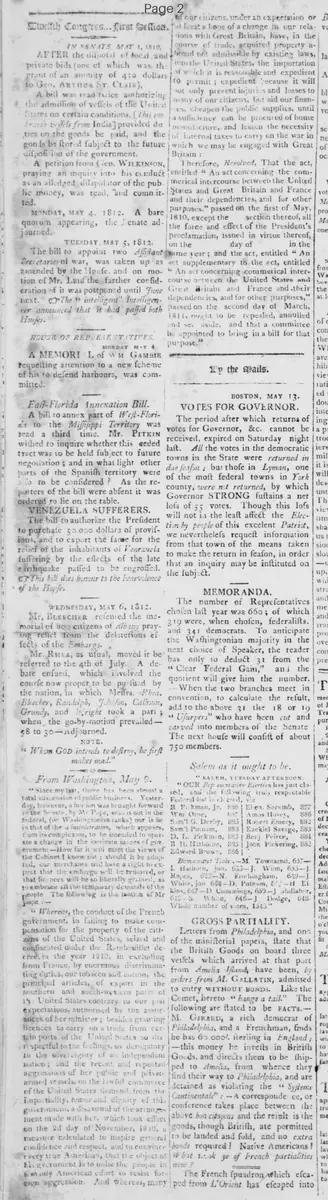
AFTER the disposal of sundry local and private bills (one of which was the grant of an annuity of $2000 dollars to Gen. ARMSTRONG (LAIR)), a bill was read twice authorizing the admission of vessels of the United States on certain conditions. This embraces vessels from India, provided duties on the goods be paid, and the goods be stored subject to the future disposition of the government.
A petition from Gen. WILKINSON, praying an inquiry into his conduct as an alleged dilapidator of the public money, was read, and committed.
MONDAY, MAY 4, 1812. A bare quorum appearing, the Senate adjourned.
TUESDAY, MAY 5, 1812.
The bill to appoint two Assistant Secretaries of war, was taken up as amended by the House, and on motion of Mr. Giles the further consideration of it was postponed until June next. The "intelligent" Intelligencer announced that it had passed both Houses.
HOUSE OF REPRESENTATIVES.
MONDAY MAY 4
A MEMORIAL OF WM GAMBIE requesting attention to a new scheme of his to defend harbours, was committed.
East-Florida Annexation Bill.
A bill to annex part of West-Florida to the Mississippi Territory was read a third time. Mr. PINKNEY wished to inquire whether this ceded tract was to be held subject to future negotiation; and in what light other parts of the Spanish territory were to be considered? As the reporters of the bill were absent it was ordered to lie on the table.
VENEZUELA SUFFERERS.
The bill to authorize the President to purchase 5000 dollars of provisions, and to export the same for the relief of the inhabitants of Venezuela suffering by the effects of the late earthquake passed to be engrossed.
This bill does honor to the benevolence of the House.
WEDNESDAY, MAY 6, 1812.
Mr. BLEECHER presented the memorial of 800 citizens of Albany, praying relief from the deleterious effects of the Embargo.
Mr. RUSS, as usual, moved it be referred to the 4th of July. A debate ensued, which involved the course now proper to be pursued by the nation, in which Messrs. Phea, Bleecker, Randolph, Johnson, Calhoun, Grundy, and Wright took a part; when the go-by-motion prevailed—98 to 30—Adjourned.
NOTE.
"Whom God intends to destroy, he first makes mad."
From Washington, May 9.
"Since last, there has been almost a total suspension of public business. Yesterday, however, a motion was brought forward in the Senate, by Mr. Pope, who is not in the federal, (or Washingtonian) ranks nor is he in that of the administration, which appears, from its complexion, to be intended to operate a change in the intricate mazes of government—How far it will meet the views of the Cabinet I know not; should it be adopted, our merchants will have a right to expect that the embargo will be removed, or that licenses will be so liberally granted, as to embrace all the temporary demands of the people. The following is the motion of Mr. Pope:-
"Whereas, the conduct of the French government, in failing to make compensation for the property of the citizens of the United States, seized and confiscated under the Rambouillet decree, in the year 1810, in excluding from France, by enormous discriminating duties, our tobacco and cotton, the principal articles of export in the southern and south-western parts of the United States contrary to our just expectations, authorized by the assurances of her minister; besides granting licenses to carry on a trade from certain ports of the United States so disrespectful to the feelings, so derogatory to the sovereignty of an independent nation; and the recent and repeated aggressions of her public and private armed vessels, on the infant commerce of the United States demand, from the impartiality, honor and dignity of this government, a disavowal of the arrangement made with her, which took effect on the 2d day of November, 1810, a measure calculated to inspire general confidence and respect, and to convince every true American, that the object of this government is to unite the people in a manly American effort to resist foreign aggression. And whereas, many of our citizens, under an expectation of at least a hope of a change in our relations with Great Britain, have, in the course of trade, acquired property abroad not admissible by existing laws, into the United States, the importation of which it is reasonable and expedient to permit; expedient because it will not only prevent injuries and losses to many of our citizens, but aid our finances, cheapen the public supplies, until a sufficient supply can be procured of home manufacture, and lessen the necessity of internal taxes to carry on the war in which we may be engaged with Great Britain:
Therefore, Resolved, That the act, entitled "An act concerning the commercial intercourse between the United States and Great Britain and France and their dependencies, and for other purposes," passed on the first of May, 1810, except the section thereof, all the force and effect of the President's proclamation, issued in virtue thereof, on the day of in the same year; and the act, entitled "An act supplementary to the act, entitled 'An act concerning commercial intercourse between the United States and Great Britain and France and their dependencies, and for other purposes,' passed on the second day of March, 1811, ought to be repealed, annulled and set aside, and that a committee be appointed to bring in a bill for that purpose."
What sub-type of article is it?
What keywords are associated?
What entities or persons were involved?
Where did it happen?
Domestic News Details
Primary Location
Washington
Event Date
May 1 9, 1812
Key Persons
Outcome
various bills read, committed, postponed, or passed; motions debated and prevailed; petition for embargo relief defeated 98-30; motion to repeal commercial acts proposed.
Event Details
Congressional sessions in Senate and House addressed local bills, annuity grants, vessel admissions, official conduct inquiries, war secretary appointments, harbor defense memorials, Florida annexation, Venezuela earthquake relief provisions, embargo effects petitions, and a Senate motion by Mr. Pope to repeal 1810 and 1811 commercial intercourse acts with Britain and France due to French aggressions.