Thank you for visiting SNEWPapers!
Sign up free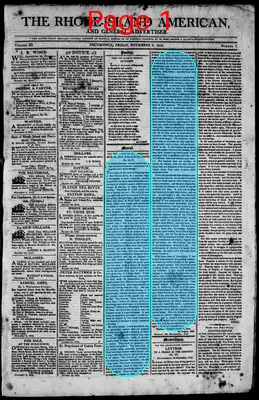
Literary
November 9, 1810
The Rhode Island American, And General Advertiser
Providence, Providence County, Rhode Island
What is this article about?
President Dwight's 1810 charity sermon praises New-Haven women's benevolent societies for relieving poverty and preventing vice through schools, especially for black girls. It argues that emancipation alone is insufficient; society must provide education and moral guidance to former slaves and their descendants to fulfill ancestral debts and promote true liberty.
Clipping
OCR Quality
95%
Excellent
Full Text
FOR THE RHODE-ISLAND AMERICAN.
MORAL AND RELIGIOUS HINTS.
No. XLIV.
The Female Character adorned with its fairest, highest, richest ornaments; and arrayed with angelick lustre and loveliness!
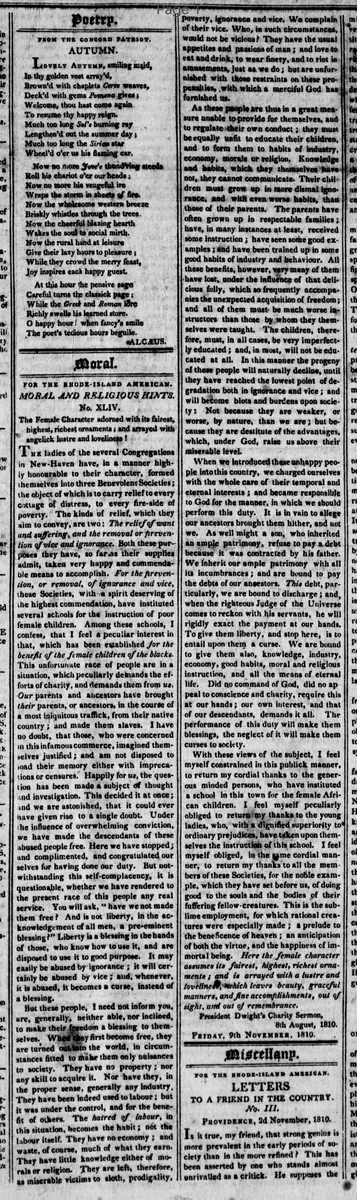
The ladies of the several Congregations in New-Haven have, in a manner highly honourable to their character, formed themselves into three Benevolent Societies; the object of which is to carry relief to every Cottage of distress, to every fire-side of poverty. The kinds of relief, which they aim to convey, are two: The relief of want and suffering, and the removal or prevention of vice and ignorance. Both these purposes they have, so far as their supplies admit, taken very happy and commendable means to accomplish. For the prevention, or removal, of ignorance and vice, these Societies, with a spirit deserving of the highest commendation, have instituted several schools for the instruction of poor female children. Among these schools, I confess, that I feel a peculiar interest in that, which has been established for the benefit of the female children of the blacks. This unfortunate race of people are in a situation, which peculiarly demands the efforts of charity, and demands them from us. Our parents and ancestors have brought their parents, or ancestors, in the course of a most iniquitous traffick, from their native country; and made them slaves. I have no doubt, that those, who were concerned in this infamous commerce, imagined themselves justified; and am not disposed to load their memory either with imprecations or censures. Happily for us, the question has been made a subject of thought and investigation. This decided it at once; and we are astonished, that it could ever have given rise to a single doubt. Under the influence of overwhelming conviction, we have made the descendants of these abused people free. Here we have stopped; and complimented, and congratulated ourselves for having done our duty. But notwithstanding this self-complacency, it is questionable, whether we have rendered to the present race of this people any real service. You will ask, "have we not made them free? And is not liberty, in the acknowledgement of all men, a pre-eminent blessing?" Liberty is a blessing in the hands of those, who know how to use it, and are disposed to use it to good purpose. It may easily be abused by ignorance; it will certainly be abused by vice; and, whenever, it is abused, it becomes a curse, instead of a blessing. But these people, I need not inform you, are, generally, neither able, nor inclined, to make their freedom a blessing to themselves. When they first become free, they are turned out into the world, in circumstances fitted to make them only nuisances to society. They have no property; nor any skill to acquire it. Nor have they, in the proper sense, generally any industry. They have been indeed used to labour; but it was under the control, and for the benefit of others. The hatred of labour, in this situation, becomes the habit; not the labour itself. They have no economy; and waste, of course, much of what they earn. They have little knowledge either of morals or religion. They are left, therefore, as miserable victims to sloth, prodigality, poverty, ignorance and vice. We complain of their vice. Who, in such circumstances, would not be vicious? They have the usual appetites and passions of man; and love to eat and drink, to wear finery, and to riot in amusements, just as we do; but are unfurnished with those restraints on these propensities, with which a merciful God has furnished us. As these people are thus in a great measure unable to provide for themselves, and to regulate their own conduct; they must be equally unfit to educate their children, and to form them to habits of industry, economy, morals or religion. Knowledge and habits, which they themselves have not, they cannot communicate. Their children must grow up in more dismal ignorance, and with even worse habits, than those of their parents. The parents have often grown up in respectable families; have, in many instances at least, received some instruction; have seen some good examples; and have been trained up in some good habits of industry and behaviour. All these benefits, however, very many of them have lost, under the influence of that delicious folly, which so frequently accompanies the unexpected acquisition of freedom; and all of them must be much worse instructors than those by whom they themselves were taught. The children, therefore, must, in all cases, be very imperfectly educated; and, in most, will not be educated at all. In this manner the progeny of these people will naturally decline, until they have reached the lowest point of degradation both in ignorance and vice; and will become blots and burdens upon society: Not because they are weaker, or worse, by nature, than we are; but because they are destitute of the advantages, which, under God, raise us above their miserable level. When we introduced these unhappy people into this country, we charged ourselves with the whole care of their temporal and eternal interests; and became responsible to God for the manner, in which we should perform this duty. It is in vain to allege our ancestors brought them hither, and not we. As well might a son, who inherited an ample patrimony, refuse to pay a debt because it was contracted by his father. We inherit our ample patrimony with all its incumbrances; and are bound to pay the debts of our ancestors. This debt, particularly, we are bound to discharge; and when the righteous Judge of the Universe comes to reckon with his servants, he will rigidly exact the payment at our hands. To give them liberty, and stop here, is to entail upon them a curse. We are bound to give them also, knowledge, industry, economy, good habits, moral and religious instruction, and all the means of eternal life. Did no command of God, did no appeal to conscience and charity, require this at our hands; our own interest, and that of our descendants, demands it all. The performance of this duty will make them blessings, the neglect of it will make them curses to society. With these views of the subject, I feel myself constrained in this publick manner, to return my cordial thanks to the generous minded persons, who have instituted a school in this town for the female African children. I feel myself peculiarly obliged to return my thanks to the young ladies, who, with a dignified superiority to ordinary prejudices, have taken upon themselves the instruction of this school. I feel myself obliged, in the same cordial manner, to return my thanks to all the members of these Societies, for the noble example, which they have set before us, of doing good to the souls and the bodies of their suffering fellow-Creatures. This is the sublime employment, for which rational creatures were especially made; a prelude to the beneficence of heaven; an anticipation of both the virtue, and the happiness of immortal being. Here the female character assumes its fairest, highest, richest ornaments; and is arrayed with a lustre and loveliness which leaves beauty, graceful manners, and fine accomplishments, out of sight, and out of remembrance.
President Dwight's Charity Sermon, 8th August, 1810.
MORAL AND RELIGIOUS HINTS.
No. XLIV.
The Female Character adorned with its fairest, highest, richest ornaments; and arrayed with angelick lustre and loveliness!
The ladies of the several Congregations in New-Haven have, in a manner highly honourable to their character, formed themselves into three Benevolent Societies; the object of which is to carry relief to every Cottage of distress, to every fire-side of poverty. The kinds of relief, which they aim to convey, are two: The relief of want and suffering, and the removal or prevention of vice and ignorance. Both these purposes they have, so far as their supplies admit, taken very happy and commendable means to accomplish. For the prevention, or removal, of ignorance and vice, these Societies, with a spirit deserving of the highest commendation, have instituted several schools for the instruction of poor female children. Among these schools, I confess, that I feel a peculiar interest in that, which has been established for the benefit of the female children of the blacks. This unfortunate race of people are in a situation, which peculiarly demands the efforts of charity, and demands them from us. Our parents and ancestors have brought their parents, or ancestors, in the course of a most iniquitous traffick, from their native country; and made them slaves. I have no doubt, that those, who were concerned in this infamous commerce, imagined themselves justified; and am not disposed to load their memory either with imprecations or censures. Happily for us, the question has been made a subject of thought and investigation. This decided it at once; and we are astonished, that it could ever have given rise to a single doubt. Under the influence of overwhelming conviction, we have made the descendants of these abused people free. Here we have stopped; and complimented, and congratulated ourselves for having done our duty. But notwithstanding this self-complacency, it is questionable, whether we have rendered to the present race of this people any real service. You will ask, "have we not made them free? And is not liberty, in the acknowledgement of all men, a pre-eminent blessing?" Liberty is a blessing in the hands of those, who know how to use it, and are disposed to use it to good purpose. It may easily be abused by ignorance; it will certainly be abused by vice; and, whenever, it is abused, it becomes a curse, instead of a blessing. But these people, I need not inform you, are, generally, neither able, nor inclined, to make their freedom a blessing to themselves. When they first become free, they are turned out into the world, in circumstances fitted to make them only nuisances to society. They have no property; nor any skill to acquire it. Nor have they, in the proper sense, generally any industry. They have been indeed used to labour; but it was under the control, and for the benefit of others. The hatred of labour, in this situation, becomes the habit; not the labour itself. They have no economy; and waste, of course, much of what they earn. They have little knowledge either of morals or religion. They are left, therefore, as miserable victims to sloth, prodigality, poverty, ignorance and vice. We complain of their vice. Who, in such circumstances, would not be vicious? They have the usual appetites and passions of man; and love to eat and drink, to wear finery, and to riot in amusements, just as we do; but are unfurnished with those restraints on these propensities, with which a merciful God has furnished us. As these people are thus in a great measure unable to provide for themselves, and to regulate their own conduct; they must be equally unfit to educate their children, and to form them to habits of industry, economy, morals or religion. Knowledge and habits, which they themselves have not, they cannot communicate. Their children must grow up in more dismal ignorance, and with even worse habits, than those of their parents. The parents have often grown up in respectable families; have, in many instances at least, received some instruction; have seen some good examples; and have been trained up in some good habits of industry and behaviour. All these benefits, however, very many of them have lost, under the influence of that delicious folly, which so frequently accompanies the unexpected acquisition of freedom; and all of them must be much worse instructors than those by whom they themselves were taught. The children, therefore, must, in all cases, be very imperfectly educated; and, in most, will not be educated at all. In this manner the progeny of these people will naturally decline, until they have reached the lowest point of degradation both in ignorance and vice; and will become blots and burdens upon society: Not because they are weaker, or worse, by nature, than we are; but because they are destitute of the advantages, which, under God, raise us above their miserable level. When we introduced these unhappy people into this country, we charged ourselves with the whole care of their temporal and eternal interests; and became responsible to God for the manner, in which we should perform this duty. It is in vain to allege our ancestors brought them hither, and not we. As well might a son, who inherited an ample patrimony, refuse to pay a debt because it was contracted by his father. We inherit our ample patrimony with all its incumbrances; and are bound to pay the debts of our ancestors. This debt, particularly, we are bound to discharge; and when the righteous Judge of the Universe comes to reckon with his servants, he will rigidly exact the payment at our hands. To give them liberty, and stop here, is to entail upon them a curse. We are bound to give them also, knowledge, industry, economy, good habits, moral and religious instruction, and all the means of eternal life. Did no command of God, did no appeal to conscience and charity, require this at our hands; our own interest, and that of our descendants, demands it all. The performance of this duty will make them blessings, the neglect of it will make them curses to society. With these views of the subject, I feel myself constrained in this publick manner, to return my cordial thanks to the generous minded persons, who have instituted a school in this town for the female African children. I feel myself peculiarly obliged to return my thanks to the young ladies, who, with a dignified superiority to ordinary prejudices, have taken upon themselves the instruction of this school. I feel myself obliged, in the same cordial manner, to return my thanks to all the members of these Societies, for the noble example, which they have set before us, of doing good to the souls and the bodies of their suffering fellow-Creatures. This is the sublime employment, for which rational creatures were especially made; a prelude to the beneficence of heaven; an anticipation of both the virtue, and the happiness of immortal being. Here the female character assumes its fairest, highest, richest ornaments; and is arrayed with a lustre and loveliness which leaves beauty, graceful manners, and fine accomplishments, out of sight, and out of remembrance.
President Dwight's Charity Sermon, 8th August, 1810.
What sub-type of article is it?
Essay
What themes does it cover?
Slavery Abolition
Moral Virtue
Religious
What keywords are associated?
Benevolent Societies
Female Character
African Children Education
Slavery Legacy
Moral Duty
Charity Sermon
What entities or persons were involved?
President Dwight
Literary Details
Title
Moral And Religious Hints. No. Xliv.
Author
President Dwight
Subject
Charity Sermon On Benevolent Societies And Education Of Poor And Black Female Children
Key Lines
The Ladies Of The Several Congregations In New Haven Have, In A Manner Highly Honourable To Their Character,Formed Themselves Into Three Benevolent Societies; The Object Of Which Is To Carry Relief To Every Cottage Of Distress, To Every Fire Side Of Poverty.
This Unfortunate Race Of People Are In A Situation, Which Peculiarly Demands The Efforts Of Charity, And Demands Them From Us.
To Give Them Liberty, And Stop Here, Is To Entail Upon Them A Curse. We Are Bound To Give Them Also, Knowledge, Industry, Economy, Good Habits, Moral And Religious Instruction, And All The Means Of Eternal Life.