Thank you for visiting SNEWPapers!
Sign up free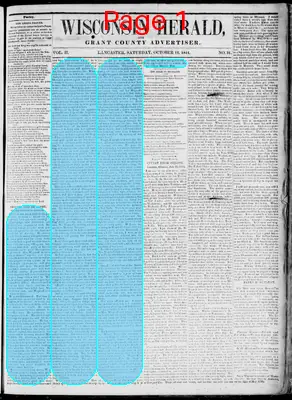
Literary
October 12, 1844
Wisconsin Herald, And Grant County Advertiser
Lancaster, Grant County, Wisconsin
What is this article about?
Satirical prose sketch depicting Mr. Wagstaff, a jovial but hypocritical husband who neglects his devoted wife Arabella and family for club socializing, while she endures with unwavering love and makes do at home.
Clipping
OCR Quality
75%
Good
Full Text
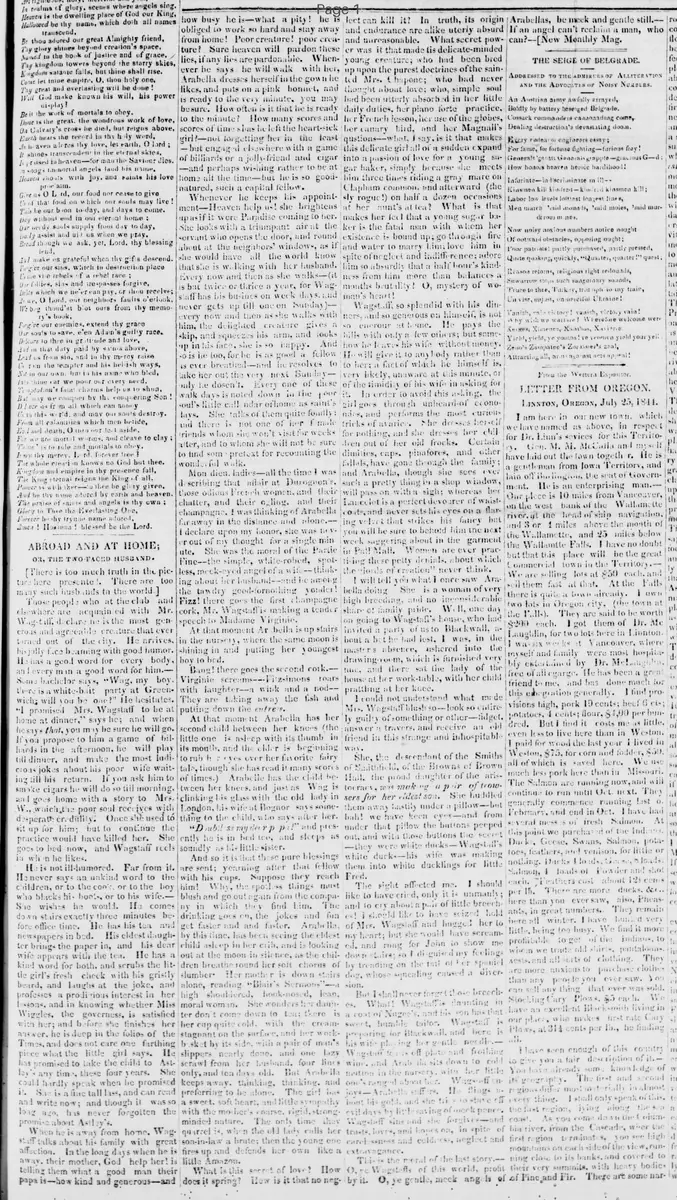
ABROAD AND AT HOME:
OR, THE TWO-FACED HUSBAND.
[There is too much truth in the picture here presented. There are too many such husbands to the world.]
Those people who at the club and elsewhere are acquainted with Mr. Wagstaff, declare he is the most generous and agreeable creature that ever tired of the city. He arrives, his jolly face beaming with good humor. He has a good word for everybody, and every man a good word for him.—Some bachelor says, "Wag, my boy, there is a white-bait party at Greenwich: will you be one?" he hesitates. "I promised Mrs. Wagstaff to be at home at dinner," says he; and when he says that, you may be sure he will go. If you propose to him a game of billiards in the afternoon, he will play till dinner, and make the most ludicrous jokes about his poor wife waiting till his return. If you ask him to smoke cigars he will do so till morning, and goes home with a story to Mrs. W., which the poor soul receives with desperate credulity: Once she used to sit up for him; but to continue the practice would have killed her. She goes to bed now, and Wagstaff reels in when he likes.
He is not ill-humored. Far from it. He never says an unkind word to the children, or to the cook, or to the boy who blacks his boots, or to his wife.—She wishes he would. He comes down stairs exactly three minutes before office time. He has his tea and newspapers in bed. His eldest daughter brings the paper in, and his dear wife appears with the tea. He has a kind word for both, and scrubs the little girl's fresh cheek with his gristly beard, and laughs at the joke, and professes a prodigious interest in her lessons, and in knowing whether Miss Wiggles, the governess, is satisfied with her; and before she finishes her answer, he is deep in the folio of the Times, and does not care one farthing piece what the little girl says. He has promised to take the child to Astley's time these four years. She could hardly speak when he promised it. She is a fine tall lass, and can read and write now; and though it was so long ago, he has never forgotten the promise about Astley's.
When he is away from home. Wagstaff talks about his family with great affection. In the long days when he is away, their mother, God help her! is telling them what a good man their papa is—how kind and generous—and how busy he is—what a pity! he is obliged to work so hard and stay away from home! Poor creature! poor creature! Sure heaven will pardon these lies, if any lies are pardonable. Whenever he says he will walk with her, Arabella dresses herself in the gown he likes, and puts on a pink bonnet, and is ready to the very minute, you may be sure. How often is it that he is ready to the minute? How many scores and scores of time has he left the heart-sick girl?—not forgetting her in the least—but engaged elsewhere with a game of billiards or a jolly friend and cigar—and perhaps wishing rather to be at home all the time—but he is so good-natured, such a capital fellow.
Whenever he keeps his appointment—Heaven help us! she brightens up as if it were Paradise coming to her. She looks with a triumphant air at the servant who opens the door, and round about at the neighbors' windows, as if she would have all the world know that she is walking with her husband. Every now and then as she walks—(it is but twice or thrice a year, for Wagstaff has his business on week days, and never gets up till one on Sunday)—every now and then as she walks with him, the delighted creature gives a skip, and squeezes his arm, and looks up in his face, she is so happy. And so is he too, for he is as good a fellow as ever breathed—and he resolves to take her out the very next Sunday—only he doesn't. Every one of these walk days is noted down in the poor soul's little calendar at home as saint's days. She talks of them quite fondly: and there is not one of her female friends whom she won't visit for weeks after, and to whom she will not be sure to find some pretext for recounting the wonderful walk.
Mon Dieu, ladies—all the time I was describing that affair at Drouet's, those odious French women, and their chatter, and their ogling, and their champagne, I was thinking of Arabella far away in the distance and alone.—I declare upon my honor, she was the crowd of my thought for a single minute. She was the moral of the Parisian fete—the simple, white-robed, spotless, meek-eyed angel of a wife—thinking about her husband—and he among the tawdry good-for-nothing squanderers! Fizz! there goes the first champagne cork. Mr. Wagstaff is making a tender speech to Madame Virginie.
At that moment Arabella is up stairs in the nursery, where the same moon is shining in and putting her youngest boy to bed. Bang! there goes the second cork.—Virginie screams—Fitz-simons roars with laughter—a wink and a nod—They are taking away the fish and putting down the entrées.
At that moment Arabella has her second child between her knees (the little one is asleep with its thumb in its mouth, and the elder is beginning to rub her eyes over her favorite fairy tale, though she has read it many scores of times.) Arabella has the child between her knees, and just as Wag is clinking his glass with the old lady in London, his wife at Bognor says something to the child, who says after her, "God bless my dear pa!" and peevishly he is in bed, and sleeps as soundly as his little sister.
And so it is that those pure blessings are sent; yearning after that fellow with his cups. Suppose they reach him! Why, the spotless things must blush and go out again from the company in which they find him. The drinking goes on, the jokes and fun get faster and faster. Arabella, by this time, has been tucking the last child asleep in her crib, and is looking out at the moon in silence, as the children breathe round her soft chorus of slumber. Her mother is down stairs alone, reading "Blair's Sermons"—a high shouldered, hook-nosed, lean, moral woman. She wonders: daughter don't come down to tea: there is her cup quite cold, with the cream stagnant on the surface, and her work basket by its side, with a pair of man's slippers nearly done, and one lazy scrawl from her husband, four lines only, and ten days old. But Arabella keeps away, thinking, thanking, and preferring to be alone. The girl has a sweet, soft heart, and little sympathy with the mother's coarse, rigid, strong minded nature. The only time they quarrel is, when the old lady calls her son-in-law a brute; then the young one fires up and defends her own like a little Amazon.
What is this secret of love? How does it spring? How is it that no neglect can kill it? In truth, its origin and endurance are alike utterly absurd and unreasonable. What secret power was it that made this delicate-minded young creature; who had been bred up upon the purest doctrines of the sainted Mrs. Chapone; who had never thought about love; who, simple soul had been utterly absorbed in her little daily duties, her piano forte practice, her French lesson, her use of the globes, her canary bird, and her Mangnall's questions—what, I say, is it that makes this delicate girl all of a sudden expand into a passion of love for a young sugar baker, simply because she meets him three times riding a gray mare on Clapham common, and afterward (the sly rogue!) on half a dozen occasions at her aunt's at tea? What is that makes her feel that a young sugar baker is the fatal man with whom her existence is bound up; go through fire and water to marry him: love him in spite of neglect and indifference: adore him so absurdly that a half hour's kindness from him more than balances a month's brutality? O, mystery of woman's heart!
Wagstaff, so splendid with his dinners, and so generous on himself, is not so generous at home. He pays the bills with only a few others; but somehow he leaves his wife without money. He will give it to anybody rather than to her: a fact of which he himself is, very likely, unaware at this minute, or of the timidity of his wife in asking for it. In order to avoid this asking, the girl goes through unheard-of economies, and performs the most curious tricks of artifice. She dresses herself for nothing, and she dresses her children out of her old frocks. Certain dimities, caps, pinafores, and other fallals, have gone through the family: and Arabella, though she sees ever such a pretty thing in a shop window, will pass on with a sigh; whereas her Lancelot is a perfect devourer of waistcoats, and never sets his eyes on a flaring velvet that strikes his fancy but you will be sure to behold him the next week saggering about in the garment in Pall Mall. Women are ever practicing these petty denials, about which the "lords of creation" never think.
I will tell you what I once saw Arabella doing. She is a woman of very high breeding, and no inconsiderable share of family pride. Well, one day on going to Wagstaff's house, who had invited a party of us to Blackwall, about a bet he had lost, I was, in the master's absence, ushered into the drawing-room, which is furnished very a la mode, and there sat the lady of the house at her work-table, with her child prattling at her knee. I could not understand what made Mrs. Wagstaff blush so—look so entirely guilty of something or other—fidget, answer evasively, and receive an old friend in this strange and inhospitable way.
She, the descendant of the Smiths of Smithy Hall, eldest of the Browns of Brown Hall, the proud daughter of the aristocrats, was making a pair of trousers for her eldest son. She huddled them away hastily under a pillow—but bah! we have keen eyes—and from under that pillow the buttons peeped out, and with those buttons the secret—they were white ducks—Wagstaff's white ducks—his wife was making them into white ducklings for little Fred.
The sight affected me. I should like to have cried, only it is unmanly: and to cry about a pair of little breeches! I simply like to have seized hold of Mrs. Wagstaff and hugged her to my heart: but she would have screamed, and rung for John to show me down stairs so I disguised my feelings by treading on the tail of her spaniel dog, whose yelling caused a diversion.
But I shall never forget one breeches episode. What! Wagstaff strutting in a coat of Nugee's and his son have that short, humble tunic, Wagstaff is preparing for Blackwall, and here is his wife making her grand needle.—Wagstaff orders all out tea and foaming wine, and Arabella sits down to cold mutton in the nursery, with her little one ranging about her, Wagstaff on Jove-Arabella, -F r, H. diogen bong his golf, and she tries to stave off cold at by little easing of meck pence. Wagstaff sins and the forgive-and trust, love, and Lois op. in spite of care sneee and cold es, neglect and extravagance.
This the real of the last story.—O, ye Wagstaffs of this world, profit by it. O, ye gentle, meek and Is of Arabellas, be meek and gentle still.—If an angel can't reclaim a man, who can?—[New Monthly Mag.
OR, THE TWO-FACED HUSBAND.
[There is too much truth in the picture here presented. There are too many such husbands to the world.]
Those people who at the club and elsewhere are acquainted with Mr. Wagstaff, declare he is the most generous and agreeable creature that ever tired of the city. He arrives, his jolly face beaming with good humor. He has a good word for everybody, and every man a good word for him.—Some bachelor says, "Wag, my boy, there is a white-bait party at Greenwich: will you be one?" he hesitates. "I promised Mrs. Wagstaff to be at home at dinner," says he; and when he says that, you may be sure he will go. If you propose to him a game of billiards in the afternoon, he will play till dinner, and make the most ludicrous jokes about his poor wife waiting till his return. If you ask him to smoke cigars he will do so till morning, and goes home with a story to Mrs. W., which the poor soul receives with desperate credulity: Once she used to sit up for him; but to continue the practice would have killed her. She goes to bed now, and Wagstaff reels in when he likes.
He is not ill-humored. Far from it. He never says an unkind word to the children, or to the cook, or to the boy who blacks his boots, or to his wife.—She wishes he would. He comes down stairs exactly three minutes before office time. He has his tea and newspapers in bed. His eldest daughter brings the paper in, and his dear wife appears with the tea. He has a kind word for both, and scrubs the little girl's fresh cheek with his gristly beard, and laughs at the joke, and professes a prodigious interest in her lessons, and in knowing whether Miss Wiggles, the governess, is satisfied with her; and before she finishes her answer, he is deep in the folio of the Times, and does not care one farthing piece what the little girl says. He has promised to take the child to Astley's time these four years. She could hardly speak when he promised it. She is a fine tall lass, and can read and write now; and though it was so long ago, he has never forgotten the promise about Astley's.
When he is away from home. Wagstaff talks about his family with great affection. In the long days when he is away, their mother, God help her! is telling them what a good man their papa is—how kind and generous—and how busy he is—what a pity! he is obliged to work so hard and stay away from home! Poor creature! poor creature! Sure heaven will pardon these lies, if any lies are pardonable. Whenever he says he will walk with her, Arabella dresses herself in the gown he likes, and puts on a pink bonnet, and is ready to the very minute, you may be sure. How often is it that he is ready to the minute? How many scores and scores of time has he left the heart-sick girl?—not forgetting her in the least—but engaged elsewhere with a game of billiards or a jolly friend and cigar—and perhaps wishing rather to be at home all the time—but he is so good-natured, such a capital fellow.
Whenever he keeps his appointment—Heaven help us! she brightens up as if it were Paradise coming to her. She looks with a triumphant air at the servant who opens the door, and round about at the neighbors' windows, as if she would have all the world know that she is walking with her husband. Every now and then as she walks—(it is but twice or thrice a year, for Wagstaff has his business on week days, and never gets up till one on Sunday)—every now and then as she walks with him, the delighted creature gives a skip, and squeezes his arm, and looks up in his face, she is so happy. And so is he too, for he is as good a fellow as ever breathed—and he resolves to take her out the very next Sunday—only he doesn't. Every one of these walk days is noted down in the poor soul's little calendar at home as saint's days. She talks of them quite fondly: and there is not one of her female friends whom she won't visit for weeks after, and to whom she will not be sure to find some pretext for recounting the wonderful walk.
Mon Dieu, ladies—all the time I was describing that affair at Drouet's, those odious French women, and their chatter, and their ogling, and their champagne, I was thinking of Arabella far away in the distance and alone.—I declare upon my honor, she was the crowd of my thought for a single minute. She was the moral of the Parisian fete—the simple, white-robed, spotless, meek-eyed angel of a wife—thinking about her husband—and he among the tawdry good-for-nothing squanderers! Fizz! there goes the first champagne cork. Mr. Wagstaff is making a tender speech to Madame Virginie.
At that moment Arabella is up stairs in the nursery, where the same moon is shining in and putting her youngest boy to bed. Bang! there goes the second cork.—Virginie screams—Fitz-simons roars with laughter—a wink and a nod—They are taking away the fish and putting down the entrées.
At that moment Arabella has her second child between her knees (the little one is asleep with its thumb in its mouth, and the elder is beginning to rub her eyes over her favorite fairy tale, though she has read it many scores of times.) Arabella has the child between her knees, and just as Wag is clinking his glass with the old lady in London, his wife at Bognor says something to the child, who says after her, "God bless my dear pa!" and peevishly he is in bed, and sleeps as soundly as his little sister.
And so it is that those pure blessings are sent; yearning after that fellow with his cups. Suppose they reach him! Why, the spotless things must blush and go out again from the company in which they find him. The drinking goes on, the jokes and fun get faster and faster. Arabella, by this time, has been tucking the last child asleep in her crib, and is looking out at the moon in silence, as the children breathe round her soft chorus of slumber. Her mother is down stairs alone, reading "Blair's Sermons"—a high shouldered, hook-nosed, lean, moral woman. She wonders: daughter don't come down to tea: there is her cup quite cold, with the cream stagnant on the surface, and her work basket by its side, with a pair of man's slippers nearly done, and one lazy scrawl from her husband, four lines only, and ten days old. But Arabella keeps away, thinking, thanking, and preferring to be alone. The girl has a sweet, soft heart, and little sympathy with the mother's coarse, rigid, strong minded nature. The only time they quarrel is, when the old lady calls her son-in-law a brute; then the young one fires up and defends her own like a little Amazon.
What is this secret of love? How does it spring? How is it that no neglect can kill it? In truth, its origin and endurance are alike utterly absurd and unreasonable. What secret power was it that made this delicate-minded young creature; who had been bred up upon the purest doctrines of the sainted Mrs. Chapone; who had never thought about love; who, simple soul had been utterly absorbed in her little daily duties, her piano forte practice, her French lesson, her use of the globes, her canary bird, and her Mangnall's questions—what, I say, is it that makes this delicate girl all of a sudden expand into a passion of love for a young sugar baker, simply because she meets him three times riding a gray mare on Clapham common, and afterward (the sly rogue!) on half a dozen occasions at her aunt's at tea? What is that makes her feel that a young sugar baker is the fatal man with whom her existence is bound up; go through fire and water to marry him: love him in spite of neglect and indifference: adore him so absurdly that a half hour's kindness from him more than balances a month's brutality? O, mystery of woman's heart!
Wagstaff, so splendid with his dinners, and so generous on himself, is not so generous at home. He pays the bills with only a few others; but somehow he leaves his wife without money. He will give it to anybody rather than to her: a fact of which he himself is, very likely, unaware at this minute, or of the timidity of his wife in asking for it. In order to avoid this asking, the girl goes through unheard-of economies, and performs the most curious tricks of artifice. She dresses herself for nothing, and she dresses her children out of her old frocks. Certain dimities, caps, pinafores, and other fallals, have gone through the family: and Arabella, though she sees ever such a pretty thing in a shop window, will pass on with a sigh; whereas her Lancelot is a perfect devourer of waistcoats, and never sets his eyes on a flaring velvet that strikes his fancy but you will be sure to behold him the next week saggering about in the garment in Pall Mall. Women are ever practicing these petty denials, about which the "lords of creation" never think.
I will tell you what I once saw Arabella doing. She is a woman of very high breeding, and no inconsiderable share of family pride. Well, one day on going to Wagstaff's house, who had invited a party of us to Blackwall, about a bet he had lost, I was, in the master's absence, ushered into the drawing-room, which is furnished very a la mode, and there sat the lady of the house at her work-table, with her child prattling at her knee. I could not understand what made Mrs. Wagstaff blush so—look so entirely guilty of something or other—fidget, answer evasively, and receive an old friend in this strange and inhospitable way.
She, the descendant of the Smiths of Smithy Hall, eldest of the Browns of Brown Hall, the proud daughter of the aristocrats, was making a pair of trousers for her eldest son. She huddled them away hastily under a pillow—but bah! we have keen eyes—and from under that pillow the buttons peeped out, and with those buttons the secret—they were white ducks—Wagstaff's white ducks—his wife was making them into white ducklings for little Fred.
The sight affected me. I should like to have cried, only it is unmanly: and to cry about a pair of little breeches! I simply like to have seized hold of Mrs. Wagstaff and hugged her to my heart: but she would have screamed, and rung for John to show me down stairs so I disguised my feelings by treading on the tail of her spaniel dog, whose yelling caused a diversion.
But I shall never forget one breeches episode. What! Wagstaff strutting in a coat of Nugee's and his son have that short, humble tunic, Wagstaff is preparing for Blackwall, and here is his wife making her grand needle.—Wagstaff orders all out tea and foaming wine, and Arabella sits down to cold mutton in the nursery, with her little one ranging about her, Wagstaff on Jove-Arabella, -F r, H. diogen bong his golf, and she tries to stave off cold at by little easing of meck pence. Wagstaff sins and the forgive-and trust, love, and Lois op. in spite of care sneee and cold es, neglect and extravagance.
This the real of the last story.—O, ye Wagstaffs of this world, profit by it. O, ye gentle, meek and Is of Arabellas, be meek and gentle still.—If an angel can't reclaim a man, who can?—[New Monthly Mag.
What sub-type of article is it?
Prose Fiction
Satire
What themes does it cover?
Social Manners
Moral Virtue
Love Romance
What keywords are associated?
Hypocritical Husband
Devoted Wife
Marital Neglect
Family Life
Satirical Sketch
Literary Details
Title
Abroad And At Home: Or, The Two Faced Husband.
Subject
Satire On The Hypocritical Husband And Devoted Wife
Key Lines
He Has Promised To Take The Child To Astley's Time These Four Years. She Could Hardly Speak When He Promised It. She Is A Fine Tall Lass, And Can Read And Write Now; And Though It Was So Long Ago, He Has Never Forgotten The Promise About Astley's.
O, Mystery Of Woman's Heart!
The Sight Affected Me. I Should Like To Have Cried, Only It Is Unmanly: And To Cry About A Pair Of Little Breeches!