Thank you for visiting SNEWPapers!
Sign up free
Daily National Intelligencer
Washington, District Of Columbia
What is this article about?
Boundary commissioners from the US and Britain, appointed under the Treaty of Ghent, will meet on September 15 at St. Andrews, New Brunswick, to decide ownership of islands in Passamaquoddy and Fundy Bays. Key figures include US commissioner John Holmes and agent James T. Austin; British commissioner Thomas Barclay and agent Ward Chipman. The decision could impact fishing, trade, and frontier relations.
Clipping
OCR Quality
Full Text
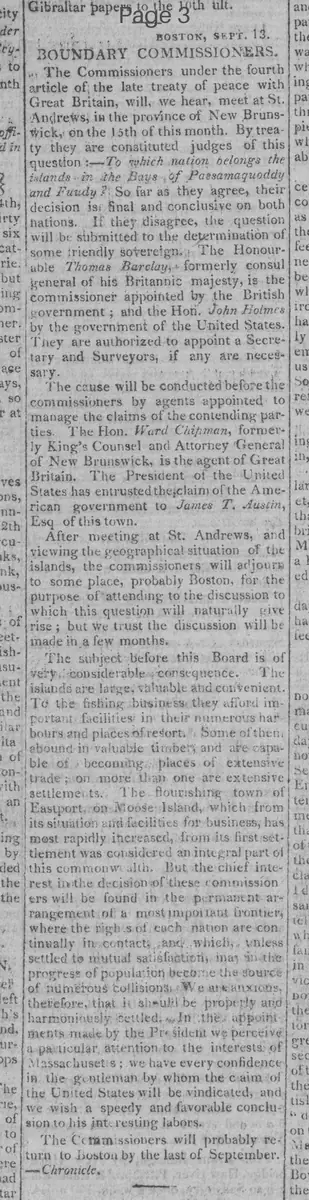
BOUNDARY COMMISSIONERS.
The Commissioners under the fourth article of the late treaty of peace with Great Britain, will, we hear, meet at St. Andrews, in the province of New Brunswick, on the 15th of this month. By treaty they are constituted judges of this question:--To which nation belongs the islands in the Bays of Passamaquoddy and Fundy? So far as they agree, their decision is final and conclusive on both nations. If they disagree, the question will be submitted to the determination of some friendly sovereign. The Honourable Thomas Barclay, formerly consul general of his Britannic majesty, is the commissioner appointed by the British government; and the Hon. John Holmes by the government of the United States.
They are authorized to appoint a Secretary and Surveyors, if any are necessary.
The cause will be conducted before the commissioners by agents appointed to manage the claims of the contending parties. The Hon. Ward Chipman, formerly King's Counsel and Attorney General of New Brunswick, is the agent of Great Britain. The President of the United States has entrusted the claim of the American government to James T. Austin, Esq. of this town.
After meeting at St. Andrews, and viewing the geographical situation of the islands, the commissioners will adjourn to some place, probably Boston, for the purpose of attending to the discussion to which this question will naturally give rise; but we trust the discussion will be made in a few months.
The subject before this Board is of very considerable consequence. The islands are large, valuable and convenient. To the fishing business they afford important facilities in their numerous harbours and places of resort. Some of them abound in valuable timbers and are capable of becoming places of extensive trade; on more than one are extensive settlements. The flourishing town of Eastport, on Moose Island, which from its situation and facilities for business, has most rapidly increased, from its first settlement was considered an integral part of this commonwealth. But the chief interest in the decision of these commissioners will be found in the permanent arrangement of a most important frontier where the rights of each nation are continually in contact, and which, unless settled to mutual satisfaction, may in the progress of population become the source of numerous collisions. We are anxious, therefore, that it should be properly and harmoniously settled. In the appointments made by the President we perceive a particular attention to the interests of Massachusetts; we have every confidence in the gentleman by whom the claim of the United States will be vindicated, and we wish a speedy and favorable conclusion to his interesting labors.
The commissioners will probably return to Boston by the last of September.
Chronicle.
What sub-type of article is it?
What keywords are associated?
What entities or persons were involved?
Where did it happen?
Domestic News Details
Primary Location
St. Andrews, New Brunswick
Event Date
15th Of This Month
Key Persons
Outcome
decision on island ownership to be final if commissioners agree; otherwise submitted to friendly sovereign. expected to settle important frontier to prevent future collisions.
Event Details
Commissioners under the fourth article of the Treaty of Peace with Great Britain will meet to determine ownership of islands in Passamaquoddy and Fundy Bays. They will view the islands, then adjourn for discussion, possibly in Boston. Agents will manage claims. The islands are valuable for fishing, timber, trade, and settlements like Eastport on Moose Island.