Thank you for visiting SNEWPapers!
Sign up free
Southern Christian Advocate
Charleston, Charleston County, South Carolina
What is this article about?
A conference of over 600 ministers from various denominations convened in Manchester from August 17-20 to oppose the corn-laws as immoral. They prepared addresses to the queen and people, and petitions to parliament. The author supports free trade but cautions against ecclesiastical interference in politics, emphasizing separation of church and state powers.
Clipping
OCR Quality
Full Text
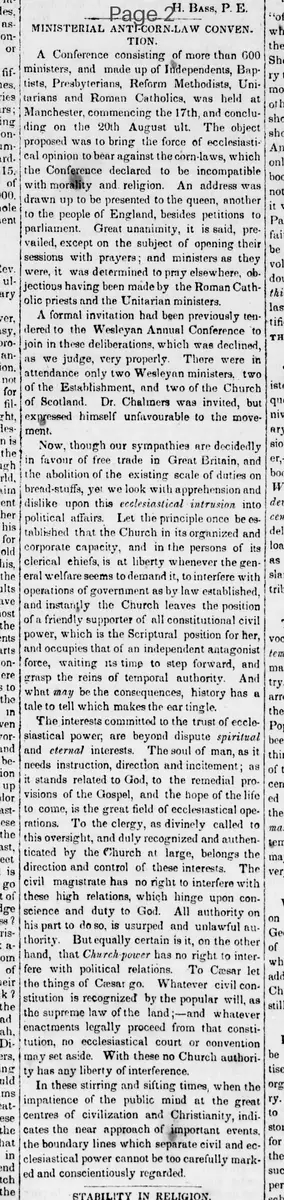
A Conference consisting of more than 600 ministers, and made up of Independents, Baptists, Presbyterians, Reform Methodists, Unitarians and Roman Catholics, was held at Manchester, commencing the 17th, and concluding on the 20th August ult. The object proposed was to bring the force of ecclesiastical opinion to bear against the corn-laws, which the Conference declared to be incompatible with morality and religion. An address was drawn up to be presented to the queen, another to the people of England, besides petitions to parliament. Great unanimity, it is said, prevailed, except on the subject of opening their sessions with prayers; and ministers as they were, it was determined to pray elsewhere, objections having been made by the Roman Catholic priests and the Unitarian ministers.
A formal invitation had been previously tendered to the Wesleyan Annual Conference to join in these deliberations, which was declined, as we judge, very properly. There were in attendance only two Wesleyan ministers, two of the Establishment, and two of the Church of Scotland. Dr. Chalmers was invited, but expressed himself unfavourable to the movement.
Now, though our sympathies are decidedly in favour of free trade in Great Britain, and the abolition of the existing scale of duties on bread-stuffs, yet we look with apprehension and dislike upon this ecclesiastical intrusion into political affairs. Let the principle once be established that the Church in its organized and corporate capacity, and in the persons of its clerical chiefs, is at liberty whenever the general welfare seems to demand it, to interfere with operations of government as by law established, and instantly the Church leaves the position of a friendly supporter of all constitutional civil power, which is the Scriptural position for her, and occupies that of an independent antagonist force, waiting its time to step forward, and grasp the reins of temporal authority. And what may be the consequences, history has a tale to tell which makes the ear tingle.
The interests committed to the trust of ecclesiastical power, are beyond dispute spiritual and eternal interests. The soul of man, as it needs instruction, direction and incitement; as it stands related to God, to the remedial provisions of the Gospel, and the hope of the life to come, is the great field of ecclesiastical operations. To the clergy, as divinely called to this oversight, and duly recognized and authenticated by the Church at large, belongs the direction and control of these interests. The civil magistrate has no right to interfere with these high relations, which hinge upon conscience and duty to God. All authority on his part to do so, is usurped and unlawful authority. But equally certain is it, on the other hand, that Church-power has no right to interfere with political relations. To Cæsar let the things of Cæsar go. Whatever civil constitution is recognized by the popular will, as the supreme law of the land;—and whatever enactments legally proceed from that constitution, no ecclesiastical court or convention may set aside. With these no Church authority has any liberty of interference.
In these stirring and sifting times, when the impatience of the public mind at the great centres of civilization and Christianity, indicates the near approach of important events, the boundary lines which separate civil and ecclesiastical power cannot be too carefully marked and conscientiously regarded.
What sub-type of article is it?
What themes does it cover?
What keywords are associated?
What entities or persons were involved?
Where did it happen?
Story Details
Key Persons
Location
Manchester
Event Date
17th To 20th August Ult.
Story Details
Over 600 ministers from various denominations held a conference in Manchester to oppose the corn-laws as immoral and irreligious, preparing addresses to the queen and people, and petitions to parliament. Invitation to Wesleyan Conference declined; Dr. Chalmers unfavorable. Author supports free trade but warns against church intrusion into politics, advocating separation of spiritual and civil powers.