Thank you for visiting SNEWPapers!
Sign up free
Editorial
November 17, 1823
New Hampshire Statesman
Concord, Merrimack County, New Hampshire
What is this article about?
An editorial in The Statesman opposes the Congressional Caucus system for nominating presidential candidates, arguing it undermines the U.S. Constitution's election provisions and favors congressional influence over popular choice among five Republican contenders in 1823.
Clipping
OCR Quality
98%
Excellent
Full Text
THE STATESMAN,
CONCORD, NOVEMBER 17, 1823.
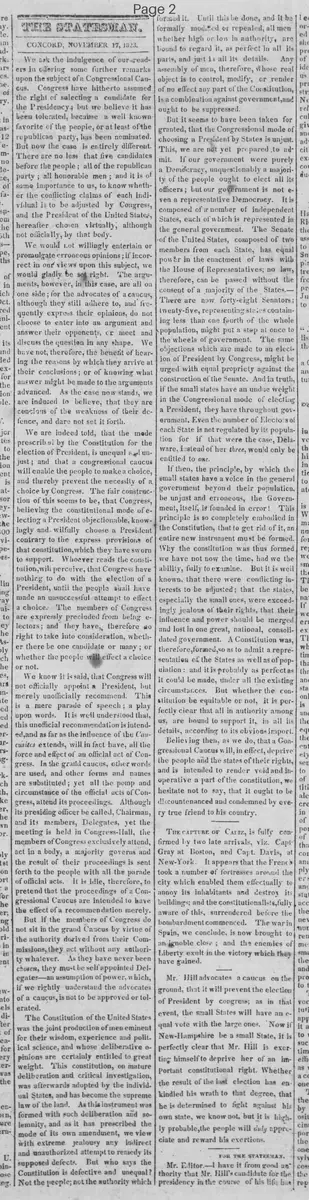
We ask the indulgence of our readers in offering some further remarks upon the subject of a Congressional Caucus. Congress have hitherto assumed the right of selecting a candidate for the Presidency but we believe it has been tolerated, because a well known favorite of the people, or at least of the republican party, has been nominated. But now the case is entirely different. There are no less than five candidates before the people; all of the republican party; all honorable men; and it is of some importance to us, to know whether the conflicting claims of each individual is to be adjusted by Congress, and the President of the United States hereafter chosen virtually, although not officially, by that body.
We would not willingly entertain or promulgate erroneous opinions; if incorrect in our views upon this subject, we would gladly be set right. The arguments, however, in this case, are all on one side; for the advocates of a caucus, although they still adhere to, and frequently express their opinions, do not choose to enter into an argument and answer their opponents, or meet and discuss the question in any shape. We have not, therefore, the benefit of hearing the reasons by which they arrive at their conclusions; or of knowing what answer might be made to the arguments advanced. As the case now stands, we are induced to believe, that they are conscious of the weakness of their defence, and dare not set it forth.
We are indeed told, that the mode prescribed by the Constitution for the election of President, is unequal and unjust; and that a congressional caucus will enable the people to make a choice, and thereby prevent the necessity of a choice by Congress. The fair construction of this seems to be, that Congress, believing the constitutional mode of electing a President objectionable, knowingly and wilfully choose a President contrary to the express provisions of that constitution, which they have sworn to support. Whoever reads the constitution, will perceive, that Congress have nothing to do with the election of a President, until the people shall have made an unsuccessful attempt to effect a choice. The members of Congress are expressly precluded from being electors; and they have, therefore no right to take into consideration, whether there be one candidate or many; or whether the people will effect a choice or not.
We know it is said, that Congress will not officially appoint a President, but merely unofficially recommend. This is a mere parade of speech; a play upon words. It is well understood that this unofficial recommendation is intended, and as far as the influence of the Caucusites extends, will in fact have, all the force and effect of an official act of Congress. In the grand caucus, other words are used, and other forms and names are substituted; yet all the pomp and circumstance of the official acts of Congress, attend its proceedings. Although its presiding officer be called, Chairman, and its members, Delegates, yet the meeting is held in Congress Hall, the members of Congress exclusively attend, act in a body, a majority governs and the result of their proceedings is sent forth to the people with all the parade of official acts. It is idle, therefore, to pretend that the proceedings of a Congressional Caucus are intended to have the effect of a recommendation merely. But if the members of Congress do not sit in the grand Caucus by virtue of the authority derived from their Commissions, they act without any authority whatever. As they have never been chosen, they must be self appointed Delegates—an assumption of power, which, if we rightly understand the advocates of a caucus, is not to be approved or tolerated.
The Constitution of the United States was the joint production of men eminent for their wisdom, experience and political science, and whose deliberative opinions are certainly entitled to great weight. This constitution, on mature deliberation and critical investigation, was afterwards adopted by the individual States, and has become the supreme law of the land. As this instrument was formed with such deliberation and solemnity, and as it has prescribed the mode of its own amendment, we view with extreme jealousy any indirect and unauthorized attempt to remedy its supposed defects. But who says the Constitution is defective and unequal? Not the people; not the authority which formed it. Until this be done, and it be formally modified or repealed, all men whether high or low in authority, are bound to regard it, as perfect in all its parts, and just in all its details. Any assembly of men, therefore, whose real object is to control, modify, or render of no effect any part of the Constitution, is a combination against government, and ought to be suppressed.
But it seems to have been taken for granted, that the Congressional mode of choosing a President by States is unjust. This, we are not yet prepared, to admit. If our government were purely a Democracy, unquestionably a majority of the people ought to elect all its officers; but our government is not even a representative Democracy. It is composed of a number of independent States, each of which is represented in the general government. The Senate of the United States, composed of two members from each State, has equal power in the enactment of laws with the House of Representatives; no law, therefore, can be passed without the consent of a majority of the States.—There are now forty-eight Senators; twenty-five, representing states containing less than one fourth of the whole population, might put a stop at once to the wheels of government. The same objections which are made to an election of President by Congress, might be urged with equal propriety against the construction of the Senate. And in truth, if the small states have an undue weight in the Congressional mode of electing a President, they have throughout government. Even the number of Electors of each State is not regulated by its population for if that were the case, Delaware, instead of her three, would only be entitled to one.
If then, the principle, by which the small states have a voice in the general government beyond their population, be unjust and erroneous, the Government, itself, is founded in error! This principle is so completely embodied in the Constitution, that to get rid of it, an entire new instrument must be formed. Why the constitution was thus formed we have not now the time, had we the ability, fully to examine. But it is well known, that there were conflicting interests to be adjusted; that the states, especially the small ones, were exceedingly jealous of their rights, that their influence and power should be merged and lost in one great, national, consolidated government. A Constitution was, therefore, formed, so as to admit a representation of the States as well as of population: and it is probably as perfect as it could be made, under all the existing circumstances. But whether the constitution be equitable or not, it is perfectly clear that all in authority among us, are bound to support it, in all its details, according to its obvious import. Believing then, as we do, that a Congressional Caucus will, in effect, deprive the people and the states of their rights, and is intended to render void and inoperative a part of the constitution, we hesitate not to say, that it ought to be discountenanced and condemned by every true friend to his country.
CONCORD, NOVEMBER 17, 1823.
We ask the indulgence of our readers in offering some further remarks upon the subject of a Congressional Caucus. Congress have hitherto assumed the right of selecting a candidate for the Presidency but we believe it has been tolerated, because a well known favorite of the people, or at least of the republican party, has been nominated. But now the case is entirely different. There are no less than five candidates before the people; all of the republican party; all honorable men; and it is of some importance to us, to know whether the conflicting claims of each individual is to be adjusted by Congress, and the President of the United States hereafter chosen virtually, although not officially, by that body.
We would not willingly entertain or promulgate erroneous opinions; if incorrect in our views upon this subject, we would gladly be set right. The arguments, however, in this case, are all on one side; for the advocates of a caucus, although they still adhere to, and frequently express their opinions, do not choose to enter into an argument and answer their opponents, or meet and discuss the question in any shape. We have not, therefore, the benefit of hearing the reasons by which they arrive at their conclusions; or of knowing what answer might be made to the arguments advanced. As the case now stands, we are induced to believe, that they are conscious of the weakness of their defence, and dare not set it forth.
We are indeed told, that the mode prescribed by the Constitution for the election of President, is unequal and unjust; and that a congressional caucus will enable the people to make a choice, and thereby prevent the necessity of a choice by Congress. The fair construction of this seems to be, that Congress, believing the constitutional mode of electing a President objectionable, knowingly and wilfully choose a President contrary to the express provisions of that constitution, which they have sworn to support. Whoever reads the constitution, will perceive, that Congress have nothing to do with the election of a President, until the people shall have made an unsuccessful attempt to effect a choice. The members of Congress are expressly precluded from being electors; and they have, therefore no right to take into consideration, whether there be one candidate or many; or whether the people will effect a choice or not.
We know it is said, that Congress will not officially appoint a President, but merely unofficially recommend. This is a mere parade of speech; a play upon words. It is well understood that this unofficial recommendation is intended, and as far as the influence of the Caucusites extends, will in fact have, all the force and effect of an official act of Congress. In the grand caucus, other words are used, and other forms and names are substituted; yet all the pomp and circumstance of the official acts of Congress, attend its proceedings. Although its presiding officer be called, Chairman, and its members, Delegates, yet the meeting is held in Congress Hall, the members of Congress exclusively attend, act in a body, a majority governs and the result of their proceedings is sent forth to the people with all the parade of official acts. It is idle, therefore, to pretend that the proceedings of a Congressional Caucus are intended to have the effect of a recommendation merely. But if the members of Congress do not sit in the grand Caucus by virtue of the authority derived from their Commissions, they act without any authority whatever. As they have never been chosen, they must be self appointed Delegates—an assumption of power, which, if we rightly understand the advocates of a caucus, is not to be approved or tolerated.
The Constitution of the United States was the joint production of men eminent for their wisdom, experience and political science, and whose deliberative opinions are certainly entitled to great weight. This constitution, on mature deliberation and critical investigation, was afterwards adopted by the individual States, and has become the supreme law of the land. As this instrument was formed with such deliberation and solemnity, and as it has prescribed the mode of its own amendment, we view with extreme jealousy any indirect and unauthorized attempt to remedy its supposed defects. But who says the Constitution is defective and unequal? Not the people; not the authority which formed it. Until this be done, and it be formally modified or repealed, all men whether high or low in authority, are bound to regard it, as perfect in all its parts, and just in all its details. Any assembly of men, therefore, whose real object is to control, modify, or render of no effect any part of the Constitution, is a combination against government, and ought to be suppressed.
But it seems to have been taken for granted, that the Congressional mode of choosing a President by States is unjust. This, we are not yet prepared, to admit. If our government were purely a Democracy, unquestionably a majority of the people ought to elect all its officers; but our government is not even a representative Democracy. It is composed of a number of independent States, each of which is represented in the general government. The Senate of the United States, composed of two members from each State, has equal power in the enactment of laws with the House of Representatives; no law, therefore, can be passed without the consent of a majority of the States.—There are now forty-eight Senators; twenty-five, representing states containing less than one fourth of the whole population, might put a stop at once to the wheels of government. The same objections which are made to an election of President by Congress, might be urged with equal propriety against the construction of the Senate. And in truth, if the small states have an undue weight in the Congressional mode of electing a President, they have throughout government. Even the number of Electors of each State is not regulated by its population for if that were the case, Delaware, instead of her three, would only be entitled to one.
If then, the principle, by which the small states have a voice in the general government beyond their population, be unjust and erroneous, the Government, itself, is founded in error! This principle is so completely embodied in the Constitution, that to get rid of it, an entire new instrument must be formed. Why the constitution was thus formed we have not now the time, had we the ability, fully to examine. But it is well known, that there were conflicting interests to be adjusted; that the states, especially the small ones, were exceedingly jealous of their rights, that their influence and power should be merged and lost in one great, national, consolidated government. A Constitution was, therefore, formed, so as to admit a representation of the States as well as of population: and it is probably as perfect as it could be made, under all the existing circumstances. But whether the constitution be equitable or not, it is perfectly clear that all in authority among us, are bound to support it, in all its details, according to its obvious import. Believing then, as we do, that a Congressional Caucus will, in effect, deprive the people and the states of their rights, and is intended to render void and inoperative a part of the constitution, we hesitate not to say, that it ought to be discountenanced and condemned by every true friend to his country.
What sub-type of article is it?
Constitutional
Partisan Politics
What keywords are associated?
Congressional Caucus
Presidential Election
Us Constitution
Republican Candidates
Electoral Process
Federalism
Party Nomination
What entities or persons were involved?
Congress
Republican Party
Constitution Framers
Small States
Editorial Details
Primary Topic
Opposition To Congressional Caucus For Presidential Nomination
Stance / Tone
Strongly Against Congressional Caucus, Defending Constitutional Election Process
Key Figures
Congress
Republican Party
Constitution Framers
Small States
Key Arguments
Congressional Caucus Undermines Constitutional Election Provisions
Caucus Acts As Unofficial But Effective Congressional Appointment Of President
Constitution Precludes Congress From Involvement Until Electoral College Fails
Caucus Assumes Unauthorized Power By Self Appointed Delegates
Constitution's Structure Balances State And Population Representation Justly
Any Attempt To Bypass Constitution Is A Combination Against Government
Small States' Influence Is Integral To The Federal System
Caucus Deprives People And States Of Their Rights