Thank you for visiting SNEWPapers!
Sign up free
Domestic News
March 11, 1952
The News And Views
Jacksonville, Onslow County, North Carolina
What is this article about?
Onslow tobacco growers alerted to watch for flea beetles emerging after warm weather. Farm Agent Charlie C. Clark Jr. advises using DDT dusts or sprays at specific plant stages to prevent damage to buds and roots.
Clipping
OCR Quality
98%
Excellent
Full Text
Leaf Growers
Alerted To
Flea Beetle
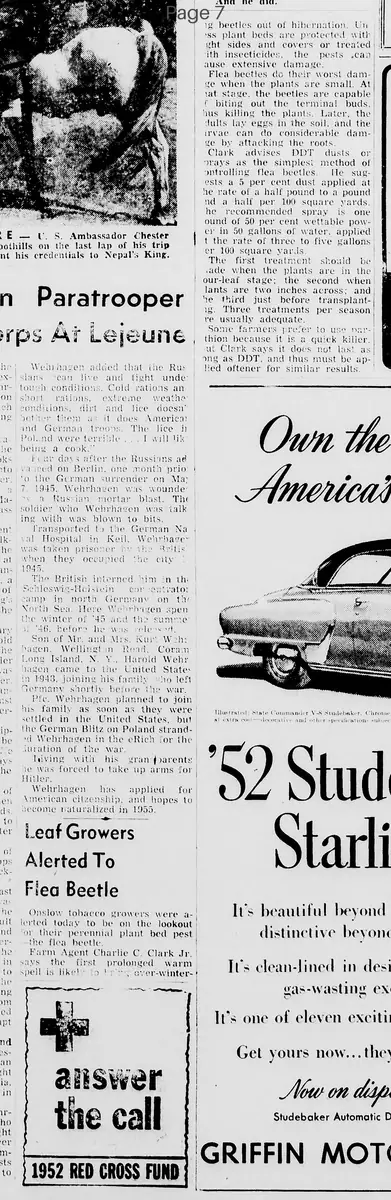
Onslow tobacco growers were alerted today to be on the lookout for their perennial plant bed pest - the flea beetle.
Farm Agent Charlie C. Clark Jr. says the first prolonged warm spell is likely to bring the over-wintering beetles out of hibernation. Unless plant beds are protected with tight sides and covers or treated with insecticides, the pests can cause extensive damage.
Flea beetles do their worst damage when the plants are small. At that stage, the beetles are capable of biting out the terminal buds, thus killing the plants. Later, the adults lay eggs in the soil, and the larvae can do considerable damage by attacking the roots.
Clark advises DDT dusts or sprays as the simplest method of controlling flea beetles. He suggests a 5 per cent dust applied at the rate of a half pound to a pound and a half per 100 square yards.
The recommended spray is one pound of 50 per cent wettable powder in 50 gallons of water, applied at the rate of three to five gallons per 100 square yards.
The first treatment should be made when the plants are in the four-leaf stage; the second when plants are two inches across; and the third just before transplanting. Three treatments per season are usually adequate.
Some farmers prefer to use parathion because it is a quick killer. But Clark says it does not last as long as DDT, and thus must be applied oftener for similar results.
Alerted To
Flea Beetle
Onslow tobacco growers were alerted today to be on the lookout for their perennial plant bed pest - the flea beetle.
Farm Agent Charlie C. Clark Jr. says the first prolonged warm spell is likely to bring the over-wintering beetles out of hibernation. Unless plant beds are protected with tight sides and covers or treated with insecticides, the pests can cause extensive damage.
Flea beetles do their worst damage when the plants are small. At that stage, the beetles are capable of biting out the terminal buds, thus killing the plants. Later, the adults lay eggs in the soil, and the larvae can do considerable damage by attacking the roots.
Clark advises DDT dusts or sprays as the simplest method of controlling flea beetles. He suggests a 5 per cent dust applied at the rate of a half pound to a pound and a half per 100 square yards.
The recommended spray is one pound of 50 per cent wettable powder in 50 gallons of water, applied at the rate of three to five gallons per 100 square yards.
The first treatment should be made when the plants are in the four-leaf stage; the second when plants are two inches across; and the third just before transplanting. Three treatments per season are usually adequate.
Some farmers prefer to use parathion because it is a quick killer. But Clark says it does not last as long as DDT, and thus must be applied oftener for similar results.
What sub-type of article is it?
Agriculture
What keywords are associated?
Flea Beetle
Tobacco Growers
Onslow
Pest Control
Ddt
Parathion
What entities or persons were involved?
Charlie C. Clark Jr.
Where did it happen?
Onslow
Domestic News Details
Primary Location
Onslow
Event Date
Today
Key Persons
Charlie C. Clark Jr.
Outcome
pests can cause extensive damage to small plants by biting terminal buds and attacking roots with larvae; controlled by ddt treatments.
Event Details
Tobacco growers alerted to flea beetles emerging from hibernation after warm spell; protect beds or treat with insecticides to prevent damage.