Thank you for visiting SNEWPapers!
Sign up free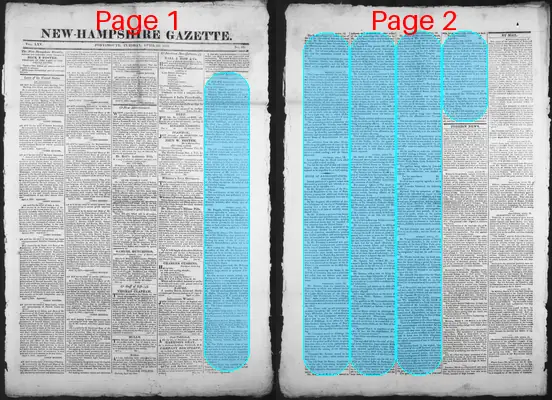
The New Hampshire Gazette
Portsmouth, Rockingham County, New Hampshire
What is this article about?
Detailed proceedings of the U.S. Sixteenth Congress First Session in the Senate and House of Representatives from April 12 to 18, covering resolutions against dueling, bills on navigation, boundaries, army clothing in domestic manufactures, relief for seamen, tariffs, and various petitions and debates on economic and judicial matters.
Merged-components note: Continuation of National Legislature proceedings across pages, changing label from 'story' to 'domestic_news' for consistency.
Clippings

1 of 2
OCR Quality
Full Text
SIXTEENTH CONGRESS.....FIRST SESSION
IN SENATE, WEDNESDAY, APRIL 12:
Mr. Morrill laid upon the table the following resolutions:
Resolved, That the practice of Duelling is inhuman, immoral, and censurable.
Resolved, That the President of the U. States would be justifiable in striking from the rolls of the army and navy the names of all persons thereon, who have been or hereafter may be directly or indirectly engaged in a duel, or who may have been, or hereafter may be in any way or manner accessory thereto.
The engrossed bill supplementary to the "act concerning navigation;" and the engrossed bill—to establish the district of Pearl River, in Mississippi, were severally read the third time, passed, and sent to the House of Representatives for concurrence.
The Senate ordered the bill for ascertaining and designating the boundary-line between the States of Indiana and Illinois to be engrossed for a third reading.
The Senate went into the consideration of Executive business, after which they adjourned.
THURSDAY, APRIL 13.
The bill concerning the salaries of certain District Judges was reconsidered, and the bill was ordered to be engrossed for a third reading.
The bill concerning "the Arkansas territory (applying to that territory the provisions of the act of June 4th, 1812, as modified by the act of April 29. 1816, for the government of the territory of Missouri) was, on motion of Mr. Johnson of Kentucky, taken up, considered, and ordered to be engrossed for a third reading.
The Senate then resumed, in committee of the whole, the bill for the relief of sick and disabled seamen.
This bill is long, and embraces numerous provisions.
The consideration of the bill was not completed, when, it was postponed till to-morrow; and
The Senate went into the consideration of Executive business; after which, they adjourned.
FRIDAY, APRIL 14.
Mr. Ruggles, having obtained leave, introduced agreeably to notice, a bill to reassert the powers of the commissioners for ascertaining and deciding on the rights of persons claiming lands in the district of Detroit, and to provide for the adjustment of claims to lands within the territory of Michigan: which bill was passed to a second reading.
Clothing the Army.—The Senate on motion of Mr. Dickerson, then proceeded to the consideration of the bill to provide for clothing the army of the U. States in Domestic Manufactures: which bill is as follows:
Be it enacted, &c. That from and after the passing of this act, the Secretary of War be, and he is hereby, authorized and required to cause the army of the United States to be clothed in articles of domestic manufacture, so far as the same can be procured in the U. States.
The bill having been read, Mr. Williams of Tennessee, for reasons which he submitted at large, moved to postpone it indefinitely.
On this motion a debate ensued, embracing in its scope the general policy of affording further encouragement to domestic manufactures, and the various considerations connected with that broad question as well as on the particular merits of this bill. The bill was supported much at large by Messrs. Dickerson, Burrill, Trimble Morrill. and King of N Y. and in a few incidental remarks, by Mr. Ruggles. The bill was opposed as earnestly and fully by Messrs. Williams of Tenn. Smith, and Macon. The debate continued till half past five o'clock; when,
The question being taken on the indefinite postponement of the bill, it was decided in the negative, by yeas and nays, as follows:
YEAS—Messrs. Barbour, Brown, Elliott, Gaillard, Johnson of Louisiana, King of Alab. Leake, Lloyd, Macon, Noble, Pleasants, Smith, Taylor, Walker of Alab. Walker of Geo. Williams o Miss Williams of Tenn 17.
NAYS—Messrs. Burrill, Dana, Dickerson, Eaton, Edwards, Horsey, Hunter, Johnson of Ky. King of N. Y. Lanman, Logan, Lowrie, Morril, Otis, Palmer, Parrott, Roberts, Ruggles, Sanford. Thomas, Tichenor, Trimble, Van Dyke, Wil son—24.
Mr. Van Dyke, to remove some of the objections which had been urged against the bill, and make it more generally acceptable, moved to divest it in part of its imperative character by modifying the bill to read, "so far as the same can be procured at as reasonable prices as similar articles of foreign manufacture."
This amendment was opposed by Mr. Trimble and Mr. Dickerson: but before the question was taken.
SATURDAY, APRIL 15.
The Senate resumed the consideration of the bill for the relief of sick and disabled Seamen. Mr. Parrott moved an amendment, by which boatmen at New Orleans were to pay 25 cents per month to the collector of that port, and be entitled to the benefits of the act. The bill was postponed till Monday, and the amendment ordered to be printed.
The bill providing for clothing the army in American fabrics, was discussed, the amendments concurred in, and the bill ordered to be engrossed and read a third time.
MONDAY, APRIL 17.
The Senate then resumed the consideration of the bill further to provide for sick and disabled seamen (making additional provision for marine hospitals at certain places, to be supported, as usual, by a contribution of 25 cents per month by the registered seamen, &c.) Mr. Parrott's amendment, offered to the bill on Saturday, to extend the provision of the bill to Mississippi boatmen, being still under consideration,
Some discussion took place, not so much on the principle of this amendment as on the propriety of discriminating between the different kinds of boatman, so as to include those only who follow the vocation regularly, and not those who are casual hands, or go for a single trip, &c. in which Messrs. Ruggles, Leake, Parrott, Johnson of La. Trimble, Logan, and Brown, joined.
The proceeding ended in postponing the bill, on motion of Mr. Trimble, who wished to modify the amendment, until to-morrow.
The engrossed bill to provide for clothing the army in domestic manufactures, were severally read the third time, passed, and sent to the House of Representatives for concurrence.
The resolution from the other House, authorizing the publication of a part of the secret journal of the Congress under the old confederation, was also considered, and ordered to a third reading: and the Senate adjourned.
TUESDAY, APRIL 18.
Several bills from the House were acted on, and passed a third reading
The bill for the relief of sick and disabled seamen, was, after some few observations, ordered to be engrossed for a third reading.
HOUSE OF REPRESENTATIVES.
WEDNESDAY, APRIL 12.
Several petitions of a general nature were this morning presented and referred, or ordered to lie on the table, viz:
By Mr. Sergeant a petition of the Printers and Booksellers in the city of Philadelphia, praying that additional duties may be imposed on paper imported into the U. States.
By Mr. Sergeant, also a petition of Sundry inhabitants of the city of Philadelphia, praying that a duty of ten per centum may be laid on all sales at auction, except Sheriff's sales.
By Mr. Baldwin, a petition from sundry Iron founders and manufacturers of Iron, in and near the city of Philadelphia, praying that additional duties may be imposed on iron imported into the United States.
By Mr Baldwin, also, a memorial of the Pennsylvania Society for the encouragement of American manufactures, praying that further protection and encouragement may be extended to the manufacturing interest of the country generally.
By Mr. Pinckney, a memorial and petition of sundry merchants and underwriters in the city of Charleston, in South Carolina, praying compensation for spoliations committed on their lawful commerce, by cruisers under the French flag, between the years 1793 and 1800, their claims to which upon the government of France for indemnity were abandoned on the part of the U. States, in the convention on the 30th September, 1800.
The bill concerning the banks in the District of Columbia was read a third time and passed, but not without great opposition, and sent to the Senate for concurrence.
THURSDAY, APRIL 13.
Mr. Newton, from the committee on Commerce to which was referred the bill from the Senate, "to authorize the erection of a Light House on one of the Isles of Shoals, near Portsmouth, in New Hampshire," made a report thereon, proposing sundry amendments thereto, and the bill and amendments were referred to a committee of the whole.
The House took up and proceeded to consider, the bill for the relief of General James Wilkinson, (for the indemnification of Gen. W. from a judgement obtained against him in one of the Courts of the State of Mississippi, in an action for false imprisonment, during the alarm of Burr's conspiracy. After some discussion, the bill was ordered to be engrossed for a third reading.
Mr. Livermore moved to discharge the committee of the whole from the further consideration of the bill, for the alteration of the present tariff of duties on goods imported, with a view to its postponement.
But the motion was declared not to be in order before the reading of the following bill:
Thereupon Mr. Barbour moved to lay that bill on the table; which motion was negatived.
The bill from the Senate, supplementary to the act, "concerning navigation," was twice read, and was, on motion of Mr. Hill, referred to the committee on commerce.
Mr. Williams, of N. C. then moved to postpone until to-morrow the other orders of the day preceding that referred to by Mr. Livermore, with a view to then moving to postpone that bill, until the next session of Congress.
In support of this motion, Mr. W. said, the subject was one of great importance; that a proper consideration of it would occupy the attention of the House exclusively, for at least a month, and would for so long protract the session beyond the time necessarily to be devoted to the consideration of other subjects. The question ought therefore to be now determined, whether the House would or would not act upon the subject at the present session.
Mr. Lowndes said, he concurred so fully in the views of the gentleman from North Carolina, that, if he now persevered in his motion, he should certainly vote for it. But, as the decision of the question, would in fact be a decision on the main question of the bill for the present session, he wished the motion could be deferred until to-morrow, that the members of the House might be all aware of its agitation. Mr. W. said he did not believe, that unless it was passed without debate, the bill in question could not be acted on at the present session.
Mr. Williams, assented to the wish of Mr. Lowndes: withdrew his motion, with the intimation, that if no one else moved it, he should himself renew the motion to-morrow.
The House resolved itself into a committee of the whole, on the bill concerning surviving revolutionary officers. A motion to that effect having been made, the question was taken on striking out the first section of the bill, and decided in the affirmative, by a majority of about 20 votes.
This decision (vitally affecting the bill) was reported to the House; when, on motion of Mr. Nelson, of Va. the report of the committee of the whole was ordered to lie on the table in order that it might be finally acted on, in full House; and the House adjourned.
FRIDAY, APRIL 14.
Mr. Smith of Md. from the committee of ways and means, made a detailed report, accompanied by a bill authorizing the President of the United States to borrow two millions of dollars, and for other purposes; which was twice read and committed.
The Speaker laid before the House a report of contracts from the Commissary General of Purchases for supplying the army with provisions, &c. rendered in pursuance of a resolution of the House
Revolutionary Officers.--The house resumed the consideration of the report of the committee of the whole on the bill for the relief of certain surviving officers of the Revolutionary Army.
Whereupon, a debate of considerable interest arose, in which Messrs. Livermore, Nelson, of Va. Hemphill, Cushman, Meigs, and Warfield, advocated the bill, and Mr. Harden and Mr. Southard opposed it.
The question on concurring in the report of the committee of the whole, to strike out the first section of the bill, was decided yeas 94, nays 70.
So the first section was stricken out, and the bill of course REJECTED.
Mr. Livermore then moved to discharge the committee of the whole from the further consideration of the bill which proposes to change the tariff of duties on goods imported, with a view to move for its indefinite postponement. He proceeded to assign the reasons for this motion. This bill, he said, had for its object essentially to change our revenue system, and to change it, in his opinion, for the worse. The time, too, for making this experiment was, he said, of all times the most unfortunate, at a moment when it is known that the Treasury is drained to the very dregs--
Mr. Speaker here arrested Mr. Livermore's speech, by declaring the debate on the merits of the bill was not in order on this motion, according to the rules of the house.
Mr. Barbour, with a view to bring the question into a shape susceptible of debate, moved to amend Mr. Livermore's motion, so as to add to it a provision to postpone the bill indefinitely.
This motion, and debate on it, were also pronounced irregular, for reasons which Mr. Speaker assigned.
After some observations on the point of order, from Messrs. Barbour, Livermore, and Lowndes,
The question on Mr. Livermore's motion was taken, without debate, on the merits of the bill, and decided as follows:--yeas 71, nays 86.
So the House refused to discharge the committee of the whole from the consideration of the said bill. Whereupon,
Mr. Storrs offered the following resolution, and moved that it be committed to a committee of the whole, on the state of the Union.
"Resolved That it is expedient to provide, by law, for the establishment of a system of internal revenue."
This resolve was referred as moved, without debate.
The engrossed bill for the relief of General James Wilkinson, (appropriation 3000 dls. to indemnify him from a certain judgement obtained against him, by Gen. John Adair) was read a third time, and passed, by a vote of 70 to 54, and was sent to the Senate for concurrence.
The bill next in order was the bill to establish an Uniform System of Bankruptcy.—
Mr. Sergeant moved that the house do now resolve itself into a committee of the whole on that bill. This motion was negatived, 56 to 47; and the house being thin and the hour late. the house adjourned.
SATURDAY, APRIL 15,
On motion of Mr. Alexander Smyth, the Secretary of War was directed to prepare a statement of the whole number of militia in service during the late war with Great Britain; shewing the periods of their service, their pay, and from what states and territories drawn, to be laid before this house at the next session of Congress.
On motion of Mr. Pinckney, the committee on the Judiciary were instructed to report on the expediency of so far altering and amending the Judiciary System as to enable defendants, in all suits originally brought in the District Courts of the United States, to have the same right of appeal to the Supreme Court of the United States as they would be entitled to had the suits against them been originally, instituted in the Circuit Courts thereof.
Mr. Meigs moved that the House do now proceed to consider the resolution submitted by him on the 5th of February last, in relation to the abolition of Slavery within the U. States. Negatived.
Mr. Cobb then moved that the House do now proceed to consider the report of the committee of the whole on the state of the Union, on a resolution submitted by him, proposing an amendment to the Constitution of the United States, in relation to appointments to office.
And the question being taken thereon, it passed in the affirmative--yeas 71, nays 69
The amendments reported to the said resolution by the committee of the whole on the state of the Union, were then read and concurred in by the House, and the said amendment, as amended, is in the words following, to wit:
"No Senator or Representative in the Congress of the United States shall during the time for which he was elected, or within one year thereafter, be appointed to any civil office under the authority of the United States."
On the question to order the resolution to a third reading, a Debate arose, which occupied about two hours. The gentlemen who engaged in the debate were, Messrs. Pindall, Brush, Neale, Cobb, Robinson, Sergeant, and Cushman.
The question being taken, by yeas and nays, on agreeing to the proposed amendment to the constitution, was decided as follows:
For the amendment 72
Against it 87
So there was a majority against, it and it was rejected.
Mr Lowndes submitted the following resolution:
Resolved, That the committee of Manufactures be instructed to report to this House such evidence, or estimates, as it may be in their power to present, shewing the several rates of wages given, and the expenses of all kinds incurred, in the different branches of manufactures, which in their opinion require additional encouragement, with the prices of their product, so as to exhibit the profit, which, at the present price of subsistence, materials, and labour, and the present value of land, buildings and machinery, may be obtained in such manufacture, skillfully and economically conducted.
The said resolution was read and ordered to lie on the table: and the House adjourned.
MONDAY, APRIL, 17.
Mr. Tracy presented a petition of sundry merchants of Rochester, in the county of Genesee, in the state of New-York, praying that the bill now pending before this house, supplementary to the act "concerning navigation," may not be passed into a law.
Mr. Harden moved that the select committee to which is referred the resolution from the Senate fixing a period for the termination of the present session of Congress, be discharged from the further consideration thereof: which was decided in the negative --yeas 68, nays 71.
Mr Slocumb then moved that the House do now proceed to consider the resolution submitted by him on the 6th ult. to fix a period for the termination of the present session.
And the question was then taken by yeas and nays, will the House now proceed to consider the said resolution, and was decided in the Negative, 86 votes to 70.
On the motion of Mr. Cocke. the report from the War Department, on the subject of contracts,was referred to a select committee.
On motion of Mr. Lowndes, the House proceeded to consider the resolution submitted by him, on Saturday, calling on the committee of Manufactures to report certain information respecting the state of Manufactures in the United States.
On this proposition arose a short debate. Those who supported the motion argued, that encouragement was demanded for our manufacturers by increased duties, on the ground that they were now oppressed and ruined; that, it was necessary to have these facts to know how far these allegations were true or otherwise—to know whether the distress complained of was in fact real or supposititious.
On the other hand, it was argued, that the revision of the tariff had been proposed by the committee of manufactures from considerations of national policy, and from a minute investigation of details; that the information asked was not such as a committee of this House ought to be required to give, and which each Member could as well procure for himself as a committee for him; and that the adoption of the resolve would serve the purpose of delay, &c.
The question being taken, by yeas and nays, on agreeing to the resolve, there were
For the resolution 72
Against it 90
So the resolve was rejected.
The engrossed bill "relative to the Arkansas territory;" the engrossed bill to annex certain Public Lands in the territory of Michigan. to the District of Detroit : the engrossed resolution giving the consent of Congress to a compact between the two states of Kentucky and Tennessee for the settlement of their boundary ; were severally read a third time and passed.
The House then resolved itself into a committee of the whole, Mr. Tomlinson in the chair, on the bill extending the time for the redemption of lands sold to pay the direct tax in certain cases.
Mr. Sergeant moved an amendment to provide how deeds shall be made to purchasers of lands sold for the payment of the Direct Tax, where there is no Collector now to do it—agreed to.
TUESDAY, APRIL 18.
On motion of Mr. Williams, of North Carolina, it was
Resolved, That the Secretary of War be directed to lay before this house the proceedings of the Court Martial on the trial of William King, Col. of the 4th regiment of U. S. Infantry.
(The engrossed bill extending the time allowed for the redemption of land sold for direct taxes, and purchased on behalf of the United States, was read the third time, passed, and sent to the Senate for concurrence.
What sub-type of article is it?
What keywords are associated?
What entities or persons were involved?
Where did it happen?
Domestic News Details
Primary Location
Washington
Event Date
April 12 To April 18
Key Persons
Outcome
bills passed on army clothing in domestic manufactures, relief for seamen, navigation, boundaries, and territories; debates on tariffs and manufactures; resolutions against dueling introduced; revolutionary officers bill rejected; constitutional amendment on appointments rejected.
Event Details
Proceedings in the U.S. Senate and House of Representatives during the Sixteenth Congress First Session, including introduction of anti-dueling resolutions, passage of bills on navigation, Pearl River district, Indiana-Illinois boundary, Arkansas territory, sick seamen relief, army clothing in domestic fabrics, land claims in Michigan, and various petitions on duties, manufactures, and spoliations; debates on tariffs, bankruptcy, internal revenue, and session end; rejection of revolutionary officers relief and constitutional amendment.