Thank you for visiting SNEWPapers!
Sign up free
Story
May 16, 1925
The Milwaukee Leader
Milwaukee, Milwaukee County, Wisconsin
What is this article about?
German scientist R. Hesse shares data on animal longevity from the Pathfinder, highlighting that larger mammals live longer, with specific ages for asses, horses, sheep, dogs, cats, elephants, whales, birds like roosters and swans, polyps, leeches, crawfish, spiders, beetles, bees, ants, toads, and turtles.
Clipping
OCR Quality
98%
Excellent
Full Text
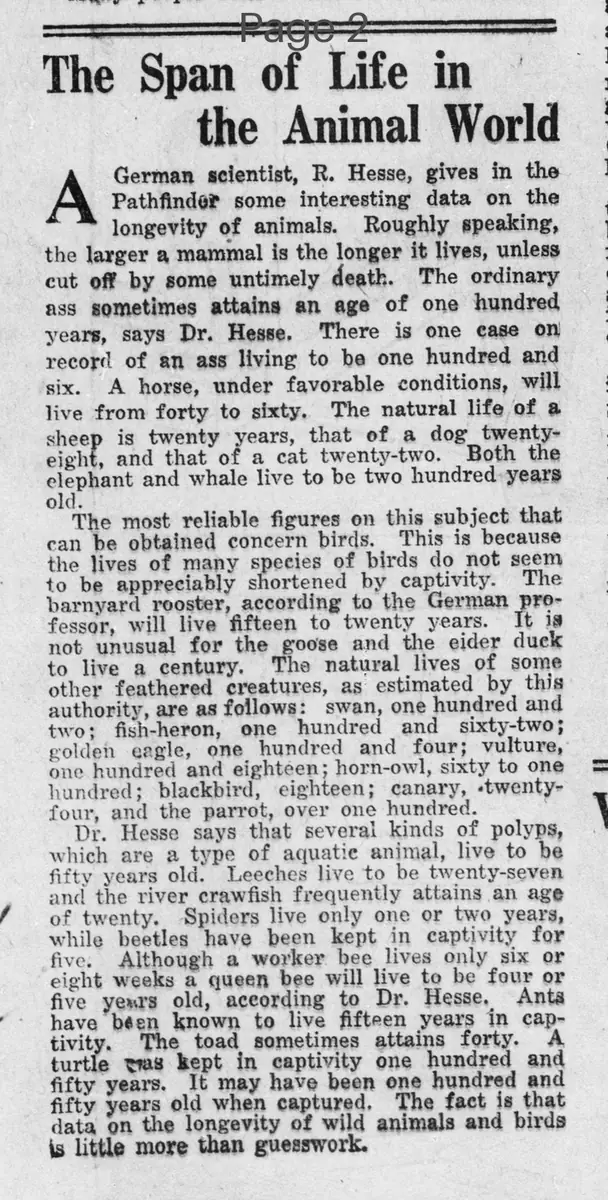
The Span of Life in the Animal World
A German scientist, R. Hesse, gives in the Pathfinder some interesting data on the longevity of animals. Roughly speaking, the larger a mammal is the longer it lives, unless cut off by some untimely death. The ordinary ass sometimes attains an age of one hundred years, says Dr. Hesse. There is one case on record of an ass living to be one hundred and six. A horse, under favorable conditions, will live from forty to sixty. The natural life of a sheep is twenty years, that of a dog twenty-eight, and that of a cat twenty-two. Both the elephant and whale live to be two hundred years old.
The most reliable figures on this subject that can be obtained concern birds. This is because the lives of many species of birds do not seem to be appreciably shortened by captivity. The barnyard rooster, according to the German professor, will live fifteen to twenty years. It is not unusual for the goose and the eider duck to live a century. The natural lives of some other feathered creatures, as estimated by this authority, are as follows: swan, one hundred and two; fish-heron, one hundred and sixty-two; golden eagle, one hundred and four; vulture, one hundred and eighteen; horn-owl, sixty to one hundred; blackbird, eighteen; canary, twenty-four, and the parrot, over one hundred.
Dr. Hesse says that several kinds of polyps, which are a type of aquatic animal, live to be fifty years old. Leeches live to be twenty-seven and the river crawfish frequently attains an age of twenty. Spiders live only one or two years, while beetles have been kept in captivity for five. Although a worker bee lives only six or eight weeks a queen bee will live to be four or five years old, according to Dr. Hesse. Ants have been known to live fifteen years in captivity. The toad sometimes attains forty. A turtle was kept in captivity one hundred and fifty years. It may have been one hundred and fifty years old when captured. The fact is that data on the longevity of wild animals and birds is little more than guesswork.
A German scientist, R. Hesse, gives in the Pathfinder some interesting data on the longevity of animals. Roughly speaking, the larger a mammal is the longer it lives, unless cut off by some untimely death. The ordinary ass sometimes attains an age of one hundred years, says Dr. Hesse. There is one case on record of an ass living to be one hundred and six. A horse, under favorable conditions, will live from forty to sixty. The natural life of a sheep is twenty years, that of a dog twenty-eight, and that of a cat twenty-two. Both the elephant and whale live to be two hundred years old.
The most reliable figures on this subject that can be obtained concern birds. This is because the lives of many species of birds do not seem to be appreciably shortened by captivity. The barnyard rooster, according to the German professor, will live fifteen to twenty years. It is not unusual for the goose and the eider duck to live a century. The natural lives of some other feathered creatures, as estimated by this authority, are as follows: swan, one hundred and two; fish-heron, one hundred and sixty-two; golden eagle, one hundred and four; vulture, one hundred and eighteen; horn-owl, sixty to one hundred; blackbird, eighteen; canary, twenty-four, and the parrot, over one hundred.
Dr. Hesse says that several kinds of polyps, which are a type of aquatic animal, live to be fifty years old. Leeches live to be twenty-seven and the river crawfish frequently attains an age of twenty. Spiders live only one or two years, while beetles have been kept in captivity for five. Although a worker bee lives only six or eight weeks a queen bee will live to be four or five years old, according to Dr. Hesse. Ants have been known to live fifteen years in captivity. The toad sometimes attains forty. A turtle was kept in captivity one hundred and fifty years. It may have been one hundred and fifty years old when captured. The fact is that data on the longevity of wild animals and birds is little more than guesswork.
What sub-type of article is it?
Curiosity
Animal Story
What themes does it cover?
Nature
What keywords are associated?
Animal Longevity
Mammal Lifespans
Bird Ages
Invertebrate Longevity
Reptile Lifespan
What entities or persons were involved?
R. Hesse
Story Details
Key Persons
R. Hesse
Story Details
R. Hesse provides estimates of animal lifespans, noting longer lives for larger mammals like elephants and whales up to 200 years, specific ages for birds such as swans to 102 years, and various invertebrates and reptiles like turtles up to 150 years, emphasizing reliable data for birds and guesswork for wild animals.