Thank you for visiting SNEWPapers!
Sign up free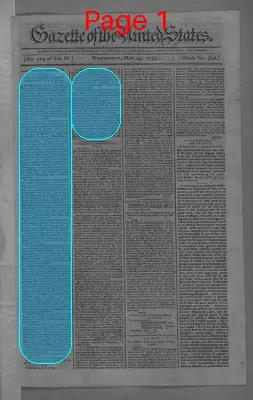
Literary
May 29, 1793
Gazette Of The United States
New York, New York County, New York
What is this article about?
This essay, part VIII, advocates establishing permanent monogamous marriage among American Indians to civilize them, condemning polygamy and informal unions. It discusses marriage's role in elevating women, fostering domestic happiness, population growth, and societal order, citing ancient Roman and Greek practices and laws against adultery.
Merged-components note: Continuation of the same literary article on the state of American Indians.
Clipping
OCR Quality
95%
Excellent
Full Text
For the GAZETTE of the UNITED STATES.
THOUGHTS ON THE
STATE OF AMERICAN INDIANS.
(Continued from No. 99, of this Gazette.)
No. VIII.
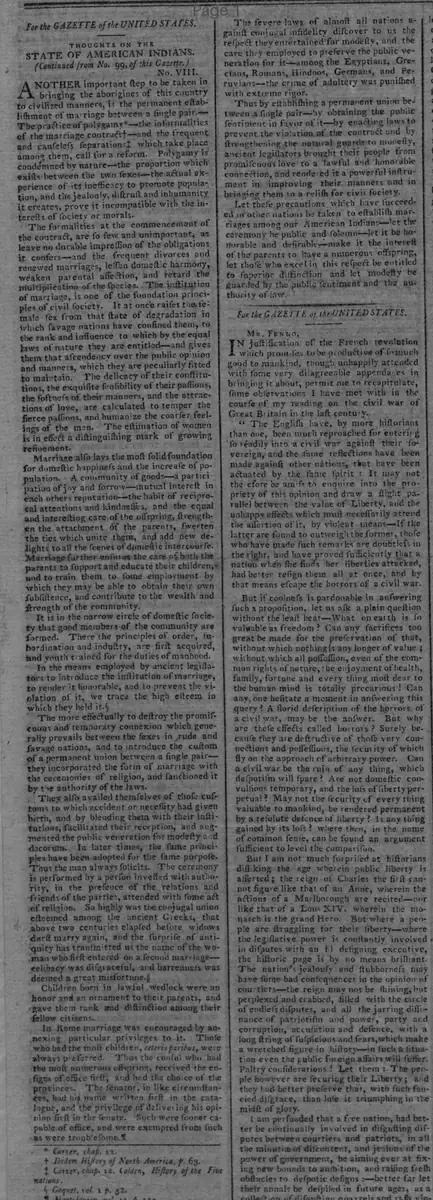
ANOTHER important step to be taken in
bringing the aborigines of this country
to civilized manners, is the permanent establishment of marriage between a single pair.
The practice of polygamy* -the informalities
of the marriage contract†-and the frequent
and careless separations which take place
among them, call for a reform. Polygamy is
condemned by nature--the proportion which
exists between the two sexes--the actual ex-
perience of its inefficacy to promote popula-
tion, and the jealousy, distrust and inhumanity
it creates, prove it incompatible with the in-
terests of society or morals.
The formalities at the commencement of
the contract, are so few and unimportant, as
leave no durable impression of the obligations
it confers-and the frequent divorces and
renewed marriages, lessen domestic harmony,
weaken parental affection, and retard the
multiplication of the species. The institution
of marriage, is one of the foundation princi-
ples of civil society. It at once raises the fe-
male sex from that state of degradation in
which savage nations have consigned them, to
the rank and influence to which by the equal
laws of nature they are entitled-and gives
them that ascendency over the public opinion
and manners, which they are peculiarly fitted
to maintain. The delicacy of their constitu-
tions, the exquisite sensibility of their passions,
the softness of their manners, and the attrac-
tions of love, are calculated to temper the
fierce passions, and humanize the coarser feel-
ings of the men. The estimation of women
is in effect a distinguishing mark of growing
refinement.
Marriage also lays the most solid foundation
for domestic happiness and the increase of po-
pulation. A community of goods-a partici-
pation of joy and sorrow-mutual interest in
each others reputation—the habit of recipro-
cal attentions and kindness, and the equal
and interesting care of the offspring, strength-
en the attachment of the parents, sweeten
the ties which unite them, and add new de-
lights to all the scenes of domestic intercourse.
Marriage further ensures the care of both the
parents to support and educate their children,
and to train them to some employment by
which they may be able to obtain their own
subsistence, and contribute to the wealth and
strength of the community.
It is in the narrow circle of domestic socie-
ty that good members of the community are
formed. There the principles of order, sub-
ordination and industry, are first acquired,
and youth trained for the duties of manhood.
In the means employed by ancient legifla-
tors to introduce the institution of marriage,
to render it honorable, and to prevent the vi-
olation of it, we trace the high esteem in
which they held it.‡
The more effectually to destroy the promi-
cuous and temporary connexion which gene-
rally prevails between the sexes in rude and
savage nations, and to introduce the custom
of a permanent union between a single pair-
they incorporated the form of marriage with
the ceremonies of religion, and sanctioned it
by the authority of the laws.
They also availed themselves of those cus-
toms to which accident or necessity had given
birth, and by blending them with their insti-
tutions, facilitated their reception, and aug-
mented the public veneration for modesty and
decorum. In later times, the same princi-
ples have been adopted for the same purpose.
Thus the man always solicits. The ceremony
is performed by a person invested with autho-
rity, in the presence of the relations and
friends of the parties, attended with some act
of religion. So highly was the conjugal union
esteemed among the ancient Greeks, that
above two centuries elapsed before widows
durst marry again, and the surprise of anti-
quity has transmitted us the name of the wo-
man who first entered on a second marriage—
celibacy was disgraceful, and barrenness was
deemed a great misfortune.
Children born in lawful wedlock were an
honor and an ornament to their parents, and
gave them rank and distinction among their
fellow citizens.
In Rome marriage was encouraged by an-
nexing particular privileges to it. Those
who had the most children, ceteris paribus, were
always preferred. Thus the consul who had
the most numerous offspring, received the en-
signs of office first, and chose the provinces.The senator, in like circumstances,
had his name written first in the cata-
logue, and the privilege of delivering his opi-
nion first in the senate. Such were sooner ca-
pable of office, and were exempted from such
as were troublesome.
* Carter, chap. 12.
† Ibidem History of North America, p. 63.
Carter, chap. 12. Colden, History of the Five
Nations.
The severe laws of almost all nations a-
gainst conjugal infidelity discover to us the
respect they entertained for modesty, and the
care they employed to preserve the public ve-
neration for it--among the Egyptians, Gre-
cians, Romans, Hindoos, Germans, and Pe-
ruvians--the crime of adultery was punished
with extreme rigor.
Thus by establishing a permanent union be-
tween a single pair-by obtaining the public
sentiment in favor of it-by enacting laws to
prevent the violation of the contract and by
strengthening the natural guards to modesty,
ancient legislators brought their people from
promiscuous love to a lawful and honorable
connection, and rendered it a powerful instru-
ment in improving their manners and in
bringing them to a relish for civil society.
Let these precautions which have succee-
ded in other nations be taken to establish mar-
riages among our American Indians--let the
ceremony be public and solemn--let it be ho-
norable and desirable-make it the interest
of the parents to have a numerous offspring,
let those who excel in this respect be entitled
to superior distinction and let modesty be
guarded by the public sentiment and the au-
thority of law.
THOUGHTS ON THE
STATE OF AMERICAN INDIANS.
(Continued from No. 99, of this Gazette.)
No. VIII.
ANOTHER important step to be taken in
bringing the aborigines of this country
to civilized manners, is the permanent establishment of marriage between a single pair.
The practice of polygamy* -the informalities
of the marriage contract†-and the frequent
and careless separations which take place
among them, call for a reform. Polygamy is
condemned by nature--the proportion which
exists between the two sexes--the actual ex-
perience of its inefficacy to promote popula-
tion, and the jealousy, distrust and inhumanity
it creates, prove it incompatible with the in-
terests of society or morals.
The formalities at the commencement of
the contract, are so few and unimportant, as
leave no durable impression of the obligations
it confers-and the frequent divorces and
renewed marriages, lessen domestic harmony,
weaken parental affection, and retard the
multiplication of the species. The institution
of marriage, is one of the foundation princi-
ples of civil society. It at once raises the fe-
male sex from that state of degradation in
which savage nations have consigned them, to
the rank and influence to which by the equal
laws of nature they are entitled-and gives
them that ascendency over the public opinion
and manners, which they are peculiarly fitted
to maintain. The delicacy of their constitu-
tions, the exquisite sensibility of their passions,
the softness of their manners, and the attrac-
tions of love, are calculated to temper the
fierce passions, and humanize the coarser feel-
ings of the men. The estimation of women
is in effect a distinguishing mark of growing
refinement.
Marriage also lays the most solid foundation
for domestic happiness and the increase of po-
pulation. A community of goods-a partici-
pation of joy and sorrow-mutual interest in
each others reputation—the habit of recipro-
cal attentions and kindness, and the equal
and interesting care of the offspring, strength-
en the attachment of the parents, sweeten
the ties which unite them, and add new de-
lights to all the scenes of domestic intercourse.
Marriage further ensures the care of both the
parents to support and educate their children,
and to train them to some employment by
which they may be able to obtain their own
subsistence, and contribute to the wealth and
strength of the community.
It is in the narrow circle of domestic socie-
ty that good members of the community are
formed. There the principles of order, sub-
ordination and industry, are first acquired,
and youth trained for the duties of manhood.
In the means employed by ancient legifla-
tors to introduce the institution of marriage,
to render it honorable, and to prevent the vi-
olation of it, we trace the high esteem in
which they held it.‡
The more effectually to destroy the promi-
cuous and temporary connexion which gene-
rally prevails between the sexes in rude and
savage nations, and to introduce the custom
of a permanent union between a single pair-
they incorporated the form of marriage with
the ceremonies of religion, and sanctioned it
by the authority of the laws.
They also availed themselves of those cus-
toms to which accident or necessity had given
birth, and by blending them with their insti-
tutions, facilitated their reception, and aug-
mented the public veneration for modesty and
decorum. In later times, the same princi-
ples have been adopted for the same purpose.
Thus the man always solicits. The ceremony
is performed by a person invested with autho-
rity, in the presence of the relations and
friends of the parties, attended with some act
of religion. So highly was the conjugal union
esteemed among the ancient Greeks, that
above two centuries elapsed before widows
durst marry again, and the surprise of anti-
quity has transmitted us the name of the wo-
man who first entered on a second marriage—
celibacy was disgraceful, and barrenness was
deemed a great misfortune.
Children born in lawful wedlock were an
honor and an ornament to their parents, and
gave them rank and distinction among their
fellow citizens.
In Rome marriage was encouraged by an-
nexing particular privileges to it. Those
who had the most children, ceteris paribus, were
always preferred. Thus the consul who had
the most numerous offspring, received the en-
signs of office first, and chose the provinces.The senator, in like circumstances,
had his name written first in the cata-
logue, and the privilege of delivering his opi-
nion first in the senate. Such were sooner ca-
pable of office, and were exempted from such
as were troublesome.
* Carter, chap. 12.
† Ibidem History of North America, p. 63.
Carter, chap. 12. Colden, History of the Five
Nations.
The severe laws of almost all nations a-
gainst conjugal infidelity discover to us the
respect they entertained for modesty, and the
care they employed to preserve the public ve-
neration for it--among the Egyptians, Gre-
cians, Romans, Hindoos, Germans, and Pe-
ruvians--the crime of adultery was punished
with extreme rigor.
Thus by establishing a permanent union be-
tween a single pair-by obtaining the public
sentiment in favor of it-by enacting laws to
prevent the violation of the contract and by
strengthening the natural guards to modesty,
ancient legislators brought their people from
promiscuous love to a lawful and honorable
connection, and rendered it a powerful instru-
ment in improving their manners and in
bringing them to a relish for civil society.
Let these precautions which have succee-
ded in other nations be taken to establish mar-
riages among our American Indians--let the
ceremony be public and solemn--let it be ho-
norable and desirable-make it the interest
of the parents to have a numerous offspring,
let those who excel in this respect be entitled
to superior distinction and let modesty be
guarded by the public sentiment and the au-
thority of law.
What sub-type of article is it?
Essay
What themes does it cover?
Moral Virtue
Political
Social Manners
What keywords are associated?
American Indians
Marriage Reform
Polygamy
Civilization
Domestic Society
Ancient Legislators
Monogamy
Adultery Laws
Literary Details
Title
Thoughts On The State Of American Indians.
Subject
On Establishing Marriage Among American Indians
Key Lines
The Institution Of Marriage, Is One Of The Foundation Principles Of Civil Society.
Polygamy Is Condemned By Nature The Proportion Which Exists Between The Two Sexes The Actual Experience Of Its Inefficacy To Promote Population, And The Jealousy, Distrust And Inhumanity It Creates, Prove It Incompatible With The Interests Of Society Or Morals.
Marriage Also Lays The Most Solid Foundation For Domestic Happiness And The Increase Of Population.
Let These Precautions Which Have Succeeded In Other Nations Be Taken To Establish Marriages Among Our American Indians Let The Ceremony Be Public And Solemn Let It Be Honorable And Desirable Make It The Interest Of The Parents To Have A Numerous Offspring, Let Those Who Excel In This Respect Be Entitled To Superior Distinction And Let Modesty Be Guarded By The Public Sentiment And The Authority Of Law.