Thank you for visiting SNEWPapers!
Sign up free
The Weston Leader
Weston, Umatilla County, Oregon
What is this article about?
The U.S. Senate rejected the Johnson amendment to the peace treaty, which sought to equalize U.S. voting power in the League of Nations with Great Britain's, by a 38-40 vote. Senators from Oregon voted against, while those from Washington supported it. Delays in treaty proceedings reduce chances of adjourning the special session by November 10.
Clipping
OCR Quality
Full Text
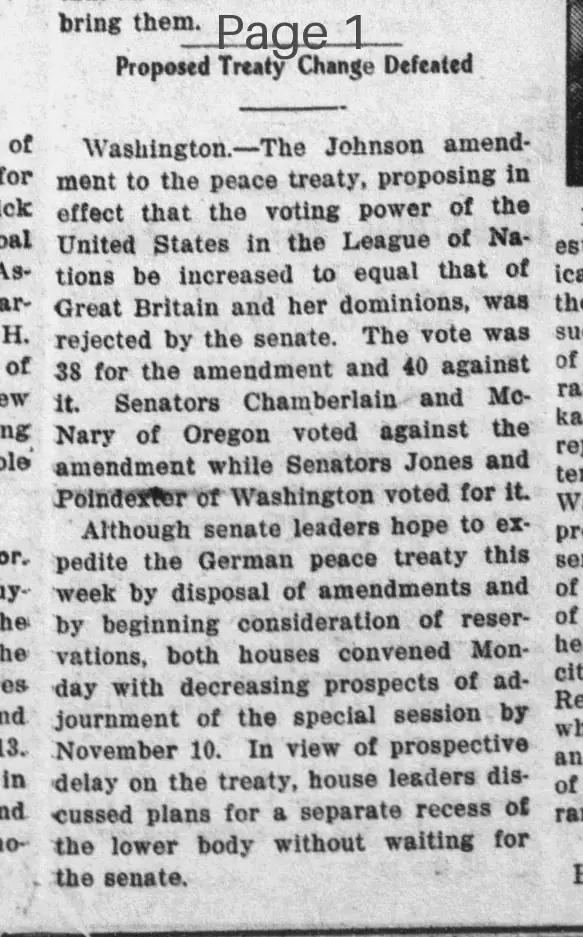
Washington.-The Johnson amendment to the peace treaty, proposing in effect that the voting power of the United States in the League of Nations be increased to equal that of Great Britain and her dominions, was rejected by the senate. The vote was 38 for the amendment and 40 against it. Senators Chamberlain and McNary of Oregon voted against the amendment while Senators Jones and Poindexter of Washington voted for it.
Although senate leaders hope to expedite the German peace treaty this week by disposal of amendments and by beginning consideration of reservations, both houses convened Monday with decreasing prospects of adjournment of the special session by November 10. In view of prospective delay on the treaty, house leaders discussed plans for a separate recess of the lower body without waiting for the senate.
What sub-type of article is it?
What keywords are associated?
What entities or persons were involved?
Where did it happen?
Domestic News Details
Primary Location
Washington
Key Persons
Outcome
the vote was 38 for the amendment and 40 against it.
Event Details
The Johnson amendment to the peace treaty, proposing in effect that the voting power of the United States in the League of Nations be increased to equal that of Great Britain and her dominions, was rejected by the senate. Senators Chamberlain and McNary of Oregon voted against the amendment while Senators Jones and Poindexter of Washington voted for it. Although senate leaders hope to expedite the German peace treaty this week by disposal of amendments and by beginning consideration of reservations, both houses convened Monday with decreasing prospects of adjournment of the special session by November 10. In view of prospective delay on the treaty, house leaders discussed plans for a separate recess of the lower body without waiting for the senate.