Thank you for visiting SNEWPapers!
Sign up free
Staunton Spectator, And General Advertiser
Staunton, Virginia
What is this article about?
Political crisis in Maryland as Van Buren Senate Electors refuse to convene, sparking large protest meetings in Baltimore and Cumberland condemning the actions as revolutionary and unconstitutional, while supporting loyal Electors and advocating orderly reform. (198 characters)
Merged-components note: These components form a continuous news report on the Maryland election crisis and related political developments; sequential reading orders and shared topic.
Clipping
OCR Quality
Full Text
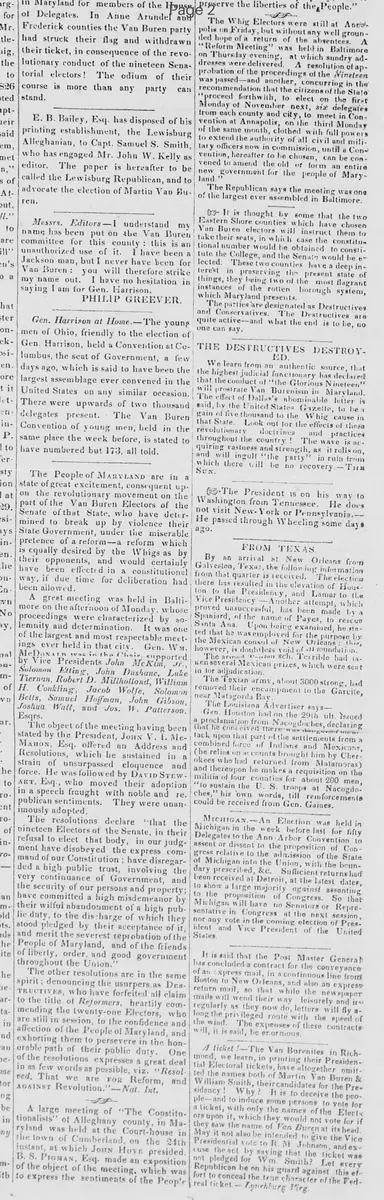
A great meeting was held in Baltimore on the afternoon of Monday, whose proceedings were characterized by solemnity and determination. It was one of the largest and most respectable meetings ever held in that city. Gen. Wm. McDonald was in the chair, supported by Vice Presidents John McKim, Jr., Solomon Etting, John Dushane, Luke Tiernan, Robert D. Millholland, William H. Conkling, Jacob Wolfe, Solomon Bells, Samuel Hoffman, John Gibson, Joshua Wall, and Jos. W. Patterson. Esqrs.
The object of the meeting having been stated by the President, John V. L. McMahon, Esq. offered an Address and Resolutions, which he sustained in a strain of unsurpassed eloquence and force. He was followed by David Stewart, Esq., who moved their adoption in a speech fraught with noble and republican sentiments. They were unanimously adopted.
The resolutions declare "that the nineteen Electors of the Senate, in their refusal to elect that body, in our judgment have disobeyed the express command of our Constitution; have disregarded a high public trust, involving the very continuance of Government, and the security of our persons and property; have committed a high misdemeanor by their wilful abandonment of a high public duty, to the discharge of which they stood pledged by their acceptance of it, and merit the severest reprobation of the People of Maryland, and of the friends of liberty, order, and good government throughout the Union."
The other resolutions are in the same spirit; denouncing the usurpers as DESTRUCTIVES, who have forfeited all claim to the title of Reformers, heartily commending the twenty-one Electors, who are still in session, to the confidence and affection of the People of Maryland, and exhorting them to persevere in the honorable path of their public duty. One of the resolutions expresses a great deal in as few words as possible, viz. "Resolved, That we are for Reform, and Against Revolution."—Nat. Int.
A large meeting of "The Constitutionalists" of Alleghany county, in Maryland was held at the Court-house in the town of Cumberland, on the 24th instant, at which John Hower presided. B. S. Pigman, Esq. made an exposition of the object of the meeting, which was to express the sentiments of the People in relation to the recent revolutionary proceedings at Annapolis. The resolutions, adopted without a dissenting voice, are in a tone of calm resolution. Highly approving of the course of the twenty-one Electors who refused to be tampered with or to palter with their duty, the Meeting declared their readiness, at the risk of their lives and property, to sustain the Constitution and Laws of the State: and took measures for organizing the People in the several districts of the county, "so as to be ready" at the first warning to carry into effect such measures as may be deemed most advisable to protect the rights of property, and to preserve the liberties of the People.
The Whig Electors were still at Annapolis on Friday, but without any well grounded hope of a return of the absentees. A "Reform Meeting" was held in Baltimore on Thursday evening, at which sundry addresses were delivered. A resolution of approbation of the proceedings of the Nineteen was passed—and another, concurring in the recommendation that the citizens of the State "proceed forthwith, to elect on the first Monday of November next, six delegates from each county and city, to meet in Convention at Annapolis, on the third Monday of the same month, clothed with full powers to extend the authority of all civil and military officers now in commission, until a Convention, hereafter to be chosen, can be convened to amend the old or form an entire new government for the people of Maryland."
The Republican says the meeting was one of the largest ever assembled in Baltimore.
It is thought by some that the two Eastern Shore counties which have chosen Van Buren electors will instruct them to take their seats, in which case the constitutional number would be obtained to constitute the College, and the Senate would be elected. These two counties have a deep interest in preserving the present state of things, they being two of the most flagrant instances of the rotten borough system, which Maryland presents.
The parties are designated as Destructives and Conservatives. The Destructives are quite active—and what the end is to be, no one can say.
THE DESTRUCTIVES DESTROYED.
We learn from an authentic source, that the highest judicial functionary has declared that the conduct of "the Glorious Nineteen" will prostrate Van Burenism in Maryland.
The effect of Dallas's abominable letter is said, by the United States Gazette, to be a gain of five thousand to the Whig cause in that State. Look out for the effects of these revolutionary doctrines and practices throughout the country! The wave is acquiring vastness and strength, as it rolls on, and will ingulf "the party" in ruin from which there will be no recovery.—Turn SUN.
What sub-type of article is it?
What keywords are associated?
What entities or persons were involved?
Where did it happen?
Domestic News Details
Primary Location
Maryland
Event Date
Late November (24th Instant Mentioned)
Key Persons
Outcome
resolutions adopted unanimously; ongoing political crisis with no resolution; potential for convention to reform government
Event Details
The Van Buren Electors in the Maryland Senate refused to elect the body, attempting to break up the state government under pretense of reform. Large meetings in Baltimore and Cumberland expressed opposition, adopting resolutions condemning the actions as unconstitutional and destructive, supporting the remaining Whig Electors, and calling for constitutional reform over revolution. A reform meeting supported the nineteen Electors and proposed electing delegates for a convention. The situation remains tense with parties divided as Destructives and Conservatives.