Thank you for visiting SNEWPapers!
Sign up free
Martinsburg Herald
Martinsburg, Berkeley County, West Virginia
What is this article about?
Secretary of War William Howard Taft delivers a strong defense of Republican policies, including imperialism in the Philippines, economic expenditures, and trust-busting, at a large campaign meeting in the Central Opera House, with Congressman A.G. Dayton also speaking.
Clipping
OCR Quality
Full Text
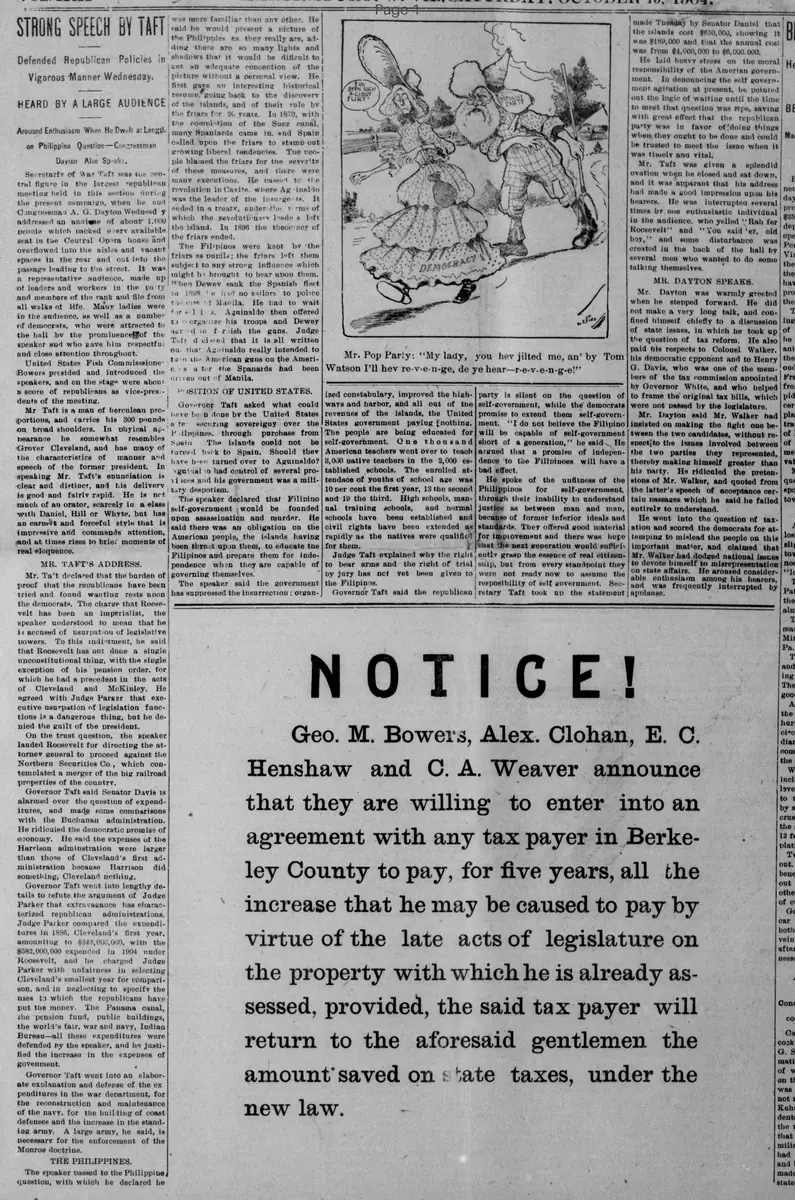
Defended Republican Policies in Vigorous Manner Wednesday,
HEARD BY A LARGE AUDIENCE
Aroused Enthusiasm When He Dwelt at Length on Philippine Question-Congressman Dayton Also Speaks.
Secretary of War Taft was the central figure in the largest republican meeting held in this section during the present campaign, when he and Congressman A. G. Dayton Wednesday addressed an audience of about 1,000 people which packed every available seat in the Central Opera house and overflowed into the aisles and vacant spaces in the rear and out into the passage leading to the street. It was a representative audience, made up of leaders and workers in the party and members of the rank and file from all walks of life. Many ladies were in the audience, as well as a number of democrats, who were attracted to the hall by the prominence of the speaker and who gave him respectful and close attention throughout.
United States Fish Commissioner Bowers presided and introduced the speakers, and on the stage were about a score of republicans as vice-presidents of the meeting.
Mr. Taft is a man of herculean proportions, and carries his 300 pounds on broad shoulders. In physical appearance he somewhat resembles Grover Cleveland, and has many of the characteristics of manner and speech of the former president. In speaking Mr. Taft's enunciation is clear and distinct, and his delivery is good and fairly rapid. He is not much of an orator, scarcely in a class with Daniel, Hill or White, but has an earnest and forceful style that is impressive and commands attention, and at times rises to brief moments of real eloquence.
MR. TAFT'S ADDRESS.
Mr. Taft declared that the burden of proof that the republicans have been tried and found wanting rests upon the democrats. The charge that Roosevelt has been an imperialist, the speaker understood to mean that he is accused of usurpation of legislative powers. To this indictment, he said that Roosevelt has not done a single unconstitutional thing, with the single exception of his pension order, for which he had a precedent in the acts of Cleveland and McKinley. He agreed with Judge Parker that executive usurpation of legislative functions is a dangerous thing, but he denied the guilt of the president.
On the trust question, the speaker lauded Roosevelt for directing the attorney general to proceed against the Northern Securities Co., which contemplated a merger of the big railroad properties of the country.
Governor Taft said Senator Davis is alarmed over the question of expenditures, and made some comparisons with the Buchanan administration. He ridiculed the democratic promise of economy. He said the expenses of the Harrison administration were larger than those of Cleveland's first administration because Harrison did something, Cleveland nothing.
Governor Taft went into lengthy details to refute the argument of Judge Parker that extravagance has characterized republican administrations. Judge Parker compared the expenditures in 1886, Cleveland's first year, amounting to $243,000,000, with the $582,000,000 expended in 1904 under Roosevelt, and he charged Judge Parker with unfairness in selecting Cleveland's smallest year for comparison, and in neglecting to specify the uses to which the republicans have put the money. The Panama canal, the pension fund, public buildings, the world's fair, war and navy, Indian Bureau-all these expenditures were defended by the speaker, and he justified the increase in the expenses of government.
Governor Taft went into an elaborate explanation and defense of the expenditures in the war department, for the reconstruction and maintenance of the navy, for the building of coast defenses and the increase in the standing army. A large army, he said, is necessary for the enforcement of the Monroe doctrine.
THE PHILIPPINES.
The speaker passed to the Philippine question, with which he declared he was more familiar than any other. He said he would present a picture of the Philippines as they really are, adding there are so many lights and shadows that it would be difficult to get an adequate conception of the picture without a personal view. He first gave an interesting historical resume, going back to the discovery of the islands, and of their rule by the friars for 200 years. In 1870, with the completion of the Suez canal, many Spaniards came in, and Spain called upon the friars to stamp out growing liberal tendencies. The people blamed the friars for the severity of these measures, and there were many executions. He passed to the revolution in Cavite, where Aguinaldo was the leader of the insurgents. It ended in a treaty, under the terms of which the revolutionary leaders left the island. In 1896 the theocracy of the friars ended.
The Filipinos were kept by the friars as pupils; the friars left them subject to any strong influence which might be brought to bear upon them. When Dewey sank the Spanish fleet in 1898, he had no sailors to police the city of Manila. He had to wait for soldiers. Aguinaldo then offered to organize his troops and Dewey agreed to furnish the guns. Governor Taft declared that it is all written that Aguinaldo really intended to turn the American guns on the Americans after the Spaniards had been driven out of Manila.
POSITION OF UNITED STATES.
Governor Taft asked what could have been done by the United States after securing sovereignty over the Philippines, through purchase from Spain. The islands could not be turned back to Spain. Should they have been turned over to Aguinaldo? Aguinaldo had control of several provinces and his government was a military despotism.
The speaker declared that Filipino self-government would be founded upon assassination and murder. He said there was an obligation on the American people, the islands having been thrust upon them, to educate the Filipinos and prepare them for independence when they are capable of governing themselves.
The speaker said the government has suppressed the insurrection; organized constabulary, improved the highways and harbor, and all out of the revenues of the islands, the United States government paying nothing.
The people are being educated for self-government. One thousand American teachers went over to teach 3,000 native teachers in the 2,000 established schools. The enrolled attendance of youths of school age was 10 per cent the first year, 13 the second and 19 the third. High schools, manual training schools, and normal schools have been established and civil rights have been extended as rapidly as the natives were qualified for them.
Governor Taft explained why the right to bear arms and the right of trial by jury has not yet been given to the Filipinos.
Governor Taft said the republican party is silent on the question of self-government, while the democrats promise to extend them self-government. "I do not believe the Filipino will be capable of self-government short of a generation," he said. He argued that a promise of independence to the Filipinos will have a bad effect.
He spoke of the unfitness of the Filipinos for self-government, through their inability to understand justice as between man and man, because of former inferior ideals and standards. They offered good material for improvement and there was hope that the next generation would sufficiently grasp the essence of real citizenship, but from every standpoint they were not ready now to assume the responsibility of self-government. Secretary Taft took up the statement made Tuesday by Senator Daniel that the islands cost $650,000, showing it was $69,000 and that the annual cost was from $4,000,000 to $6,000,000.
He laid heavy stress on the moral responsibility of the American government. In denouncing the self-government agitation at present, he pointed out the logic of waiting until the time to meet that question was ripe, saying with great effect that the republican party was in favor of doing things when they ought to be done and could be trusted to meet the issue when it was timely and vital.
Mr. Taft was given a splendid ovation when he closed and sat down, and it was apparent that his address had made a good impression upon his hearers. He was interrupted several times by one enthusiastic individual in the audience, who yelled "Rah fer Roosevelt" and "You said 'er, old boy," and some disturbance was created in the back of the hall by several men who wanted to do some talking themselves.
MR. DAYTON SPEAKS.
Mr. Dayton was warmly greeted when he stepped forward. He did not make a very long talk, and confined himself chiefly to a discussion of state issues, in which he took up the question of tax reform. He also paid his respects to Colonel Walker, his democratic opponent and to Henry G. Davis, who was one of the members of the tax commission appointed by Governor White, and who helped to frame the original tax bills, which were not passed by the legislature.
Mr. Dayton said Mr. Walker had insisted on making the fight one between the two candidates, without respect to the issues involved between the two parties they represented, thereby making himself greater than his party. He ridiculed the pretensions of Mr. Walker, and quoted from the latter's speech of acceptance certain passages which he said he failed entirely to understand.
He went into the question of taxation and scored the democrats for attempting to mislead the people on this important matter, and claimed that Mr. Walker had dodged national issues to devote himself to misrepresentation on state affairs. He aroused considerable enthusiasm among his hearers, and was frequently interrupted by applause.
What sub-type of article is it?
What themes does it cover?
What keywords are associated?
What entities or persons were involved?
Where did it happen?
Story Details
Key Persons
Location
Central Opera House
Event Date
Wednesday, 1904
Story Details
Secretary of War Taft defends Republican policies against Democratic criticisms, refuting charges of imperialism and extravagance, and provides a detailed historical and current account of U.S. administration in the Philippines, emphasizing education and preparation for future self-government; Congressman Dayton discusses state tax issues.