Thank you for visiting SNEWPapers!
Sign up free
Peninsula Enterprise
Accomac, Accomack County, Virginia
What is this article about?
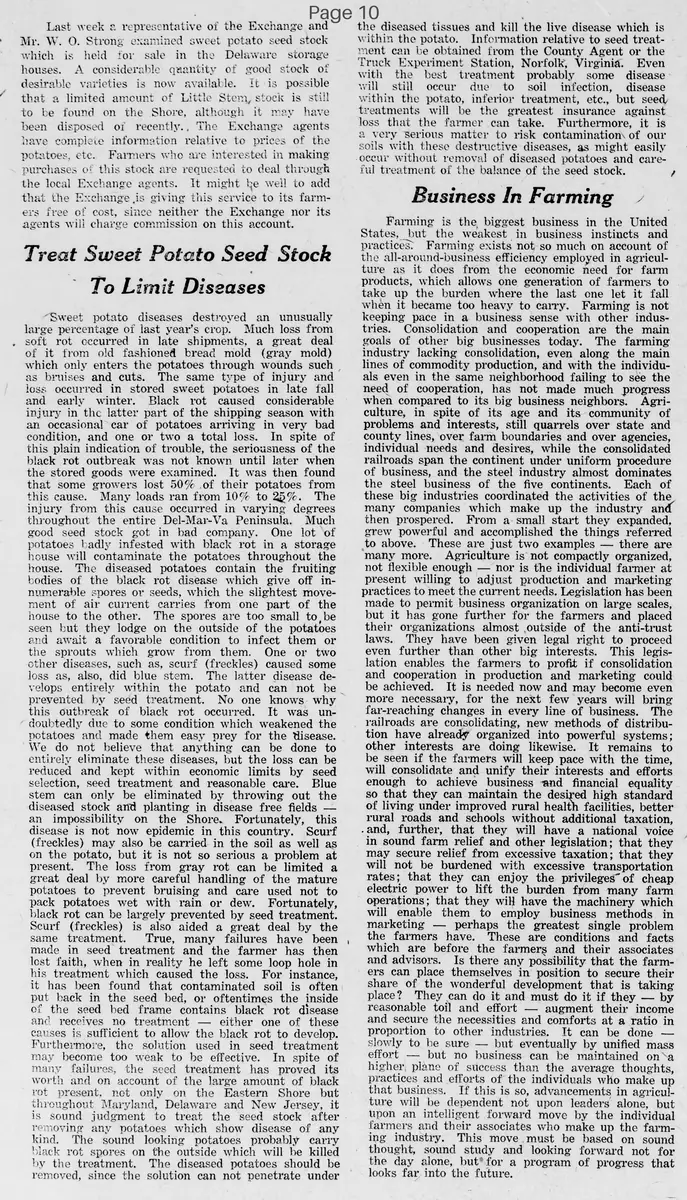
Agricultural report on available sweet potato seed stock in Delaware and advice on treating seeds to prevent diseases like black rot that devastated last year's Del-Mar-Va Peninsula crop; free service via Exchange agents.
Clipping
OCR Quality
Full Text
Treat Sweet Potato Seed Stock
To Limit Diseases
Sweet potato diseases destroyed an unusually large percentage of last year's crop. Much loss from soft rot occurred in late shipments, a great deal of it from old fashioned bread mold (gray mold) which only enters the potatoes through wounds such as bruises and cuts. The same type of injury and loss occurred in stored sweet potatoes in late fall and early winter. Black rot caused considerable injury in the latter part of the shipping season with an occasional car of potatoes arriving in very bad condition, and one or two a total loss. In spite of this plain indication of trouble, the seriousness of the black rot outbreak was not known until later when the stored goods were examined. It was then found that some growers lost 50% of their potatoes from this cause. Many loads ran from 10% to 25%. The injury from this cause occurred in varying degrees throughout the entire Del-Mar-Va Peninsula. Much good seed stock got in bad company. One lot of potatoes badly infested with black rot in a storage house will contaminate the potatoes throughout the house. The diseased potatoes contain the fruiting bodies of the black rot disease which give off innumerable spores or seeds, which the slightest movement of air current carries from one part of the house to the other. The spores are too small to be seen but they lodge on the outside of the potatoes and await a favorable condition to infect them or the sprouts which grow from them. One or two other diseases, such as, scurf (freckles) caused some loss as, also, did blue stem. The latter disease develops entirely within the potato and can not be prevented by seed treatment. No one knows why this outbreak of black rot occurred. It was undoubtedly due to some condition which weakened the potatoes and made them easy prey for the disease. We do not believe that anything can be done to entirely eliminate these diseases, but the loss can be reduced and kept within economic limits by seed selection, seed treatment and reasonable care. Blue stem can only be eliminated by throwing out the diseased stock and planting in disease free fields - an impossibility on the Shore. Fortunately, this disease is not now epidemic in this country. Scurf (freckles) may also be carried in the soil as well as on the potato, but it is not so serious a problem at present. The loss from gray rot can be limited a great deal by more careful handling of the mature potatoes to prevent bruising and care used not to pack potatoes wet with rain or dew. Fortunately, black rot can be largely prevented by seed treatment. Scurf (freckles) is also aided a great deal by the same treatment. True, many failures have been made in seed treatment and the farmer has then lost faith, when in reality he left some loop hole in his treatment which caused the loss. For instance, it has been found that contaminated soil is often put back in the seed bed, or oftentimes the inside of the seed bed frame contains black rot disease and receives no treatment - either one of these causes is sufficient to allow the black rot to develop. Furthermore, the solution used in seed treatment may become too weak to be effective. In spite of many failures, the seed treatment has proved its worth and on account of the large amount of black rot present, not only on the Eastern Shore but throughout Maryland, Delaware and New Jersey, it is sound judgment to treat the seed stock after removing any potatoes which show disease of any kind. The sound looking potatoes probably carry black rot spores on the outside which will be killed by the treatment. The diseased potatoes should be removed, since the solution can not penetrate under the diseased tissues and kill the live disease which is within the potato. Information relative to seed treatment can be obtained from the County Agent or the Truck Experiment Station, Norfolk, Virginia. Even with the best treatment probably some disease will still occur due to soil infection, disease within the potato, inferior treatment, etc., but seed treatments will be the greatest insurance against loss that the farmer can take. Furthermore, it is a very serious matter to risk contamination of our soils with these destructive diseases, as might easily occur without removal of diseased potatoes and careful treatment of the balance of the seed stock.
What sub-type of article is it?
What themes does it cover?
What keywords are associated?
What entities or persons were involved?
Where did it happen?
Story Details
Key Persons
Location
Del Mar Va Peninsula
Event Date
Last Week
Story Details
Examination of sweet potato seed stock in Delaware storage houses reveals good varieties available; farmers advised to purchase through Exchange agents for free. Last year's crop suffered heavy losses from diseases like black rot, gray mold, scurf, and blue stem; recommends seed selection, treatment, and careful handling to limit future losses, with info from County Agent or Norfolk station.