Thank you for visiting SNEWPapers!
Sign up free
Editorial
July 26, 1877
The Weekly Oskaloosa Herald
Oskaloosa, Mahaska County, Iowa
What is this article about?
The editorial mocks southern Democrats' hypocrisy in opposing federal troops in the South to protect citizens but now requesting U.S. Army intervention in West Virginia to suppress a railroad strike by firemen in Martinsburg.
Clipping
OCR Quality
95%
Excellent
Full Text
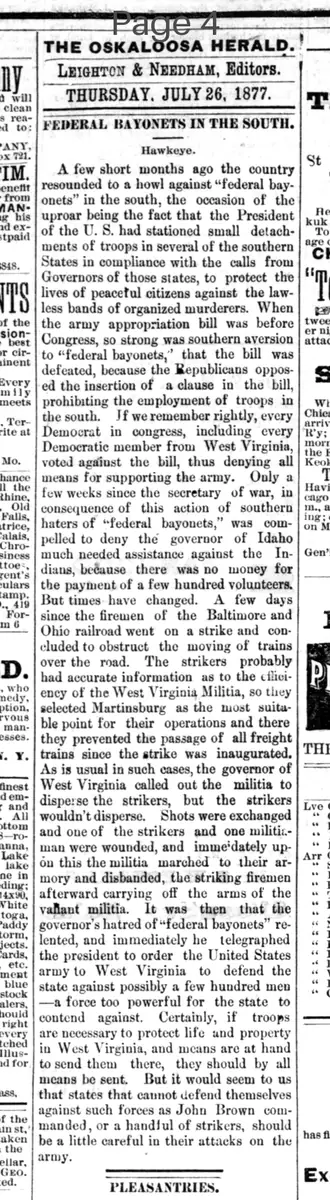
THE OSKALOOSA HERALD.
LEIGHTON & NEEDHAM, Editors.
THURSDAY, JULY 26, 1877.
FEDERAL BAYONETS IN THE SOUTH.
Hawkeye.
A few short months ago the country resounded to a howl against "federal bayonets" in the south, the occasion of the uproar being the fact that the President of the U. S. had stationed small detachments of troops in several of the southern States in compliance with the calls from Governors of those states, to protect the lives of peaceful citizens against the lawless bands of organized murderers. When the army appropriation bill was before Congress, so strong was southern aversion to "federal bayonets," that the bill was defeated, because the Republicans opposed the insertion of a clause in the bill prohibiting the employment of troops in the south. If we remember rightly, every Democrat in congress, including every Democratic member from West Virginia, voted against the bill, thus denying all means for supporting the army. Only a few weeks since the secretary of war, in consequence of this action of southern haters of "federal bayonets," was compelled to deny the governor of Idaho much needed assistance against the Indians, because there was no money for the payment of a few hundred volunteers.
But times have changed. A few days since the firemen of the Baltimore and Ohio railroad went on a strike and concluded to obstruct the moving of trains over the road. The strikers probably had accurate information as to the efficiency of the West Virginia Militia, so they selected Martinsburg as the most suitable point for their operations and there they prevented the passage of all freight trains since the strike was inaugurated. As is usual in such cases, the governor of West Virginia called out the militia to disperse the strikers, but the strikers wouldn't disperse. Shots were exchanged and one of the strikers and one militiaman were wounded, and immediately upon this the militia marched to their armory and disbanded, the striking firemen afterward carrying off the arms of the valiant militia. It was then that the governor's hatred of "federal bayonets" relented, and immediately he telegraphed the president to order the United States army to West Virginia to defend the state against possibly a few hundred men—a force too powerful for the state to contend against. Certainly, if troops are necessary to protect life and property in West Virginia, and means are at hand to send them there, they should by all means be sent. But it would seem to us that states that cannot defend themselves against such forces as John Brown commanded, or a handful of strikers, should be a little careful in their attacks on the army.
LEIGHTON & NEEDHAM, Editors.
THURSDAY, JULY 26, 1877.
FEDERAL BAYONETS IN THE SOUTH.
Hawkeye.
A few short months ago the country resounded to a howl against "federal bayonets" in the south, the occasion of the uproar being the fact that the President of the U. S. had stationed small detachments of troops in several of the southern States in compliance with the calls from Governors of those states, to protect the lives of peaceful citizens against the lawless bands of organized murderers. When the army appropriation bill was before Congress, so strong was southern aversion to "federal bayonets," that the bill was defeated, because the Republicans opposed the insertion of a clause in the bill prohibiting the employment of troops in the south. If we remember rightly, every Democrat in congress, including every Democratic member from West Virginia, voted against the bill, thus denying all means for supporting the army. Only a few weeks since the secretary of war, in consequence of this action of southern haters of "federal bayonets," was compelled to deny the governor of Idaho much needed assistance against the Indians, because there was no money for the payment of a few hundred volunteers.
But times have changed. A few days since the firemen of the Baltimore and Ohio railroad went on a strike and concluded to obstruct the moving of trains over the road. The strikers probably had accurate information as to the efficiency of the West Virginia Militia, so they selected Martinsburg as the most suitable point for their operations and there they prevented the passage of all freight trains since the strike was inaugurated. As is usual in such cases, the governor of West Virginia called out the militia to disperse the strikers, but the strikers wouldn't disperse. Shots were exchanged and one of the strikers and one militiaman were wounded, and immediately upon this the militia marched to their armory and disbanded, the striking firemen afterward carrying off the arms of the valiant militia. It was then that the governor's hatred of "federal bayonets" relented, and immediately he telegraphed the president to order the United States army to West Virginia to defend the state against possibly a few hundred men—a force too powerful for the state to contend against. Certainly, if troops are necessary to protect life and property in West Virginia, and means are at hand to send them there, they should by all means be sent. But it would seem to us that states that cannot defend themselves against such forces as John Brown commanded, or a handful of strikers, should be a little careful in their attacks on the army.
What sub-type of article is it?
Partisan Politics
Labor
Military Affairs
What keywords are associated?
Federal Bayonets
Southern Democrats
Railroad Strike
West Virginia Militia
Army Appropriation
Martinsburg Strike
What entities or persons were involved?
Democrats
Republicans
President Of The U. S.
Governor Of West Virginia
West Virginia Militia
Strikers
Baltimore And Ohio Railroad Firemen
Editorial Details
Primary Topic
Hypocrisy Of Democrats On Federal Troops In South Vs. West Virginia Strike
Stance / Tone
Critical And Sarcastic Of Democratic Inconsistency
Key Figures
Democrats
Republicans
President Of The U. S.
Governor Of West Virginia
West Virginia Militia
Strikers
Baltimore And Ohio Railroad Firemen
Key Arguments
Southern Democrats Opposed Federal Troops In The South But Now Request Them In West Virginia For Strike Suppression.
Democrats Defeated Army Appropriation Bill To Avoid Troops In South, Leading To Lack Of Funds For Other Needs Like Idaho Indians.
West Virginia Militia Failed Against Strikers, Prompting Governor To Seek Federal Intervention.
States Unable To Handle Small Threats Like John Brown's Raid Or Strikers Should Not Criticize The Army.