Thank you for visiting SNEWPapers!
Sign up free
Imperial Valley Press
El Centro, Imperial County, California
What is this article about?
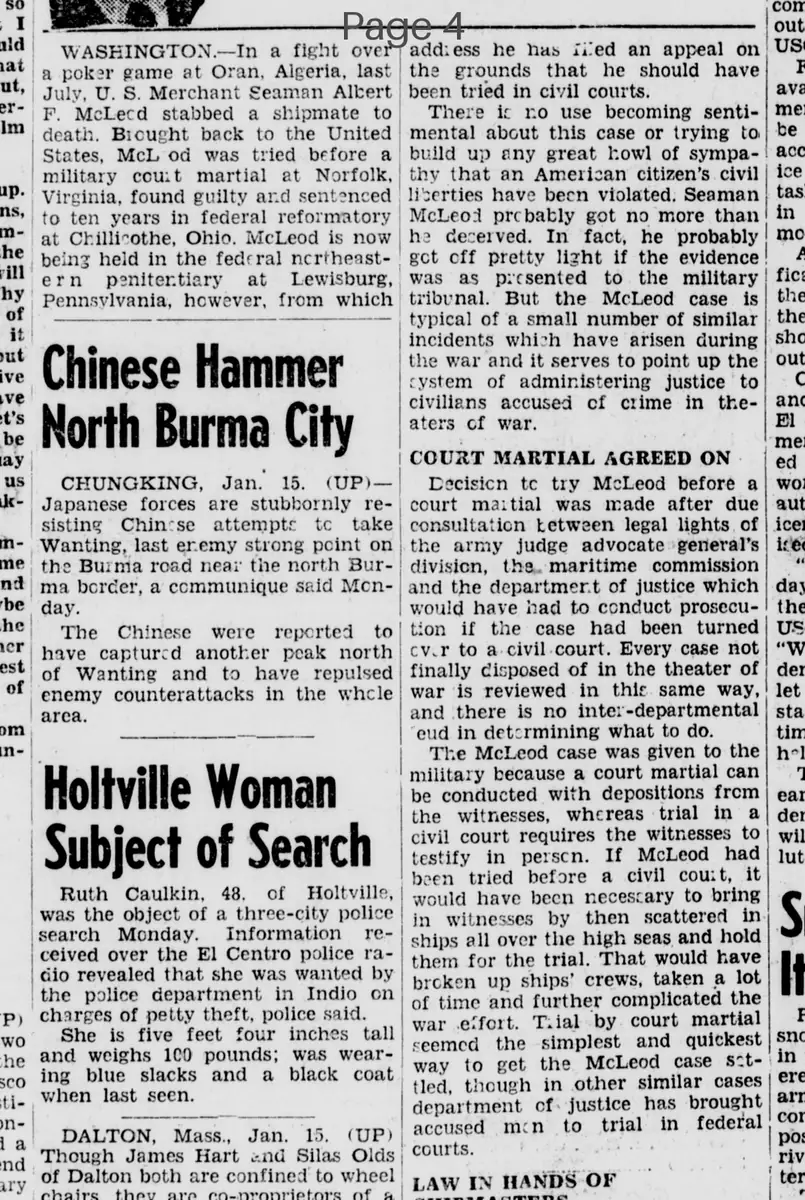
U.S. Merchant Seaman Albert F. McLeod stabbed a shipmate to death during a poker game in Oran, Algeria last July. Tried by military court martial in Norfolk, Virginia, he was sentenced to 10 years in Chillicothe, Ohio reformatory but is held in Lewisburg, Pennsylvania, appealing for civil court trial. Case highlights wartime justice for civilians.
Clipping
OCR Quality
Full Text
There is no use becoming sentimental about this case or trying to build up any great howl of sympathy that an American citizen's civil liberties have been violated. Seaman McLeod probably got no more than he deserved. In fact, he probably got off pretty light if the evidence was as presented to the military tribunal. But the McLeod case is typical of a small number of similar incidents which have arisen during the war and it serves to point up the system of administering justice to civilians accused of crime in theaters of war.
COURT MARTIAL AGREED ON
Decision to try McLeod before a court martial was made after due consultation between legal lights of the army judge advocate general's division, the maritime commission and the department of justice which would have had to conduct prosecution if the case had been turned over to a civil court. Every case not finally disposed of in the theater of war is reviewed in this same way, and there is no inter-departmental feud in determining what to do.
The McLeod case was given to the military because a court martial can be conducted with depositions from the witnesses, whereas trial in a civil court requires the witnesses to testify in person. If McLeod had been tried before a civil court, it would have been necessary to bring in witnesses then scattered in ships all over the high seas and hold them for the trial. That would have broken up ships' crews, taken a lot of time and further complicated the war effort. Trial by court martial seemed the simplest and quickest way to get the McLeod case settled, though in other similar cases department of justice has brought accused men to trial in federal courts.
LAW IN HANDS OF SHIPMASTERS
The right of the military to administer justice in such a case is well fixed by law and precedent. Navigation laws of the United States have been written with perhaps more detail than any other statute. The authority of shipmasters to "log" their crew members, forfeiting their pay and administering other disciplinary punishments, is well fixed. Shipmasters may even put men in irons for mutiny and the other more serious offenses at sea.
In criminal cases in time of war, the law gives the army and navy jurisdiction over all men with or accompanying the armed forces into a theater of war. The term "theater of war" hasn't been very accurately defined but it has been interpreted broadly as meaning any place armed cargo or personnel are being carried.
Army officers have asserted this authority more than navy officers to keep order in supply ports and on beachheads, where merchant ships unload. At the beginning of the war young merchant shipmasters tended to dump their disciplinary problems into the lap of the army authorities, but that has been largely corrected. It is only when they get a tough one, like the McLeod murder case, that the army gets called in.
And this McLeod case may set a precedent.
What sub-type of article is it?
What keywords are associated?
What entities or persons were involved?
Where did it happen?
Domestic News Details
Primary Location
Norfolk, Virginia
Event Date
Last July
Key Persons
Outcome
shipmate stabbed to death; mcleod found guilty, sentenced to ten years in federal reformatory at chillicothe, ohio; held in lewisburg, pennsylvania; filed appeal for civil court trial.
Event Details
In a fight over a poker game at Oran, Algeria, last July, U. S. Merchant Seaman Albert F. McLeod stabbed a shipmate to death. Brought back to the United States, McLeod was tried before a military court martial at Norfolk, Virginia, after consultation between army judge advocate general's division, maritime commission, and department of justice. The military trial used depositions to avoid disrupting witnesses at sea.