Thank you for visiting SNEWPapers!
Sign up free
Phenix Gazette
Alexandria, Virginia
What is this article about?
A pseudonymous letter critiques President Jackson's administration for partisanship, corruption, military-style rule, and abuse of power, contrasting it with the moderate, unifying approaches of Jefferson and Adams. It praises past leaders' virtues and calls for public vigilance and patriotism to restore national harmony.
Merged-components note: The editorial on page 3 is a direct continuation of the letter_to_editor from page 2, same topic and style, signed at end; merge into single letter_to_editor component.
Clippings
1 of 2
OCR Quality
Full Text
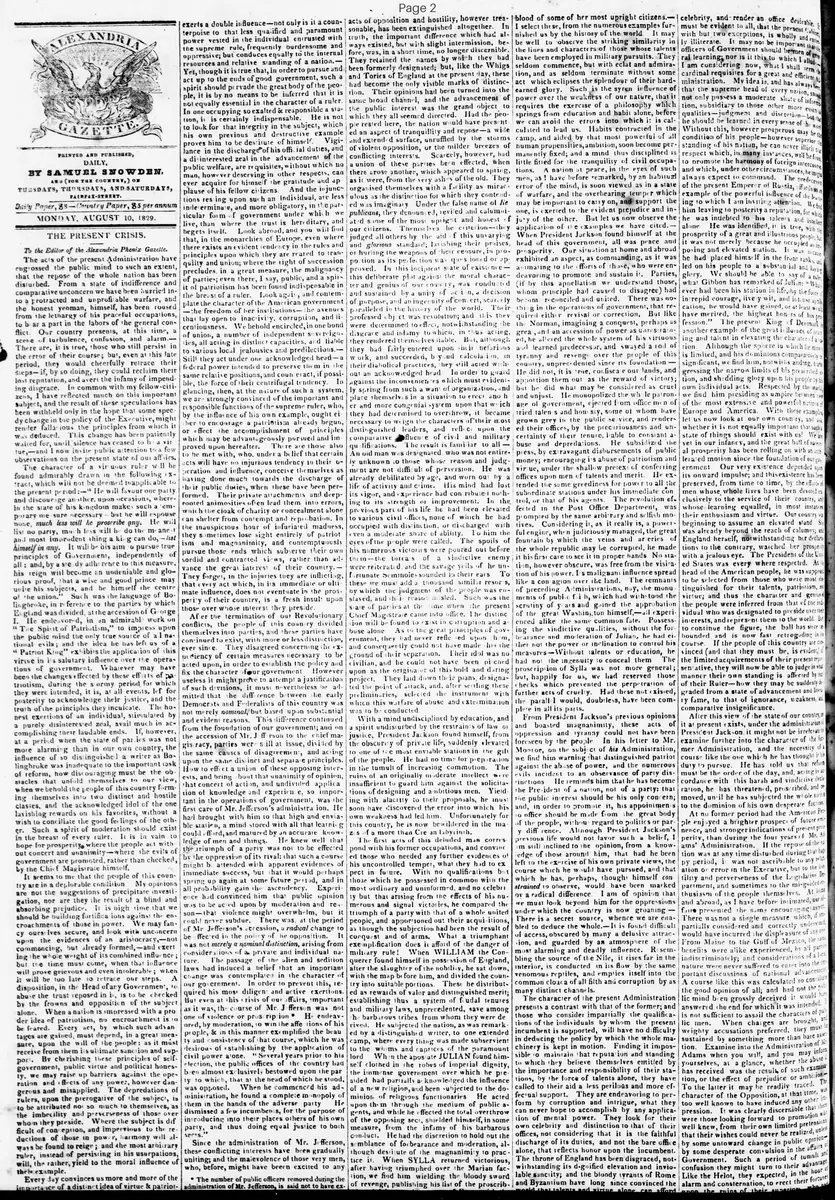
To the Editor of the Alexandria Phenix Gazette.
The acts of the present Administration have engrossed the public mind to such an extent, that the repose of the whole nation has been disturbed. From a state of indifference and comparative unconcern we have been hurried into a protracted and unprofitable warfare, and the honest yeoman, himself, has been roused from the lethargy of his peaceful occupations, to bear a part in the labors of the general conflict. Our country presents, at this time, a scene of turbulence, confusion, and alarm.
There are, it is true, those who still persist in the error of their course; but, even at this late period, they would cheerfully retrace their steps—if, by so doing, they could reclaim their lost reputation, and avert the infamy of impending disgrace. In common with my fellow-citizens, I have reflected much on this important subject, and the result of these speculations has been withheld only in the hope that some speedy change in the policy of the Executive, might render fallacious the principles from which it was deduced. This change has been patiently waited for, until silence has ceased to be a virtue,—and I now invite public attention to a few observations on the present state of our affairs.
The character of a virtuous ruler will be found admirably drawn in the following extract, which will not be deemed inapplicable to the present period:—"He will favour one party and discourage another, upon occasions, wherein the state of his kingdom makes such a temporary measure necessary—but he will espouse none, much less will he proscribe any. He will list no party, much less will he do that most imprudent thing a king can do,—list himself in any. It will be his aim to pursue true principles of Government, independently of all: and, by a steady adherence to this measure, his reign will become an undeniable and glorious proof, that a wise and good prince may unite his subjects, and be himself the centre of the union." Such was the language of Bolingbroke, in reference to the parties by which England was divided, at the accession of George I. He endeavored, in an admirable work on "The Spirit of Patriotism," to impress upon the public mind the only true source of national evils; and the idea he has left us of a "Patriot King" exhibits the application of this virtue in its salutary influence over the operations of government. Whatever may have been the changes effected by these efforts of patriotism, during the stormy period for which they were intended, it is, at all events, left for posterity to acknowledge their justice, and the truth of the principles they inculcate. The honest exertions of an individual, stimulated by a purely disinterested zeal, avail much in accomplishing their laudable ends. If, however, at a period when the state of parties was not more alarming than in our own country, the influence of so distinguished a writer as Bolingbroke was inadequate to the important task of reform, how discouraging must be the obstacles that unfold themselves to our view, when we behold the people of this country forming themselves into two distinct and hostile classes, and the acknowledged idol of the one lavishing rewards on his favorites, without a wish to conciliate the good feelings of the other. Such a spirit of moderation should exist in the breast of every ruler. It is in vain to hope for prosperity where the people act without concert and unanimity—where the evils of government are promoted, rather than checked, by the Chief Magistrate himself.
It seems to me that the people of this country are in a deplorable condition. My opinions are not the suggestions of precipitate investigation, nor are they the result of a blind and absorbing prejudice. It is high time that we should be building fortifications against the encroachments of those in power. We may fancy ourselves secure, and look with unconcern upon the evidences of an aristocracy,—not commencing, but already formed,—and exerting the whole weight of its combined influence; but the time must come, when that influence will prove grievous and even intolerable; when it will be too late to retrace our steps.
A disposition, in the Head of any Government, to abuse the trust reposed in it, is to be checked by the frowns and opposition of the subject alone. When a nation is impressed with a proper idea of patriotism, no encroachment is to be feared. Every act, by which such advantages are gained, must depend, in a great measure, upon the will of the people: as it must receive from them its ultimate sanction and support. By cherishing these principles of self-government, public virtue and political honesty, we may raise up barriers against the operation and effects of any power, however dangerous and misapplied. The depredations of rulers, upon the prerogative of the subject, is to be attributed not so much to themselves, as the imbecility and perverseness of those over whom they preside. Where the subject is difficult of conception, and impervious to the seductions of those in power, harmony will always be found to reign; and the most arbitrary ruler, instead of persisting in his usurpations, will, the rather, yield to the moral influence of their example.
Every day convinces us more and more of the importance of a distinct idea of virtue & patriotism. It exerts a double influence—not only is it a counterpoise to that less qualified and paramount power vested in the individual entrusted with the supreme rule, frequently burdensome and oppressive; but conduces equally to the internal resources and relative standing of a nation.
Yet, though it is true that, in order to pursue and act up to the ends of good government, such a spirit should pervade the great body of the people, it is by no means to be inferred that it is not equally essential in the character of a ruler. In one occupying so exalted & responsible a station, it is certainly indispensable. He is not to look for that integrity in the subject, which his own previous and destructive example proves him to be destitute of himself. Vigilance in the discharge of his official duties, and a disinterested zeal in the advancement of the public welfare, are requisites, without which no man, however deserving in other respects, can ever acquire for himself the gratitude and applause of his fellow citizens. And the injunctions resting upon such an individual, are less indeterminate, and more obligatory, in the particular form of government under which we live, than where the trust is hereditary, and begets itself. Look abroad, and you will find that, in the monarchies of Europe, even where there exists an evident tendency in the rules and principles upon which they are reared to tranquillity and union; where the right of succession precludes, in a great measure, the malignancy of parties; even there, I say, public, and a spirit of patriotism has been found indispensable in the breast of a ruler. Look again, and contemplate the character of the American government—the freedom of her institutions—the avenues that lay open to inactivity, corruption, and licentiousness. We behold encircled, in one bond of union, a number of independent sovereignties, all acting in distinct capacities, and liable to various local jealousies and predilections.
Still they act under one acknowledged head—a federal power intended to preserve them in the same relative positions, and counteract, if possible, the force of their centrifugal tendency. In glancing, then, at the nature of such a system, we are strongly convinced of the important and responsible functions of the supreme ruler, who, by the influence of his own example, ought either to encourage a patriotism already begun, or effect the accomplishment of principles which may be advantageously pursued and improved upon hereafter. There are those also to be met with, who, under a belief that certain acts will have no injurious tendency in their operation and influence, content themselves as having done much towards the discharge of their public duties, when these have been performed. Their private attachments and deep-rooted animosities often lead them into errors, which the cloak of charity or concealment alone can shelter from contempt and reprobation. In the inauspicious hour of infuriated madness, they sometimes lose sight entirely of patriotism and magnanimity, and contemptuously pursue those ends which subserve their own sordid and contracted views, rather than advance the great interest of their country.
They forget, in the injuries they are inflicting, that every act which, in its immediate or ultimate influence, does not eventuate in the prosperity of their country, is a fresh insult upon those over whose interest they preside.
After the termination of our Revolutionary conflicts, the people of this country divided themselves into parties, and these parties have continued to exist, with more or less distinction, ever since. They disagreed concerning the expediency of certain measures necessary to be acted upon, in order to establish the policy and fix the character of our government. However useless it might prove to attempt a justification of such divisions, it must nevertheless be admitted that the difference between the early Democrats and Federalists of this country was not merely nominal, but based upon substantial and evident reasons. This difference continued from the foundation of our government; and on the accession of Mr. Jefferson to the chief magistracy, parties were still at issue, divided by the same causes of disagreement, and acting upon the same distinct and separate principles.
How to effect a union of these opposing interests, and bring about that unanimity of opinion, that concert of action, and undivided application of knowledge and experience, so important in the operations of government, was the first care of Mr. Jefferson's administration. He had brought with him to that high and enviable station, a mind stored with all that learning could afford, and matured by an accurate knowledge of men and things. He knew well that the triumph of a party was not to be effected by the oppression of its rival: that such a course might be attended with apparent evidences of immediate success, but that it would perhaps spring up again at some future period, and in all probability gain the ascendency.
Experience had convinced him that public opinion was to be acted upon by moderation and reason—that violence might overwhelm, but it could never subdue. There was, at the period of Mr. Jefferson's succession, a radical change to be effected in the policy of the opposition. It was not merely a nominal distinction, arising from considerations of a private and individual nature.
The passage of the alien and sedition laws had induced a belief that an important change was contemplated in the character of our government. In order to prevent this, required his most diligent and active exertions. But even at this crisis of our affairs, important as it was, the course of Mr. Jefferson was not one of violence or proscription. He endeavored, by moderation, to win the affections of his people, & in this manner exemplified the beauty and consistency of that course, which he was desirous of establishing by the application of civil power alone. Several years prior to his election, the public offices of the country had been almost exclusively bestowed upon the party to which, that at the head of which he stood, was opposed. When he commenced his administration, he found a complete monopoly of them in the hands of the adverse party. He dismissed a few incumbents, for the purpose of introducing into their places others of his own party, and thus doing equal justice to both sects.
Since the administration of Mr. Jefferson, these conflicting interests have been gradually uniting; and the malevolence of those very men, who, before, might have been excited to any acts of opposition and hostility, however treasonable, has been extinguished altogether. In truth, the important difference which had always existed, but with slight intermission, before, was, in a short time, no longer discernible. They retained the names by which they had been formerly designated; but, like the Whigs and Tories of England at the present day, these had become the only visible marks of distinction. Their opinions had been turned into the same broad channel, and the advancement of the public interest was the grand object to which they all seemed directed. Had the people rested here, the nation would have presented an aspect of tranquillity and repose—a wide and extended surface, unruffled by the storms of violent opposition, or the milder breezes of conflicting interests. Scarcely, however, had a union of these parties been effected, when there arose another, which appeared to spring, as it were, from the very ashes of the old. They organized themselves with a facility as miraculous as the distinction for which they contended was imaginary. Under the false name of Republicans, they denounced, reviled and calumniated some of the most upright and honest of our citizens. Themselves the criterion—they judged all others by the aid of this unvarying and glorious standard; lavishing their praises, or hurling the weapons of their censure, in proportion as its perfection was questioned or approved. In this incipient state of existence—this deliberate plot against the moral character and genius of our country, was conducted and sustained by a unity of action, a decision of purpose, and an ingenuity of concert, scarcely paralleled in the history of the world. Their professed object was revolution; and this they were determined to effect, notwithstanding the disgrace and infamy to which, in thus acting, they rendered themselves liable. But, although they had fairly entered upon their nefarious work, and succeeded, by and calculation, in their diabolical practices, they still acted without an acknowledged head. In order to guard against the inconveniences which must evidently spring from such a want of organization, and place themselves in a situation to erect another and more congenial system upon that which they had determined to overthrow, it became necessary to weigh the characters of their most distinguished leaders, and reflect upon the comparative influence of civil and military qualifications. The result is familiar to all—An old man was designated who was not entirely unknown to those whose reason and judgment are not difficult of perversion. He was already debilitated by age, and worn out by a life of activity and crime. His mind had lost its vigor, and experience had contributed nothing to its strength or improvement. In the previous part of his life he had been elevated to various civil offices, none of which he had occupied with distinction, or discharged with even a moderate share of ability. To him the eyes of the people were called. The spoils of his numerous victories were poured out before them—the treasures of a vindictive enemy were reiterated, and the savage yells of the unfortunate Seminoles sounded in their ears. To these we must add a thousand similar resorts, by which the judgment of the people was enslaved, and their reason assailed. Such was the state of parties at the time when the present Chief Magistrate came into office. The distinction will be found to exist in corruption and abuse alone. As to the great principles of government, they had never reflected upon him, and consequently could not have made the ground of their separation. Their idol was no civilian, and he could not have been pitched upon as the original author of this bold and daring project. They laid down their plans, designated the point of attack, and, after settling these preliminaries, selected the instrument with which this warfare of abuse and extermination was to be conducted.
With a mind undisciplined by education, and a spirit undisturbed by the restraints of law or justice, President Jackson found himself, from the obscurity of private life, suddenly elevated to one of the most enviable stations in the gift of the people. He had no time for preparation in the tumult of increasing commotion. The ruins of an originally moderate intellect were insufficient to guard him against the solicitations of designing and ambitious men. Yielding with alacrity to their proposals, he must soon have discovered the error into which his own weakness had led him. Unfortunately for this country, he is now bewildered in the mazes of a more than Cretan labyrinth.
The first acts of this deluded man correspond with his former occupations, and convinced those who needed any further evidences of his uncontrolled temper, what they had to expect in future.
With no qualifications but those which he possessed in common with the most ordinary and uninformed, and no celebrity but that arising from the effects of his numerous and signal victories, he compared the triumph of a party with that of a whole united people, and apportioned out their acquisitions, as though the subjection had been the result of conquest and of arms. What a triumphant exemplification does it afford of the danger of military rule! When WILLIAM the Conqueror found himself in possession of England, after the slaughter of the nobility, he sat down, with the map before him, and divided the country into suitable portions. These he distributed as rewards of valor and distinguished merit; establishing thus a system of feudal tenures and military laws, unprecedented, save among the barbarous tribes from whom they were derived. He subjected the nation, as was remarked by a distinguished writer, to one extended camp, where every thing was made subservient to the whims and caprices of the paramount lord. When the apostate JULIAN found himself clothed in the robes of imperial dignity, the immense government over which he presided had partially acknowledged the influence of a new religion, and been subjected to the dominion of religious functionaries. He acted upon them through the medium of public agents, and while he effected the total overthrow of the opposing sect, shielded himself, in some measure, from the infamy of his barbarous conduct. He had the discretion to hold out the semblance of forbearance and moderation, although destitute of the magnanimity to practice it. When SYLLA returned victorious, after having triumphed over the Marian faction, we find him wielding the bloody sword of revenge, publishing his list of the proscribed, and staining the streets of Rome with the blood of some of her most upright citizens.
I select these, from the numerous examples furnished us by the history of the world. It may be well to observe the striking similarity in the lines and characters of those whose talents have been employed in military pursuits. They seldom commence, but with eclat and admiration, and as seldom terminate without some act which eclipses the splendour of their hard-earned glory. Such is the syren influence of power over the weakness of our nature, that it requires the exercise of a philosophy which springs from education and habit alone, before we can avoid the errors into which it is calculated to lead us. Habits contracted in the camp, and aided by that most powerful of all human propensities, ambition, soon become permanently fixed; and a mind thus disciplined is little fitted for the tranquility of civil occupations. A nation at peace, in the eyes of such men, as I have before remarked, by an habitual error of the mind, is soon viewed as in a state of warfare, and the overbearing temper which may be important to carry on, and support the one, is exerted to the evident prejudice and injury of the other. But let us now observe the application of the examples we have cited.
When President Jackson found himself at the head of this government, all was peace and prosperity. Our situation at home and abroad exhibited an aspect, as commanding, as it was animating to the efforts of those, who were endeavoring to promote and sustain it. Parties, (if by this appellation we understand those, whom principle had caused to disagree) had become reconciled and united. There was nothing in the operations of government, that required either revisal or correction. But like the Norman, imagining a conquest, perhaps as great, and an accession of power as unwarrantied, he altered the whole system of his virtuous and learned predecessor, and swayed a rod of tyranny and revenge over the people of this country, unprecedented since its foundation.
He did not, it is true, confiscate our lands, and apportion them out as the reward of victory: but he did what may be considered as cruel and unjust. He monopolized the whole patronage of government, ejected from office men of tried talents and honesty, some of whom have grown grey in the public service, and rendered their offices, by the precariousness and uncertainty of their tenure, liable to constant abuse and depredations. He subsidized the press, by extravagant disbursements of public money; encouraging its abuse of patriotism and virtue, under the shallow pretext of conferring offices upon men of talents and merit. He extended the same greediness for power to all the subordinate stations under his immediate control, or that of his agents. The revolution effected in the Post Office Department, was prompted by the same arbitrary and selfish motives. Considering it, as it really is, a powerful engine, when judiciously managed, the great fountain by which the veins and arteries of the whole republic may be corrupted, he made it his first care to see it in proper hands. No station, however obscure, was free from the visitation of his power. Its malignant influence spread like a contagion over the land. The remnants of preceding Administrations, nay, the monuments of public faith, which had withstood the scrutiny of years and gained the approbation of the great Washington himself,—all experienced alike the same common fate. Possessing the vindictive qualities, without the forbearance and moderation of Julian, he had either not the power or inclination to control his measures. Without talents or education, he had not the ingenuity to conceal them. The proscription of Sylla was not more general; but, happily for us, we had reserved those checks which prevented the perpetration of further acts of cruelty. Had these not existed, the parallel would, doubtless, have been complete in all its parts.
From President Jackson's previous opinions and boasted magnanimity, these acts of oppression and tyranny could not have been foreseen by the people. In his letter to Mr. Monroe, on the subject of his Administration, we find him warning that distinguished patriot against the abuse of power, and the numerous evils incident to an observance of party distinctions. He reminds him that he has become the President of a nation, not of a party: that the public interest should be his only concern; and, in order to promote it, his appointments to office should be made from the great body of the people, without regard to politics or party difference. Although President Jackson's previous life would not favor such a belief, I must still inclined to the opinion, from a knowledge of those around him, that had he been left to the exercise of his own private views, the course which he would have pursued, and that which he has, perhaps, thought himself constrained to observe, would have been marked by a radical difference. I am of opinion that we must look beyond him for the oppressions under which the country is now groaning.
There is a secret source, whence we are enabled to deduce the whole.—It is found difficult of access, obscured by many a delusive attraction, and guarded by an atmosphere of the most alarming and deadly influence. Resembling the source of the Nile, it rises far in the interior, is conducted in its flow by the same venomous reptiles, and empties itself into the common cloaca of all filth and corruption by as many distinct channels.
The character of the present Administration presents a contrast with that of the former; and those who consider impartially the qualifications of the individuals by whom the present incumbent is supported, will have no difficulty in deducing the policy by which the whole machinery is kept in motion. Finding it impossible to maintain that reputation and standing to which they believe themselves entitled by the importance and responsibility of their stations, by the force of talents alone, they have called to their aid a less perilous and more effectual support. They are endeavoring to perform by corruption and intrigue, what they can never hope to accomplish by any application of mental power. They look for their own celebrity and distinction to that of their offices, not considering that it is the faithful discharge of its duties, and not the bare office alone, that reflects honor upon the incumbent. The throne of England has been disgraced, notwithstanding its dignified elevation and inviolable sanctity; and the bloody tyrants of Rome and Byzantium have long since convinced the world that celebrity, and render an office desirable.
It must be evident to all, that the present Cabinet is filled with illiterate men but two exceptions. It may not be improper to remark, that the officers of Government should be men of real learning, considering nor is it now what to i shall.
Let us consider the cardinal requisites for a great and efficient Administration. My idea is and has that the supreme head of every nation not only possess a moderate share of information subsidiary to those other more essential qualities—judgment and discretion—but he should be learned in every sense of the word. However prosperous may be the condition of his people—however superior the standing of his nation be can never to respect promote which the in harmony many ins of foreign ances will be found and always which expect under to other circumstances command.
The predecessor of the present Emperor of Russia, affords us an example of the powerful influence of the learning to which I am inviting attention. We find him leaving to posterity a reputation, for which he was indebted to his talents and intellect alone. He was identified, it is true, with the prosperity of a great and illustrious people; but it was not merely because he occupied an imposing and elevated station. It was because he had placed himself in the front ranks led on his people to a substantial and lasting glory. We should be able to say of a ruler. What Gibbon has remarked of Julian: "Whatever had been his station in life, by the forced intrepid courage, lively wit, and intense application, he would have gained, or at least would have merited, the highest honors of his profession." The present King of Denmark another example of the great influence of learning and talent in elevating the character of a nation. Although the sphere in which he moves is limited, and his dominions comparatively insignificant, we find him, notwithstanding, transgressing the narrow limits of his prescribed condition, and shedding glory upon his people by his own individual acts. Respected by the world we find him presiding as umpire between the most extensive and powerful nations of Europe and America. With these examples let us now look at our own country, and ask whether it is not equally important that such a state of things should exist with us? We are yet in our infancy, and the great ball of national prosperity has been rolling on with an accelerated motion since the foundation of our government. Our very existence depended upon its onward impulse; and this existence has been preserved, from time to time, by the efforts of men whose whole lives have been devoted exclusively to the service of their country, and whose learning equalled, in most instances their enthusiasm and virtue. Our country was beginning to assume an elevated stand. It was already beyond the reach of calumny: and England herself, notwithstanding her declarations to the contrary, watched her prosperity with a jealous eye. The President of the United States was every where respected. At the head of the American people, he was supposed to be selected from those who were most distinguished for their talents, patriotism, virtue: and thus the character and genius of the people were inferred from that of the individual who was designated to preside over their interests, and represent them to the world. But to continue the figure, the ball has since then bounded and is now fast retrograding in its course. If the people of this country are convinced (and that they must be, is evident) of the limited acquirements of their present representative, they will now be able to judge in what manner their own standing is affected by that of their Ruler—how they may be suddenly degraded from a state of advancement and literary fame, to that of ignorance, weakness, and comparative insignificance.
After this view of the state of our country, as it at present exists, under the administration of President Jackson, it might not be irrelevant to examine further into the character of the former Administration, and the necessity of the course like the one which he has thought it his duty to pursue. He has told us that reform must be the order of the day, and, acting in accordance with this harsh and vindictive declaration, he has threatened, proscribed, and removed, until he has subjected the whole nation to the dominion of his own desperate faction.
At no former period had the American People enjoyed a brighter prospect of future eminence, and stronger indications of present prosperity, than during the four years of Mr. Adams' Administration. If the repose of the union was at any time disturbed during that happy period, it was not ascribable to any relaxation or error in the Executive, but to the hasty and perverseness of the Legislative Department, and sometimes to the mis-guided enthusiasm of the people themselves. At home and abroad, as I have before intimated, our affairs presented the same encouraging aspect. There was not a single measure which, if impartially considered and correctly understood, would have incurred the displeasure of any one. From Maine to the Gulf of Mexico, the same benefits were alike experienced, by all parties. No partiality or favoritism were never suffered to enter into the important discussions of national advancement; and considerations of abstract justice, and the good opinion of all; and had not the government been grossly deceived it would have answered the end for which it was intended.
A mind sufficient to assail the characters of public men.
When charges are brought, and weighty accusations preferred they must be sustained by something more than bare assertion.
yourselves, at a glance, whether the abuse to Adams when you will, and you may infer has received was the result of such examination.
To the latter it may be readily traced. The tion or the effect of prejudice or ambition too well known to have induced any other impression of the Opposition at that time was were those looking forward to promotion with It was clearly discernible that their wishes could never be realized, unless from their own limited pretensions by some untoward change in public opinion— by some desperate Government.
Such a period of tumult and convulsion in the affairs of Like the Helot, they expected, in the hour of confusion they might turn their advantage alarm and consternation, to erect their fortunes the ruins of their.
It is possible, to carry by force. And now that success gained by merit what they had determined, if possible, has crowned their efforts: and the country beginning to groan under the weight of their oppression, we may expose the motives by which these desperate efforts were prompted.
The excitement has passed away—the golden dream which these desperate efforts were prompted. The accession of Andrew Jackson, so far from realizing the blessings which were anticipated, have been reversed, and the American people, unclouded by the mists of deception and falsehood, and unadorned by the enlivening colors of art or sophistry. The whole picture discloses itself to the view of the American people in its native deformity. The lures of an imaginary glory no longer dazzle the eye. By a comparison of the present with the past, we are now to judge for ourselves. It should be our pride to correct it. The present condition of the country evinces by the present condition of the country. We are now to judge for ourselves.
Ellen, it must be recollected that it is never too late in life we discover the error into which we have been furnished by an acquaintance with the individual members who composed the Cabinet of General Jackson's predecessor, in regard to the ability with which the operations of this Government were conducted, will convince us how the picture then exhibited to the American people and to the world, was one worthy of contemplation. The President himself entered upon his duties with every qualification necessary to ensure him the applause of his fellow-citizens. He was an accomplished scholar—a man of science and learning—and had given to the world evidence of his genius and acquirements. Excepting Mr. Jefferson, he was probably not excelled by any of his predecessors. No man was better informed; and his superior knowledge in this respect may be gathered from the happy result of his Administration.
With the duties of a ruler, his whole life had been devoted to politics; and such was the ardor with which he devoted himself to the study, that he finally succeeded in mastering it, in its minutest detail. The Secretary of State had acquired equal celebrity. The pride of Kentucky, his talents placed him in a situation calculated to call forth his eloquence; and he soon convinced the nation of his gigantic powers. The laurel wreath was not long in suspense; and before his promotion to the Department of State, we find him occupying the most exalted station of any of his compeers. The people acknowledged the magic of his tongue; and posterity, in doing justice to his virtues, will contemplate, with admiration and gratitude, one who had occupied a distinguished post under Mr. Madison, in which he had given evidence of his superior qualifications as a financier. He had but few equals and no superior. In England he was respected, uniting the qualities of an accomplished gentleman with those of an able diplomatist.
The Secretary of the Navy was distinguished, in common with his associates, for a mind naturally strong and discriminating, and one which had been improved in early life by habits of the most rigid and intense application. He devoted himself to the duties of the Department over which he presided, with an assiduity scarcely credible. Under the happy auspices of his regenerating influence, our Navy advanced with gigantic strides. The discipline of her seamen gave a fresh impulse to his untiring effort; and her ships, regulated by the experience of other nations, and guided by the exact rules of mutual friendship and reciprocity, whitened every sea. His popularity equalled his success.
The Department of War had been, for some time, governed by a favorite son of Virginia, who, in accepting an important mission abroad, was succeeded by a gentleman whose name and services were familiar to the people of this country. With distinguished civil acquirements he united a knowledge of the tactics not exceeded perhaps by the present chief magistrate himself. His gallant conduct on the Niagara frontier, will be long remembered, and history will take a pride in recording his merits. The Attorney General was not less known and distinguished. Gifted with a genius of the most distinguished order, and talents the most commanding and brilliant, he had signalized himself in the various capacities of jurist and author, and extended his fame beyond the limits of the sphere in which he moved, and the country whose pride he had been. The pleasing orator—the solid reasoner—the profound scholar. He has left behind him a reputation, which, were he never to return, the learned sages of the judiciary will delight to cherish among their happiest recollections.
Such was the Administration of Mr. Adams. It becomes us now to say whether the revolution, which has lately taken place in the affairs of his country—was the result of necessity or revenge.
I have thus taken a general view of the present state of our affairs, under the administration of President Jackson. In this view, I have endeavored, as much as possible, to refrain from all unnecessary censure or abuse. If I have spoken freely, I trust it has been with impartiality. The characters of public men are entitled to respect, only as they have contributed to the general good. No station, in this country at least, however prominent, is a protection against the merited censure public men draw upon themselves, by their own extravagant and oppressive acts. It is not only allowed, but the duty of every good citizen, to expose these abuses whenever they occur, in order that the people, who have not the same opportunity of acquiring information, may know in whom they repose their confidence. Although we have little reason to expect a change in the policy of the executive we may at least be permitted to hope, that our situation may not be more alarming than it is at present.
It rests with the people to decide, whether they will submit without a murmur to this abuse of their confidence and power. The reputation acquired by our ancestors, is too remarkable to be suffered to retrograde in the hands of their posterity be queathing us his happy Republic which they redeemed with their own blood. They confided in our protection; and we should not be regardless of their example. I trust the people may now feel the importance and necessity of their exertions that the great Ruler of the Universe—the guardian of our lives and liberties—may save us from impending destruction.
ALEXANDER SEYERUS.
What sub-type of article is it?
What themes does it cover?
What keywords are associated?
What entities or persons were involved?
Letter to Editor Details
Author
Alexander Seyerus
Recipient
To The Editor Of The Alexandria Phenix Gazette.
Main Argument
president jackson's administration promotes party divisions, corruption, and tyrannical abuse of power through military-like rule and patronage monopolization, contrasting sharply with the moderate, unifying, and virtuous leadership of predecessors like jefferson and adams; the people must embrace patriotism to check such encroachments and restore national harmony.
Notable Details