Thank you for visiting SNEWPapers!
Sign up free
Story
July 31, 1887
The Indianapolis Journal
Indianapolis, Marion County, Indiana
What is this article about?
Critique from San Francisco Argonaut on the fall of the American legal profession from a dignified, moral calling to a corrupt field admitting unqualified individuals who promote litigation, aid crime, and undermine justice for personal gain.
Clipping
OCR Quality
95%
Excellent
Full Text
THE LEGAL FRATERNITY.
An Excoriation Which Will Meet with Disapproval in Some Quarters.
San Francisco Argonaut.
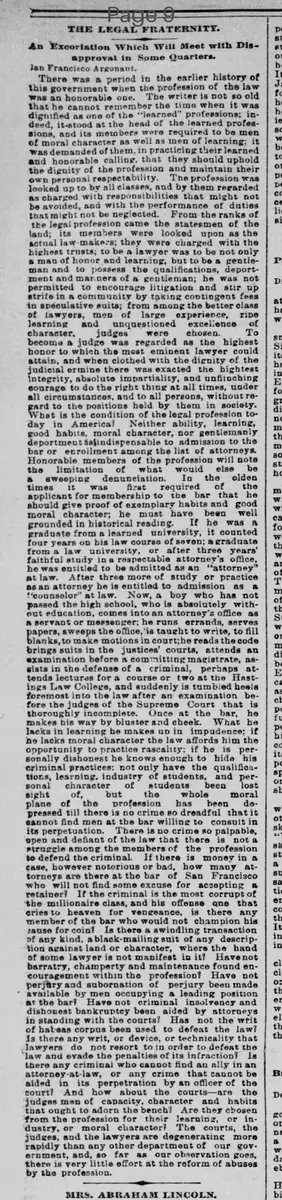
There was a period in the earlier history of this government when the profession of the law was an honorable one. The writer is not so old that he cannot remember the time when it was dignified as one of the "learned" professions; indeed, it stood at the head of the learned professions, and its members were required to be men of moral character as well as men of learning; it was demanded of them, in practicing their learned and honorable calling, that they should uphold the dignity of the profession and maintain their own personal respectability. The profession was looked up to by all classes, and by them regarded as charged with responsibilities that might not be avoided, and with the performance of duties that might not be neglected. From the ranks of the legal profession came the statesmen of the land; its members were looked upon as the actual law-makers; they were charged with the highest trusts; to be a lawyer was to be not only a man of honor and learning, but to be a gentleman and to possess the qualifications, deportment and manners of a gentleman; he was not permitted to encourage litigation and stir up strife in a community by taking contingent fees in speculative suits: from among the better class of lawyers, men of large experience, ripe learning and unquestioned excellence of character, judges were chosen. To become a judge was regarded as the highest honor to which the most eminent lawyer could attain, and when clothed with the dignity of the judicial ermine there was exacted the highest integrity, absolute impartiality, and unflinching courage to do the right thing at all times, under all circumstances, and to all persons, without regard to the positions held by them in society. What is the condition of the legal profession to-day in America? Neither ability, learning, good habits, moral character, nor gentlemanly deportment is indispensable to admission to the bar or enrollment among the list of attorneys. Honorable members of the profession will note the limitation of what would else be sweeping denunciation. In the olden times it was first required of the applicant for membership to the bar that he should give proof of exemplary habits and good moral character; he must have been well grounded in historical reading. If he was a graduate from a learned university, it counted four years on his law course of seven; a graduate from a law university, or after three years' faithful study in a respectable attorney's office, he was entitled to be admitted as an "attorney" at law. After three more years of study or practice as an attorney he was entitled to admission as a "counselor" at law. Now, a boy who has not passed the high school, who is absolutely without education, comes into an attorney's office as a servant or messenger; he runs errands, serves papers, sweeps the office, is taught to write, to fill blanks, to make motions in court; he reads the code, brings suits in the justices' courts, attends an examination before a committing magistrate, assists in the defense of a criminal, perhaps attends lectures for a course or two at the Hastings Law College, and suddenly is tumbled heels foremost into the law after an examination before the judges of the Supreme Court that is thoroughly incomplete. Once at the bar, he makes his way by bluster and cheek. What he lacks in learning he makes up in impudence: if he lacks moral character the law affords him the opportunity to practice rascality; if he is personally dishonest he knows enough to hide his criminal practices: not only have the qualifications, learning, industry of students, and personal character of students been lost sight of, but the whole moral plane of the profession has been depressed till there is no crime so dreadful that it cannot find men at the bar willing to consult in its perpetration. There is no crime so palpable, open and defiant of the law that there is not a struggle among the members of the profession to defend the criminal. If there is money in a case, however notorious or bad, how many attorneys are there at the bar of San Francisco who will not find some excuse for accepting a retainer? If the criminal is the most corrupt of the millionaire class, and his offense one that cries to heaven for vengeance, is there any member of the bar who would not champion his cause for coin? Is there a swindling transaction of any kind, a black-mailing suit of any description against land or character, where the hand of some lawyer is not manifest in it? Have not barratry, champerty and maintenance found encouragement within the profession? Have not perjury and subornation of perjury been made available by men occupying a leading position at the bar? Have not criminal insolvency and dishonest bankruptcy been aided by attorneys in standing with the courts? Has not the writ of habeas corpus been used to defeat the law? Is there any writ, or device, or technicality that lawyers do not resort to in order to defeat the law and evade the penalties of its infraction? Is there any criminal who cannot find an ally in an attorney-at-law, or any crime that cannot be aided in its perpetration by an officer of the court? And how about the courts—are the judges men of capacity, character and habits that ought to adorn the bench? Are they chosen from the profession for their learning, or industry, or moral character? The courts, the judges, and the lawyers are degenerating more rapidly than any other department of our government, and, so far as our observation goes, there is very little effort at the reform of abuses by the profession.
An Excoriation Which Will Meet with Disapproval in Some Quarters.
San Francisco Argonaut.
There was a period in the earlier history of this government when the profession of the law was an honorable one. The writer is not so old that he cannot remember the time when it was dignified as one of the "learned" professions; indeed, it stood at the head of the learned professions, and its members were required to be men of moral character as well as men of learning; it was demanded of them, in practicing their learned and honorable calling, that they should uphold the dignity of the profession and maintain their own personal respectability. The profession was looked up to by all classes, and by them regarded as charged with responsibilities that might not be avoided, and with the performance of duties that might not be neglected. From the ranks of the legal profession came the statesmen of the land; its members were looked upon as the actual law-makers; they were charged with the highest trusts; to be a lawyer was to be not only a man of honor and learning, but to be a gentleman and to possess the qualifications, deportment and manners of a gentleman; he was not permitted to encourage litigation and stir up strife in a community by taking contingent fees in speculative suits: from among the better class of lawyers, men of large experience, ripe learning and unquestioned excellence of character, judges were chosen. To become a judge was regarded as the highest honor to which the most eminent lawyer could attain, and when clothed with the dignity of the judicial ermine there was exacted the highest integrity, absolute impartiality, and unflinching courage to do the right thing at all times, under all circumstances, and to all persons, without regard to the positions held by them in society. What is the condition of the legal profession to-day in America? Neither ability, learning, good habits, moral character, nor gentlemanly deportment is indispensable to admission to the bar or enrollment among the list of attorneys. Honorable members of the profession will note the limitation of what would else be sweeping denunciation. In the olden times it was first required of the applicant for membership to the bar that he should give proof of exemplary habits and good moral character; he must have been well grounded in historical reading. If he was a graduate from a learned university, it counted four years on his law course of seven; a graduate from a law university, or after three years' faithful study in a respectable attorney's office, he was entitled to be admitted as an "attorney" at law. After three more years of study or practice as an attorney he was entitled to admission as a "counselor" at law. Now, a boy who has not passed the high school, who is absolutely without education, comes into an attorney's office as a servant or messenger; he runs errands, serves papers, sweeps the office, is taught to write, to fill blanks, to make motions in court; he reads the code, brings suits in the justices' courts, attends an examination before a committing magistrate, assists in the defense of a criminal, perhaps attends lectures for a course or two at the Hastings Law College, and suddenly is tumbled heels foremost into the law after an examination before the judges of the Supreme Court that is thoroughly incomplete. Once at the bar, he makes his way by bluster and cheek. What he lacks in learning he makes up in impudence: if he lacks moral character the law affords him the opportunity to practice rascality; if he is personally dishonest he knows enough to hide his criminal practices: not only have the qualifications, learning, industry of students, and personal character of students been lost sight of, but the whole moral plane of the profession has been depressed till there is no crime so dreadful that it cannot find men at the bar willing to consult in its perpetration. There is no crime so palpable, open and defiant of the law that there is not a struggle among the members of the profession to defend the criminal. If there is money in a case, however notorious or bad, how many attorneys are there at the bar of San Francisco who will not find some excuse for accepting a retainer? If the criminal is the most corrupt of the millionaire class, and his offense one that cries to heaven for vengeance, is there any member of the bar who would not champion his cause for coin? Is there a swindling transaction of any kind, a black-mailing suit of any description against land or character, where the hand of some lawyer is not manifest in it? Have not barratry, champerty and maintenance found encouragement within the profession? Have not perjury and subornation of perjury been made available by men occupying a leading position at the bar? Have not criminal insolvency and dishonest bankruptcy been aided by attorneys in standing with the courts? Has not the writ of habeas corpus been used to defeat the law? Is there any writ, or device, or technicality that lawyers do not resort to in order to defeat the law and evade the penalties of its infraction? Is there any criminal who cannot find an ally in an attorney-at-law, or any crime that cannot be aided in its perpetration by an officer of the court? And how about the courts—are the judges men of capacity, character and habits that ought to adorn the bench? Are they chosen from the profession for their learning, or industry, or moral character? The courts, the judges, and the lawyers are degenerating more rapidly than any other department of our government, and, so far as our observation goes, there is very little effort at the reform of abuses by the profession.
What sub-type of article is it?
Historical Event
What themes does it cover?
Moral Virtue
Deception
Justice
What keywords are associated?
Legal Profession
Decline
Corruption
Attorneys
Judges
Moral Character
Unethical Practices
Where did it happen?
America
Story Details
Location
America
Story Details
Contrast between the honorable past of the legal profession, requiring moral character and learning, and its current degraded state with unqualified, unethical lawyers aiding crime and corruption for profit, and judges lacking integrity.