Thank you for visiting SNEWPapers!
Sign up free
Literary
July 2, 1857
The Westerly Echo, & Pawcatuck Advertiser
Westerly, Washington County, Rhode Island
What is this article about?
A poor naval lieutenant, Ferris Harvard, loves Anne, daughter of wealthy Bostonian Harris H—. Her father tests Ferris's character by disguising as a beggar and receiving alms twice. Impressed by his generosity and virtue, the father consents to their marriage and rewards him richly.
Clipping
OCR Quality
85%
Good
Full Text
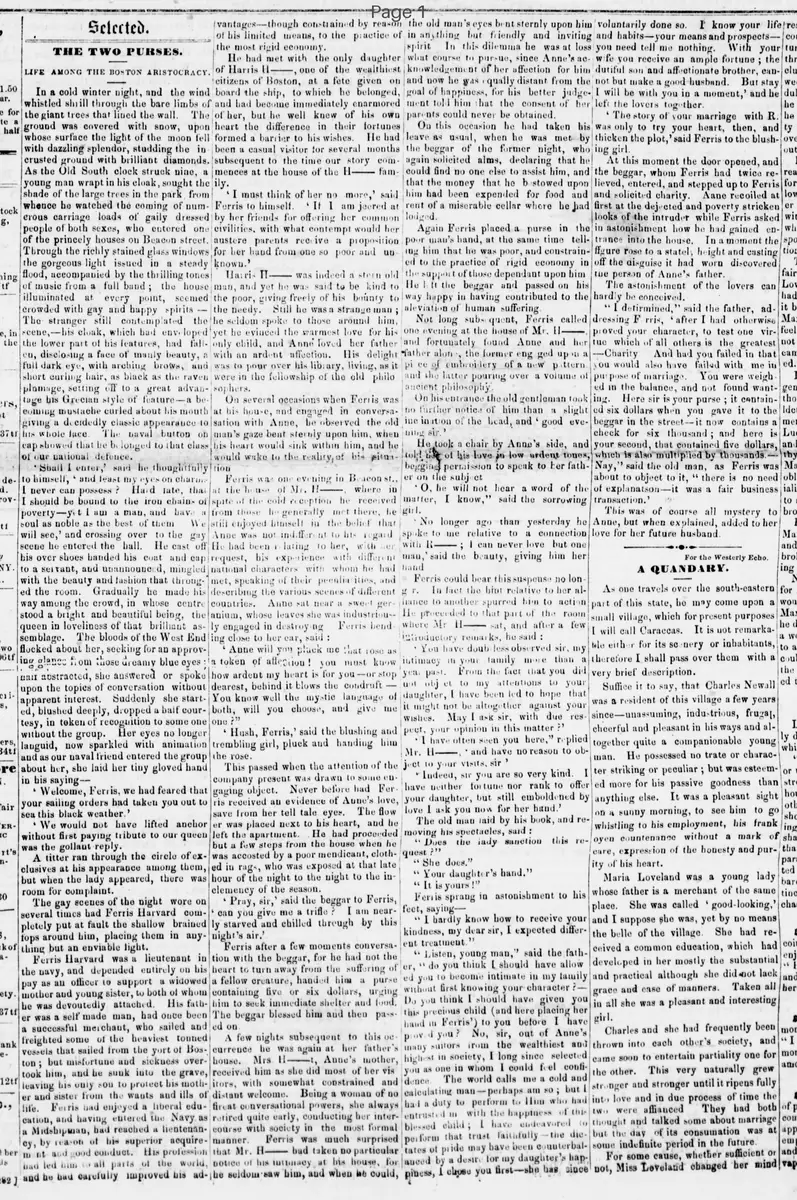
THE TWO PURSES.
LIFE AMONG THE BOSTON ARISTOCRACY.
In a cold winter night, and the wind whistled shrill through the bare limbs of the giant trees that lined the wall. The ground was covered with snow, upon whose surface the light of the moon fell with dazzling splendor, studding the incrusted ground with brilliant diamonds.
As the Old South clock struck nine, a young man wrapt in his cloak, sought the shade of the large trees in the park from whence he watched the coming of numerous carriage loads of gaily dressed people of both sexes, who entered one of the princely houses on Beacon street.
Through the richly stained glass windows the gorgeous light issued in a steady flood, accompanied by the thrilling tones of music from a full band; the house illuminated at every point, seemed crowded with gay and happy spirits—
The stranger still contemplated the scene,—his cloak, which had enveloped the lower part of his features, had fallen, disclosing a face of manly beauty, a full dark eye, with arching brows, and short curling hair, as black as the raven plumage, setting off to a great advantage his Grecian style of feature—a becoming mustache curled about his mouth giving a decidedly classic appearance to his whole face. The naval button on his cap showed that he belonged to that class of our national defence.
'Shall I enter,' said he thoughtfully to himself, 'and feast my eyes on charms I never can possess? Hard fate, that I should be bound to the iron chain—of poverty—yet I am a man, and have a soul as noble as the best of them. We will see,' and crossing over to the gay scene he entered the hall. He cast off his overshoes handed his coat and cap to a servant, and unannounced, mingled with the beauty and fashion that thronged the room. Gradually he made his way among the crowd, in whose centre stood a bright and beautiful being, the queen in loveliness of that brilliant assemblage. The bloods of the West End flocked about her, seeking for an approving glance from those dreamy blue eyes: not abstracted, she answered or spoke upon the topics of conversation without apparent interest. Suddenly she started, blushed deeply, dropped a half courtesy, in token of recognition to some one without the group. Her eyes no longer languid, now sparkled with animation and as our naval friend entered the group about her, she laid her tiny gloved hand in his saying—
Welcome, Ferris. we had feared that your sailing orders had taken you out to sea this black weather.'
We would not have lifted anchor without first paying tribute to our queen was the gallant reply.
A titter ran through the circle of exclusives at his appearance among them, but when the lady appeared, there was room for complaint.
The gay scenes of the night wore on several times had Ferris Harvard completely put at fault the shallow brained fops around him, placing them in anything but an enviable light.
Ferris Harvard was a lieutenant in the navy, and depended entirely on his pay as an officer to support a widowed mother and young sister, to both of whom he was devoutly attached. His father was a self made man, had once been a successful merchant, who sailed and freighted some of the heaviest toned vessels that sailed from the port of Boston; but misfortune and sickness overtook him, and he sunk into the grave, leaving his only son to protect his mother and sister from the wants and ills of life. Ferris had enjoyed a liberal education, and having entered the Navy as a Midshipman, had reached a lieutenancy, by reason of his superior acquirements and good conduct. His profession had led him to all parts of the world. and he had carefully improved his advantages—though constrained by reason of his limited means, to the practice of the most rigid economy.
He had met with the only daughter of Harris H—, one of the wealthiest citizens of Boston, at a fete given on board the ship, to which he belonged, and had become immediately enamored of her, but he well knew of his own heart the difference in their fortunes formed a barrier to his wishes. He had been a casual visitor for several months subsequent to the time our story commences at the house of the H— family.
I must think of her no more,' said Ferris to himself. 'If I am jeered at by her friends for offering her common civilities, with what contempt would her austere parents receive a proposition for her hand from one so poor and unknown.'
Harris H— was indeed a stern old man, and yet he was said to be kind to the poor, giving freely of his bounty to the needy. Still he was a strange man ; he seldom spoke to those around him. yet he evinced the warmest love for his only child, and Anne loved her father with an ardent affection. His delight was to pore over his library, living, as it were in the fellowship of the old philosophers.
On several occasions when Ferris was at his house, and engaged in conversation with Anne, he observed the old man's gaze bent sternly upon him, when his heart would sink within him, and he would wake to the reality of his situation
Ferris was one evening in Beacon st., at the house of Mr. H—, where in spite of the cold reception he received from those he generally met there, he still enjoyed himself in the belief that Anne was not indifferent to his regard He had been relating to her, with her request, his experience with different national characters with whom he had met, speaking of their peculiarities, and describing the various scenes of different countries. Anne sat near a sweet geranium, whose leaves she was industriously engaged in destroying Ferris bending close to her ear, said :
Anne will you pluck me that rose as a token of affection! you must know how ardent my heart is for you—or stop dearest, behind it blows the coneflower— You know well the mystic language of both, will you choose, and give me one ?"
Hush, Ferris,' said the blushing and trembling girl, pluck and handing him the rose.
This passed when the attention of the company present was drawn to some engaging object. Never before had Ferris received an evidence of Anne's love, save from her tell tale eyes. The flower was placed next to his heart, and he left the apartment. He had proceeded but a few steps from the house when he was accosted by a poor mendicant, clothed in rags, who was exposed at that late hour of the night to the inclemency of the season.
Pray, sir,' said the beggar to Ferris, 'can you give me a trifle ? I am nearly starved and chilled through by this night's air.'
Ferris after a few moments conversation with the beggar, for he had not the heart to turn away from the suffering of a fellow creature, handed him a purse containing five or six dollars, urging him to seek immediate shelter and food.
The beggar blessed him and then passed on
A few nights subsequent to this occurrence he was again at her father's house. Mrs H—, Anne's mother, received him as she did most of her visitors, with somewhat constrained and distant welcome. Being a woman of no great conversational powers, she always retired quite early, conducting her intercourse with society in the most formal manner. Ferris was much surprised that Mr. H— had taken no particular notice of his multiplicity at his house, for he seldom saw him, and when he could, parents could never be obtained.
On this occasion he had taken his leave as usual, when he was met by the beggar of the former night, who again solicited alms, declaring that he could find no one else to assist him, and that the money that he bestowed upon him had been expended for food and rent of a miserable cellar where he had lodged.
Again Ferris placed a purse in the poor man's hand, at the same time telling him that he was poor, and constrained to the practice of rigid economy in the support of those dependant upon him He left the beggar and passed on his way happy in having contributed to the alleviation of human suffering
Not long subsequent, Ferris called one evening at the house of Mr. H—. and fortunately found Anne and her father alone, the former engaged upon a piece of embroidery of a new pattern and the latter pouring over a volume of ancient philosophy
On his entrance the old gentleman took no further notice of him than a slight inclination of the head, and good evening sir.'
He took a chair by Anne's side, and told her of his love in low ardent tones, begging permission to speak to her father on the subject
O, he will not hear a word of the matter, I know," said the sorrowing girl.
'No longer ago than yesterday he spoke to me relative to a connection with R—; I can never love but one man,' said the beauty, giving him her hand
Ferris could bear this suspense no longer. In fact the hint relative to her alliance to another spurred him to action He proceeded to that part of the room where Mr H— sat, and after a few introductory remarks, he said :
'You have doubtless observed sir, my intimacy in your family more than a year past. From the fact that you did not object to my attentions to your daughter, I have been led to hope that it might not be altogether against your wishes. May I ask sir, with due respect, your opinion in this matter ?'
I have often seen you here," replied Mr. H—, and have no reason to object to your visits, sir'
Indeed, sir you are so very kind. I have neither fortune nor rank to offer your daughter, but still emboldened by love I ask you now for her hand.'
The old man laid by his book, and removing his spectacles, said :
"Does the lady sanction this request?"
"She does."
"Your daughter's hand."
"It is yours!"
Ferris sprang in astonishment to his feet, saying
" I hardly know how to receive your kindness, my dear sir, I expected different treatment."
" Listen, young man," said the father, " do you think I should have allowed you to become intimate in my family without first knowing your character?— Do you think I should have given you this precious child (and here placing her hand in Ferris') to you before I have proved you? No, sir, out of Anne's many suitors from the wealthiest and highest in society, I long since selected you as one in whom I could feel confidence The world calls me a cold and calculating man—perhaps I am so ; but I had a duty to perform to Him who had entrusted me with the happiness of this blessed child; I have endeavored to perform that trust faithfully —the dictates of pride may have been counterbalanced by a desire for my daughter's happiness, I chose you first—she has since
The story of your marriage with R was only to try your heart, then, and thicken the plot,' said Ferris to the blushing girl.
At this moment the door opened, and the beggar, whom Ferris had twice relieved, entered, and stepped up to Ferris and solicited charity. Anne recoiled at first at the dejected and poverty stricken looks of the intruder while Ferris asked in astonishment how he had gained entrance into the house. In a moment the figure rose to a stately height and casting off the disguise it had worn discovered the person of Anne's father.
The astonishment of the lovers can hardly be conceived.
"I determined," said the father, addressing Ferris, 'after I had otherwise proved your character, to test one virtue which of all others is the greatest —Charity And had you failed in that you would also have failed with me in purpose of marriage. You were weighed in the balance, and not found wanting. Here sir is your purse; it contained six dollars when you gave it to the beggar in the street—it now contains a check for six thousand: and here is your second, that contained five dollars, which is also multiplied by thousands.
Nay," said the old man, as Ferris was about to object to it, " there is no need of explanation—it was a fair business transaction.'
This was of course all mystery to Anne, but when explained, added to her love for her future husband.
LIFE AMONG THE BOSTON ARISTOCRACY.
In a cold winter night, and the wind whistled shrill through the bare limbs of the giant trees that lined the wall. The ground was covered with snow, upon whose surface the light of the moon fell with dazzling splendor, studding the incrusted ground with brilliant diamonds.
As the Old South clock struck nine, a young man wrapt in his cloak, sought the shade of the large trees in the park from whence he watched the coming of numerous carriage loads of gaily dressed people of both sexes, who entered one of the princely houses on Beacon street.
Through the richly stained glass windows the gorgeous light issued in a steady flood, accompanied by the thrilling tones of music from a full band; the house illuminated at every point, seemed crowded with gay and happy spirits—
The stranger still contemplated the scene,—his cloak, which had enveloped the lower part of his features, had fallen, disclosing a face of manly beauty, a full dark eye, with arching brows, and short curling hair, as black as the raven plumage, setting off to a great advantage his Grecian style of feature—a becoming mustache curled about his mouth giving a decidedly classic appearance to his whole face. The naval button on his cap showed that he belonged to that class of our national defence.
'Shall I enter,' said he thoughtfully to himself, 'and feast my eyes on charms I never can possess? Hard fate, that I should be bound to the iron chain—of poverty—yet I am a man, and have a soul as noble as the best of them. We will see,' and crossing over to the gay scene he entered the hall. He cast off his overshoes handed his coat and cap to a servant, and unannounced, mingled with the beauty and fashion that thronged the room. Gradually he made his way among the crowd, in whose centre stood a bright and beautiful being, the queen in loveliness of that brilliant assemblage. The bloods of the West End flocked about her, seeking for an approving glance from those dreamy blue eyes: not abstracted, she answered or spoke upon the topics of conversation without apparent interest. Suddenly she started, blushed deeply, dropped a half courtesy, in token of recognition to some one without the group. Her eyes no longer languid, now sparkled with animation and as our naval friend entered the group about her, she laid her tiny gloved hand in his saying—
Welcome, Ferris. we had feared that your sailing orders had taken you out to sea this black weather.'
We would not have lifted anchor without first paying tribute to our queen was the gallant reply.
A titter ran through the circle of exclusives at his appearance among them, but when the lady appeared, there was room for complaint.
The gay scenes of the night wore on several times had Ferris Harvard completely put at fault the shallow brained fops around him, placing them in anything but an enviable light.
Ferris Harvard was a lieutenant in the navy, and depended entirely on his pay as an officer to support a widowed mother and young sister, to both of whom he was devoutly attached. His father was a self made man, had once been a successful merchant, who sailed and freighted some of the heaviest toned vessels that sailed from the port of Boston; but misfortune and sickness overtook him, and he sunk into the grave, leaving his only son to protect his mother and sister from the wants and ills of life. Ferris had enjoyed a liberal education, and having entered the Navy as a Midshipman, had reached a lieutenancy, by reason of his superior acquirements and good conduct. His profession had led him to all parts of the world. and he had carefully improved his advantages—though constrained by reason of his limited means, to the practice of the most rigid economy.
He had met with the only daughter of Harris H—, one of the wealthiest citizens of Boston, at a fete given on board the ship, to which he belonged, and had become immediately enamored of her, but he well knew of his own heart the difference in their fortunes formed a barrier to his wishes. He had been a casual visitor for several months subsequent to the time our story commences at the house of the H— family.
I must think of her no more,' said Ferris to himself. 'If I am jeered at by her friends for offering her common civilities, with what contempt would her austere parents receive a proposition for her hand from one so poor and unknown.'
Harris H— was indeed a stern old man, and yet he was said to be kind to the poor, giving freely of his bounty to the needy. Still he was a strange man ; he seldom spoke to those around him. yet he evinced the warmest love for his only child, and Anne loved her father with an ardent affection. His delight was to pore over his library, living, as it were in the fellowship of the old philosophers.
On several occasions when Ferris was at his house, and engaged in conversation with Anne, he observed the old man's gaze bent sternly upon him, when his heart would sink within him, and he would wake to the reality of his situation
Ferris was one evening in Beacon st., at the house of Mr. H—, where in spite of the cold reception he received from those he generally met there, he still enjoyed himself in the belief that Anne was not indifferent to his regard He had been relating to her, with her request, his experience with different national characters with whom he had met, speaking of their peculiarities, and describing the various scenes of different countries. Anne sat near a sweet geranium, whose leaves she was industriously engaged in destroying Ferris bending close to her ear, said :
Anne will you pluck me that rose as a token of affection! you must know how ardent my heart is for you—or stop dearest, behind it blows the coneflower— You know well the mystic language of both, will you choose, and give me one ?"
Hush, Ferris,' said the blushing and trembling girl, pluck and handing him the rose.
This passed when the attention of the company present was drawn to some engaging object. Never before had Ferris received an evidence of Anne's love, save from her tell tale eyes. The flower was placed next to his heart, and he left the apartment. He had proceeded but a few steps from the house when he was accosted by a poor mendicant, clothed in rags, who was exposed at that late hour of the night to the inclemency of the season.
Pray, sir,' said the beggar to Ferris, 'can you give me a trifle ? I am nearly starved and chilled through by this night's air.'
Ferris after a few moments conversation with the beggar, for he had not the heart to turn away from the suffering of a fellow creature, handed him a purse containing five or six dollars, urging him to seek immediate shelter and food.
The beggar blessed him and then passed on
A few nights subsequent to this occurrence he was again at her father's house. Mrs H—, Anne's mother, received him as she did most of her visitors, with somewhat constrained and distant welcome. Being a woman of no great conversational powers, she always retired quite early, conducting her intercourse with society in the most formal manner. Ferris was much surprised that Mr. H— had taken no particular notice of his multiplicity at his house, for he seldom saw him, and when he could, parents could never be obtained.
On this occasion he had taken his leave as usual, when he was met by the beggar of the former night, who again solicited alms, declaring that he could find no one else to assist him, and that the money that he bestowed upon him had been expended for food and rent of a miserable cellar where he had lodged.
Again Ferris placed a purse in the poor man's hand, at the same time telling him that he was poor, and constrained to the practice of rigid economy in the support of those dependant upon him He left the beggar and passed on his way happy in having contributed to the alleviation of human suffering
Not long subsequent, Ferris called one evening at the house of Mr. H—. and fortunately found Anne and her father alone, the former engaged upon a piece of embroidery of a new pattern and the latter pouring over a volume of ancient philosophy
On his entrance the old gentleman took no further notice of him than a slight inclination of the head, and good evening sir.'
He took a chair by Anne's side, and told her of his love in low ardent tones, begging permission to speak to her father on the subject
O, he will not hear a word of the matter, I know," said the sorrowing girl.
'No longer ago than yesterday he spoke to me relative to a connection with R—; I can never love but one man,' said the beauty, giving him her hand
Ferris could bear this suspense no longer. In fact the hint relative to her alliance to another spurred him to action He proceeded to that part of the room where Mr H— sat, and after a few introductory remarks, he said :
'You have doubtless observed sir, my intimacy in your family more than a year past. From the fact that you did not object to my attentions to your daughter, I have been led to hope that it might not be altogether against your wishes. May I ask sir, with due respect, your opinion in this matter ?'
I have often seen you here," replied Mr. H—, and have no reason to object to your visits, sir'
Indeed, sir you are so very kind. I have neither fortune nor rank to offer your daughter, but still emboldened by love I ask you now for her hand.'
The old man laid by his book, and removing his spectacles, said :
"Does the lady sanction this request?"
"She does."
"Your daughter's hand."
"It is yours!"
Ferris sprang in astonishment to his feet, saying
" I hardly know how to receive your kindness, my dear sir, I expected different treatment."
" Listen, young man," said the father, " do you think I should have allowed you to become intimate in my family without first knowing your character?— Do you think I should have given you this precious child (and here placing her hand in Ferris') to you before I have proved you? No, sir, out of Anne's many suitors from the wealthiest and highest in society, I long since selected you as one in whom I could feel confidence The world calls me a cold and calculating man—perhaps I am so ; but I had a duty to perform to Him who had entrusted me with the happiness of this blessed child; I have endeavored to perform that trust faithfully —the dictates of pride may have been counterbalanced by a desire for my daughter's happiness, I chose you first—she has since
The story of your marriage with R was only to try your heart, then, and thicken the plot,' said Ferris to the blushing girl.
At this moment the door opened, and the beggar, whom Ferris had twice relieved, entered, and stepped up to Ferris and solicited charity. Anne recoiled at first at the dejected and poverty stricken looks of the intruder while Ferris asked in astonishment how he had gained entrance into the house. In a moment the figure rose to a stately height and casting off the disguise it had worn discovered the person of Anne's father.
The astonishment of the lovers can hardly be conceived.
"I determined," said the father, addressing Ferris, 'after I had otherwise proved your character, to test one virtue which of all others is the greatest —Charity And had you failed in that you would also have failed with me in purpose of marriage. You were weighed in the balance, and not found wanting. Here sir is your purse; it contained six dollars when you gave it to the beggar in the street—it now contains a check for six thousand: and here is your second, that contained five dollars, which is also multiplied by thousands.
Nay," said the old man, as Ferris was about to object to it, " there is no need of explanation—it was a fair business transaction.'
This was of course all mystery to Anne, but when explained, added to her love for her future husband.
What sub-type of article is it?
Prose Fiction
What themes does it cover?
Love Romance
Moral Virtue
Social Manners
What keywords are associated?
Naval Lieutenant
Boston Aristocracy
Charity Test
Romantic Love
Moral Virtue
Class Difference
Disguised Father
Poverty Reward
Literary Details
Title
The Two Purses.
Subject
Life Among The Boston Aristocracy
Form / Style
Romantic Short Story With Moral Test
Key Lines
'Shall I Enter,' Said He Thoughtfully To Himself, 'And Feast My Eyes On Charms I Never Can Possess? Hard Fate, That I Should Be Bound To The Iron Chain—Of Poverty—Yet I Am A Man, And Have A Soul As Noble As The Best Of Them.'
"Listen, Young Man," Said The Father, " Do You Think I Should Have Allowed You To Become Intimate In My Family Without First Knowing Your Character?— Do You Think I Should Have Given You This Precious Child ... To You Before I Have Proved You?"
"I Determined," Said The Father, Addressing Ferris, 'After I Had Otherwise Proved Your Character, To Test One Virtue Which Of All Others Is The Greatest —Charity And Had You Failed In That You Would Also Have Failed With Me In Purpose Of Marriage.'