Thank you for visiting SNEWPapers!
Sign up free
Story
February 21, 1880
The Republican
Oakland, Garrett County, Maryland
What is this article about?
Article on the invention of cheap postage by Sir Rowland Hill, the rise of stamp collecting as a costly hobby for children, and a prevalent fraud where used stamps are collected under false pretenses for charity but reused for profit, as evidenced by postal discrepancies in Great Britain.
Clipping
OCR Quality
98%
Excellent
Full Text
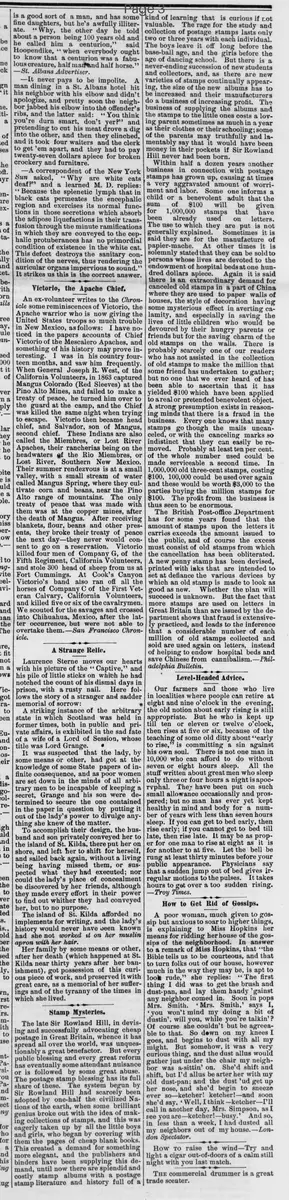
Stamp Mysteries.
The late Sir Rowland Hill, in devising and successfully advocating cheap postage in Great Britain, whence it has spread all over the world, was unquestionably a great benefactor. But every public blessing and every great reform has eventually some attendant nuisance or is followed by some great abuse.
The postage stamp blessing has its full share of these. The system begun by Sir Rowland Hill had scarcely been adopted by one-half the civilized Nations of the earth, when some brilliant genius broke out with the idea of making collections of stamps, and this was eagerly taken up by all the little boys and girls, who began by covering with them the pages of cheap blank books. This created a demand for something more elegant, and the publishers and binders have been supplying this demand, until now there are splendid and costly stamp albums with a postage stamp literature and history full of a kind of learning that is curious if not valuable. The rage for the study and collection of postage stamps lasts only two or three years with each individual. The boys leave it off long before the base-ball age, and the girls before the age of dancing school. But there is a never-ending succession of new students and collectors, and, as there are new varieties of stamps continually appearing, the size of the new albums has to be increased and their manufacturers do a business of increasing profit. The business of supplying the albums and the stamps to the little ones costs a loving parent sometimes as much in a year as their clothes or their schooling; some of the parents may truthfully and lamentably say that it would have been money in their pockets if Sir Rowland Hill never had been born.
Within half a dozen years another business in connection with postage stamps has grown up, causing at times a very aggravated amount of worriment and labor. Some one informs a child or a benevolent adult that the sum of $100 will be given for 1,000,000 stamps that have already been used on letters. The use to which they are put is not generally explained. Sometimes it is said they are for the manufacture of papier-mache. At other times it is solemnly stated that they can be sold to persons whose lives are devoted to the endowment of hospital beds at one hundred dollars apiece. Again it is said there is an extraordinary demand for canceled old stamps in a part of China where they are used to paper walls of houses, the style of decoration having some mysterious effect in averting calamity, and especially in saving the lives of little children who would be devoured by their hungry parents or friends but for the saving charm of the old stamps on the walls. There is probably scarcely one of our readers who has not assisted in the collection of old stamps to make the million that some friend has undertaken to gather; but no one that we ever heard of has been able to ascertain that it has yielded $100 which have been applied to a real or pretended benevolent object.
A strong presumption exists in reasoning minds that there is a fraud in the business. Every one knows that many stamps go through the mails uncanceled, or with the canceling marks so indistinct that they can easily be removed. Probably at least ten per cent. of the whole number used could be made serviceable a second time. In 1,000,000 old three-cent stamps, costing $100, 100,000 could be used over again and these would be worth $3,000 to the parties buying the million stamps for $100. The profit from the business is thus seen to be enormous.
The British Post-office Department has for some years found that the amount of stamps upon the letters it carries exceeds the amount issued to the public, and of course the excess must consist of old stamps from which the cancellation has been obliterated. A new penny stamp has been devised, printed with inks that are intended to set at defiance the various devices by which an old stamp is made to look as good as new. Whether the plan will succeed is unknown. But the fact that more stamps are used on letters in Great Britain than are issued by the department shows that fraud is extensively practiced, and leads to the inference that a considerable number of each million of old stamps collected and sold are used again on letters, instead of helping to endow hospital beds and save Chinese from cannibalism.—Philadelphia Bulletin.
The late Sir Rowland Hill, in devising and successfully advocating cheap postage in Great Britain, whence it has spread all over the world, was unquestionably a great benefactor. But every public blessing and every great reform has eventually some attendant nuisance or is followed by some great abuse.
The postage stamp blessing has its full share of these. The system begun by Sir Rowland Hill had scarcely been adopted by one-half the civilized Nations of the earth, when some brilliant genius broke out with the idea of making collections of stamps, and this was eagerly taken up by all the little boys and girls, who began by covering with them the pages of cheap blank books. This created a demand for something more elegant, and the publishers and binders have been supplying this demand, until now there are splendid and costly stamp albums with a postage stamp literature and history full of a kind of learning that is curious if not valuable. The rage for the study and collection of postage stamps lasts only two or three years with each individual. The boys leave it off long before the base-ball age, and the girls before the age of dancing school. But there is a never-ending succession of new students and collectors, and, as there are new varieties of stamps continually appearing, the size of the new albums has to be increased and their manufacturers do a business of increasing profit. The business of supplying the albums and the stamps to the little ones costs a loving parent sometimes as much in a year as their clothes or their schooling; some of the parents may truthfully and lamentably say that it would have been money in their pockets if Sir Rowland Hill never had been born.
Within half a dozen years another business in connection with postage stamps has grown up, causing at times a very aggravated amount of worriment and labor. Some one informs a child or a benevolent adult that the sum of $100 will be given for 1,000,000 stamps that have already been used on letters. The use to which they are put is not generally explained. Sometimes it is said they are for the manufacture of papier-mache. At other times it is solemnly stated that they can be sold to persons whose lives are devoted to the endowment of hospital beds at one hundred dollars apiece. Again it is said there is an extraordinary demand for canceled old stamps in a part of China where they are used to paper walls of houses, the style of decoration having some mysterious effect in averting calamity, and especially in saving the lives of little children who would be devoured by their hungry parents or friends but for the saving charm of the old stamps on the walls. There is probably scarcely one of our readers who has not assisted in the collection of old stamps to make the million that some friend has undertaken to gather; but no one that we ever heard of has been able to ascertain that it has yielded $100 which have been applied to a real or pretended benevolent object.
A strong presumption exists in reasoning minds that there is a fraud in the business. Every one knows that many stamps go through the mails uncanceled, or with the canceling marks so indistinct that they can easily be removed. Probably at least ten per cent. of the whole number used could be made serviceable a second time. In 1,000,000 old three-cent stamps, costing $100, 100,000 could be used over again and these would be worth $3,000 to the parties buying the million stamps for $100. The profit from the business is thus seen to be enormous.
The British Post-office Department has for some years found that the amount of stamps upon the letters it carries exceeds the amount issued to the public, and of course the excess must consist of old stamps from which the cancellation has been obliterated. A new penny stamp has been devised, printed with inks that are intended to set at defiance the various devices by which an old stamp is made to look as good as new. Whether the plan will succeed is unknown. But the fact that more stamps are used on letters in Great Britain than are issued by the department shows that fraud is extensively practiced, and leads to the inference that a considerable number of each million of old stamps collected and sold are used again on letters, instead of helping to endow hospital beds and save Chinese from cannibalism.—Philadelphia Bulletin.
What sub-type of article is it?
Curiosity
Deception Fraud
What themes does it cover?
Deception
Moral Virtue
What keywords are associated?
Postage Stamps
Stamp Collecting
Fraud
Stamp Reuse
Sir Rowland Hill
What entities or persons were involved?
Sir Rowland Hill
Where did it happen?
Great Britain
Story Details
Key Persons
Sir Rowland Hill
Location
Great Britain
Story Details
Sir Rowland Hill's cheap postage system leads to stamp collecting hobby among children, costing parents dearly, and a fraud where used stamps are collected for false charitable causes but reused after removing cancellations for profit, as shown by British postal excesses.