Thank you for visiting SNEWPapers!
Sign up free
Editorial
September 21, 1829
Lynchburg Virginian
Lynchburg, Virginia
What is this article about?
Editorial from New York Commercial Advertiser advocating for the American Colonization Society's Liberia efforts, emphasizing affordable slave emancipation ($30 vs. $300 market), provision of education and religion, and founding a thriving African nation under providential guidance.
Clipping
OCR Quality
95%
Excellent
Full Text
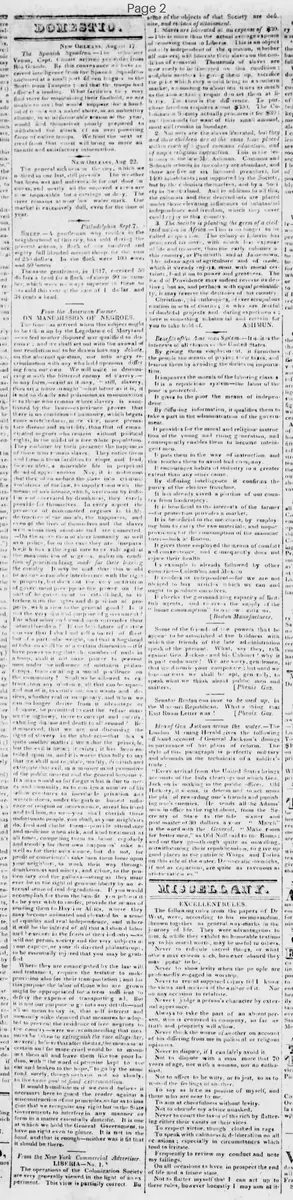
From the New York Commercial Advertiser
LIBERIA-No. 1.
The operations of the Colonization Society
are very generally viewed in the light of an experiment. This view is partially correct. But
some of the objects of that Society are definite,
and certain of attainment.
1. Slaves are liberated at an expense of $30.
—This is more than the actual average expense
of removing them to Liberia. This is an object
entirely independent of the question, whether
all masters will liberate their slaves on the con-
dition of removal.
Thousands of slaves are
now ready to be liberated on this condition:
and their masters in giving them up, sacrifice
the price which they would bring in a southern
market, amounting to about ten times as much
as the sum actually required to set them at li-
berty. To turn is the difference. To purchase freedom requires about $300. The Colonization Society actually procures it for $30:
and thousands for want of this small amount
must still remain in bondage.
2. Not only are the slaves liberated, but they
and their children are at the same time placed
within reach of good common education, and
of ample religious instruction. This is the tes-
timony of the late Mr. Ashmun. Common and
Sabbath schools in the colony are abundant, and
there are five or six licensed preachers, for
1400 inhabitants; not supported by the Society
but by the colonists themselves, and by a Society in Switzerland. And in addition to all this,
the colonists and their descendants are placed
under those elevating influences of substantial
independence and freedom, which they never
could have in this country.
3. The Society is planting the germ of a civil-
ized nation in Africa —This is no longer to be
called in question. The colony at Liberia has
prospered far more, with much less expense
of life and treasure, than the early colonies of
this country, at Plymouth and at Jamestown.
The advantages of agriculture and of trade.
which it already enjoys, must, with moral cer-
tainty, lead it on to power and greatness. The
hand of Providence may indeed reverse its des-
tiny; but so, and perhaps with equal probability, it may reverse the destinies of this country.
Christian philanthropy—reverse scrupulous
caution in acts of charity—ye who are fearful
of doubtful projects and daring experiments;
here is something substantial and certain for
you to take hold of.
ASHMUN.
LIBERIA-No. 1.
The operations of the Colonization Society
are very generally viewed in the light of an experiment. This view is partially correct. But
some of the objects of that Society are definite,
and certain of attainment.
1. Slaves are liberated at an expense of $30.
—This is more than the actual average expense
of removing them to Liberia. This is an object
entirely independent of the question, whether
all masters will liberate their slaves on the con-
dition of removal.
Thousands of slaves are
now ready to be liberated on this condition:
and their masters in giving them up, sacrifice
the price which they would bring in a southern
market, amounting to about ten times as much
as the sum actually required to set them at li-
berty. To turn is the difference. To purchase freedom requires about $300. The Colonization Society actually procures it for $30:
and thousands for want of this small amount
must still remain in bondage.
2. Not only are the slaves liberated, but they
and their children are at the same time placed
within reach of good common education, and
of ample religious instruction. This is the tes-
timony of the late Mr. Ashmun. Common and
Sabbath schools in the colony are abundant, and
there are five or six licensed preachers, for
1400 inhabitants; not supported by the Society
but by the colonists themselves, and by a Society in Switzerland. And in addition to all this,
the colonists and their descendants are placed
under those elevating influences of substantial
independence and freedom, which they never
could have in this country.
3. The Society is planting the germ of a civil-
ized nation in Africa —This is no longer to be
called in question. The colony at Liberia has
prospered far more, with much less expense
of life and treasure, than the early colonies of
this country, at Plymouth and at Jamestown.
The advantages of agriculture and of trade.
which it already enjoys, must, with moral cer-
tainty, lead it on to power and greatness. The
hand of Providence may indeed reverse its des-
tiny; but so, and perhaps with equal probability, it may reverse the destinies of this country.
Christian philanthropy—reverse scrupulous
caution in acts of charity—ye who are fearful
of doubtful projects and daring experiments;
here is something substantial and certain for
you to take hold of.
ASHMUN.
What sub-type of article is it?
Slavery Abolition
Social Reform
Moral Or Religious
What keywords are associated?
Colonization Society
Liberia
Slave Liberation
Africa Colony
Education
Religious Instruction
Philanthropy
What entities or persons were involved?
Colonization Society
Mr. Ashmun
Liberia Colony
Editorial Details
Primary Topic
Promotion Of The Colonization Society's Liberia Project
Stance / Tone
Strongly Supportive And Promotional
Key Figures
Colonization Society
Mr. Ashmun
Liberia Colony
Key Arguments
Slaves Liberated At $30 Expense, Far Less Than Market Purchase Price Of $300
Liberated Slaves And Children Receive Education And Religious Instruction In The Colony
Society Establishes A Prosperous Civilized Nation In Africa, Comparable To Early American Colonies