Thank you for visiting SNEWPapers!
Sign up free
Editorial
December 29, 1813
Daily National Intelligencer
Washington, District Of Columbia
What is this article about?
An allegorical editorial criticizing Britain's envious and restrictive trade policies toward the newly independent United States, portraying Britain as John Bull and America as Jonathan Freeman, who achieves commercial independence after enduring mistreatment.
Clipping
OCR Quality
95%
Excellent
Full Text
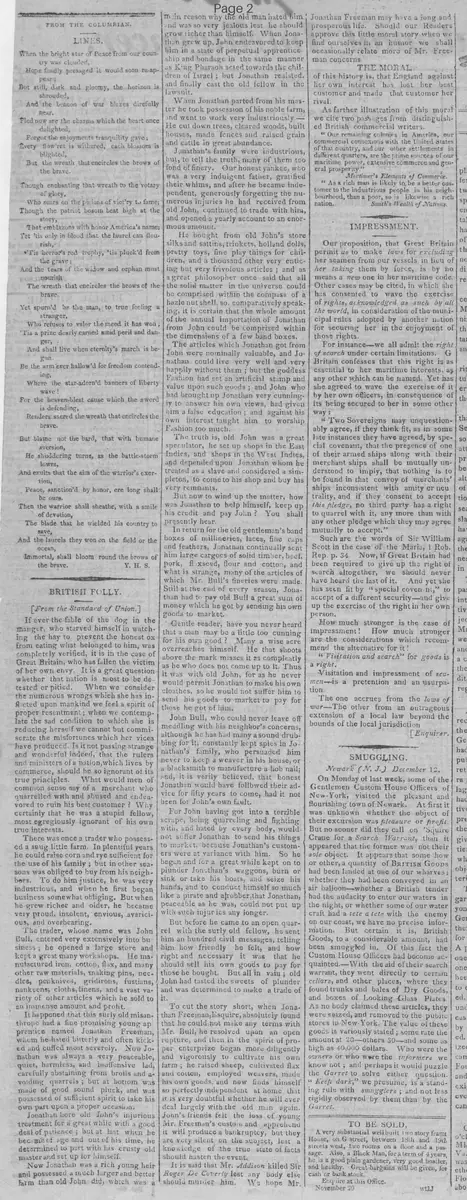
BRITISH FOLLY.
[From the Standard of Union.]
If ever the fable of the dog in the manger, who starved himself in watching the hay to prevent the honest ox from eating what belonged to him, was completely verified, it is in the case of Great Britain, who has fallen the victim of her own envy. It is a great question whether that nation is most to be detested or pitied. When we consider the numerous wrongs which she has inflicted upon mankind we feel a spirit of proper resentment; when we contemplate the sad condition to which she is reducing herself we cannot but commiserate the misfortunes which her vices have produced. Is it not passing strange and wonderful indeed, that the rulers and ministers of a nation, which lives by commerce, should be so ignorant of its true principles. What would men of common sense say of a merchant who quarrelled with and abused and endeavored to ruin his best customer? Why certainly that he was a stupid fellow, most egregiously ignorant of his own true interests.
There was once a trader who possessed a snug little farm. In plentiful years he could raise corn and rye sufficient for the use of his family; but in other seasons was obliged to buy from his neighbors. To do him justice, he was very industrious, and when he first began business somewhat obliging. But when he grew richer and older, he became very proud, insolent, envious, avaricious, and overbearing.
The trader, whose name was John Bull, entered very extensively into business: he opened a large store and kept a great many workshops. He manufactured iron, cotton, flax, and many other raw materials, making pins, needles, penknives, gridirons, fustians, nankeens, cloths, linens, and a vast variety of other articles which he sold to an immense amount and profit.
It happened that this surly old misanthrope had a fine promising young apprentice named Jonathan Freeman, whom he hated bitterly and often kicked and cuffed most severely. Now Jonathan was always a very peaceable, quiet, harmless, and inoffensive lad, carefully abstaining from broils and avoiding quarrels; but at bottom was made of good sound pluck, and was possessed of sufficient spirit to take his own part upon a proper occasion.
Jonathan bore old John's injurious treatment for a great while with a good deal of patience; but at last when he became of age and out of his time, he determined to part with his crusty old master and set up for himself.
Now Jonathan was a rich young heir and possessed a much larger and better farm than old John did, which was in main reason why the old man hated him and was so very jealous lest he should grow richer than himself. When Jonathan grew up, John endeavored to keep him in a state of perpetual apprenticeship and bondage in the same manner as King Pharaoh acted towards the children of Israel; but Jonathan resisted, and finally cast the old fellow in the lawsuit.
When Jonathan parted from his master he took possession of his noble farm, and went to work very industriously— He cut down trees, cleared woods, built houses, made fences and raised grain and cattle in great abundance.
Jonathan's family were industrious, but, to tell the truth, many of them too fond of finery. Our honest yankee, who was a very indulgent father, gratified their whims, and after he became independent, generously forgetting the numerous injuries he had received from old John, continued to trade with him, and opened a yearly account to an enormous amount.
He bought from old John's store silks and satins, trinkets, holland dolls, pretty toys, fine play things for children, and a thousand other very enticing but very frivolous articles; and as a great philosopher once said that all the solid matter in the universe could be comprised within the compass of a hazel nut shell, so, comparatively speaking, it is certain that the whole amount of the annual importation of Jonathan from John could be comprised within the dimensions of a few band boxes.
The articles which Jonathan got from John were nominally valuable, and Jonathan could live very well and very happily without them; but the goddess Fashion had set an artificial stamp and value upon such goods; and John who had brought up Jonathan very cunningly to answer his own views, had given him a false education; and against his own interest taught him to worship Fashion too much.
The truth is, old John was a great speculator, he set up shops in the East Indies, and shops in the West Indies, and depended upon Jonathan whom he treated as a slave and considered a simpleton, to come to his shop and buy his very remnants.
But now to wind up the matter, how was Jonathan to help himself, keep up his credit and pay John? You shall presently hear.
In return for the old gentleman's band boxes of millineries, laces, fine caps and feathers, Jonathan continually sent him large cargoes of solid timber, beef, pork, flaxseed, flour and cotton, and what is strange, many of the articles of which Mr. Bull's fineries were made.
Still at the end of every season, Jonathan had to pay old Bull a great sum of money which he got by sending his own goods to market.
Gentle reader, have you never heard that a man may be a little too cunning for his own good? Many a wise acre overreaches himself. He that shoots above the mark misses it as compleatly as he who does not come up to it. Thus it was with old John, for as he never would permit Jonathan to make his own cloathes, so he would not suffer him to send his goods to market to pay for those he got of him.
John Bull, who could never leave off meddling with his neighbor's concerns, although he has had many a sound drubbing for it, constantly kept spies in Jonathan's family, who persuaded him never to keep a weaver in his house, or a blacksmith to manufacture a hob nail; and, it is verily believed, that honest Jonathan would have followed their advice for fifty years to come, had it not been for John's own fault.
For John having got into a terrible scrape, being quarreling and fighting with, and hated by every body, would not suffer Jonathan to send his things to market, because Jonathan's customers were at variance with him. So he began and for a great while kept on to plunder Jonathan's waggons, burn or sink or take his boats, and seize his hands, and to conduct himself so much like a pirate and a robber, that Jonathan, peaceable as he was, could not put up with such injuries any longer.
But before he came to an open quarrel with the surly old fellow, he sent him an hundred civil messages, telling him how friendly he felt, and how right and necessary it was that he should sell his own goods to pay for those he bought. But all in vain; old John had tasted the sweets of plunder and was determined to make a trade of it.
To cut the story short, when Jonathan Freeman, Esquire, absolutely found that he could not make any terms with Mr. Bull, he resolved upon an open rupture, and then in the spirit of proper enterprize began more diligently and vigorously to cultivate his own farm; he raised sheep, cultivated flax and cotton, employed weavers, made his own goods, and now finds himself so perfectly independent at home that it is very doubtful whether he will ever deal largely with the old man again.
John's friends feel the loss of young Mr. Freeman's custom and apprehend it will produce a bankruptcy, but they are very silent on the subject, lest a knowledge of the true state of facts should hasten the event.
It is said that Mr. Addison killed Sir Roger De Coverley lest any body else should murder him. We hope Mr. Jonathan Freeman may have a long and prosperous life. Should our Readers approve this little moral story when we find ourselves in an humor we shall occasionally relate more of Mr. Freeman concerns.
THE MORAL of this history is, that England against her own interest has lost her best customer and made that customer her rival.
As farther illustration of this moral we cite two passages from distinguished British commercial writers.
"Our remaining colonies in America, our commercial connexions with the United States of that country, and our other settlements in different quarters, are the prime sources of our maritime power, extensive commerce and general prosperity."
Mortimer's Elements of Commerce.
"As a rich man is likely to be a better customer to the industrious people in his neighbourhood, than a poor, so is likewise a rich nation."
Smith's Wealth of Nations.
[From the Standard of Union.]
If ever the fable of the dog in the manger, who starved himself in watching the hay to prevent the honest ox from eating what belonged to him, was completely verified, it is in the case of Great Britain, who has fallen the victim of her own envy. It is a great question whether that nation is most to be detested or pitied. When we consider the numerous wrongs which she has inflicted upon mankind we feel a spirit of proper resentment; when we contemplate the sad condition to which she is reducing herself we cannot but commiserate the misfortunes which her vices have produced. Is it not passing strange and wonderful indeed, that the rulers and ministers of a nation, which lives by commerce, should be so ignorant of its true principles. What would men of common sense say of a merchant who quarrelled with and abused and endeavored to ruin his best customer? Why certainly that he was a stupid fellow, most egregiously ignorant of his own true interests.
There was once a trader who possessed a snug little farm. In plentiful years he could raise corn and rye sufficient for the use of his family; but in other seasons was obliged to buy from his neighbors. To do him justice, he was very industrious, and when he first began business somewhat obliging. But when he grew richer and older, he became very proud, insolent, envious, avaricious, and overbearing.
The trader, whose name was John Bull, entered very extensively into business: he opened a large store and kept a great many workshops. He manufactured iron, cotton, flax, and many other raw materials, making pins, needles, penknives, gridirons, fustians, nankeens, cloths, linens, and a vast variety of other articles which he sold to an immense amount and profit.
It happened that this surly old misanthrope had a fine promising young apprentice named Jonathan Freeman, whom he hated bitterly and often kicked and cuffed most severely. Now Jonathan was always a very peaceable, quiet, harmless, and inoffensive lad, carefully abstaining from broils and avoiding quarrels; but at bottom was made of good sound pluck, and was possessed of sufficient spirit to take his own part upon a proper occasion.
Jonathan bore old John's injurious treatment for a great while with a good deal of patience; but at last when he became of age and out of his time, he determined to part with his crusty old master and set up for himself.
Now Jonathan was a rich young heir and possessed a much larger and better farm than old John did, which was in main reason why the old man hated him and was so very jealous lest he should grow richer than himself. When Jonathan grew up, John endeavored to keep him in a state of perpetual apprenticeship and bondage in the same manner as King Pharaoh acted towards the children of Israel; but Jonathan resisted, and finally cast the old fellow in the lawsuit.
When Jonathan parted from his master he took possession of his noble farm, and went to work very industriously— He cut down trees, cleared woods, built houses, made fences and raised grain and cattle in great abundance.
Jonathan's family were industrious, but, to tell the truth, many of them too fond of finery. Our honest yankee, who was a very indulgent father, gratified their whims, and after he became independent, generously forgetting the numerous injuries he had received from old John, continued to trade with him, and opened a yearly account to an enormous amount.
He bought from old John's store silks and satins, trinkets, holland dolls, pretty toys, fine play things for children, and a thousand other very enticing but very frivolous articles; and as a great philosopher once said that all the solid matter in the universe could be comprised within the compass of a hazel nut shell, so, comparatively speaking, it is certain that the whole amount of the annual importation of Jonathan from John could be comprised within the dimensions of a few band boxes.
The articles which Jonathan got from John were nominally valuable, and Jonathan could live very well and very happily without them; but the goddess Fashion had set an artificial stamp and value upon such goods; and John who had brought up Jonathan very cunningly to answer his own views, had given him a false education; and against his own interest taught him to worship Fashion too much.
The truth is, old John was a great speculator, he set up shops in the East Indies, and shops in the West Indies, and depended upon Jonathan whom he treated as a slave and considered a simpleton, to come to his shop and buy his very remnants.
But now to wind up the matter, how was Jonathan to help himself, keep up his credit and pay John? You shall presently hear.
In return for the old gentleman's band boxes of millineries, laces, fine caps and feathers, Jonathan continually sent him large cargoes of solid timber, beef, pork, flaxseed, flour and cotton, and what is strange, many of the articles of which Mr. Bull's fineries were made.
Still at the end of every season, Jonathan had to pay old Bull a great sum of money which he got by sending his own goods to market.
Gentle reader, have you never heard that a man may be a little too cunning for his own good? Many a wise acre overreaches himself. He that shoots above the mark misses it as compleatly as he who does not come up to it. Thus it was with old John, for as he never would permit Jonathan to make his own cloathes, so he would not suffer him to send his goods to market to pay for those he got of him.
John Bull, who could never leave off meddling with his neighbor's concerns, although he has had many a sound drubbing for it, constantly kept spies in Jonathan's family, who persuaded him never to keep a weaver in his house, or a blacksmith to manufacture a hob nail; and, it is verily believed, that honest Jonathan would have followed their advice for fifty years to come, had it not been for John's own fault.
For John having got into a terrible scrape, being quarreling and fighting with, and hated by every body, would not suffer Jonathan to send his things to market, because Jonathan's customers were at variance with him. So he began and for a great while kept on to plunder Jonathan's waggons, burn or sink or take his boats, and seize his hands, and to conduct himself so much like a pirate and a robber, that Jonathan, peaceable as he was, could not put up with such injuries any longer.
But before he came to an open quarrel with the surly old fellow, he sent him an hundred civil messages, telling him how friendly he felt, and how right and necessary it was that he should sell his own goods to pay for those he bought. But all in vain; old John had tasted the sweets of plunder and was determined to make a trade of it.
To cut the story short, when Jonathan Freeman, Esquire, absolutely found that he could not make any terms with Mr. Bull, he resolved upon an open rupture, and then in the spirit of proper enterprize began more diligently and vigorously to cultivate his own farm; he raised sheep, cultivated flax and cotton, employed weavers, made his own goods, and now finds himself so perfectly independent at home that it is very doubtful whether he will ever deal largely with the old man again.
John's friends feel the loss of young Mr. Freeman's custom and apprehend it will produce a bankruptcy, but they are very silent on the subject, lest a knowledge of the true state of facts should hasten the event.
It is said that Mr. Addison killed Sir Roger De Coverley lest any body else should murder him. We hope Mr. Jonathan Freeman may have a long and prosperous life. Should our Readers approve this little moral story when we find ourselves in an humor we shall occasionally relate more of Mr. Freeman concerns.
THE MORAL of this history is, that England against her own interest has lost her best customer and made that customer her rival.
As farther illustration of this moral we cite two passages from distinguished British commercial writers.
"Our remaining colonies in America, our commercial connexions with the United States of that country, and our other settlements in different quarters, are the prime sources of our maritime power, extensive commerce and general prosperity."
Mortimer's Elements of Commerce.
"As a rich man is likely to be a better customer to the industrious people in his neighbourhood, than a poor, so is likewise a rich nation."
Smith's Wealth of Nations.
What sub-type of article is it?
Trade Or Commerce
Economic Policy
Foreign Affairs
What keywords are associated?
British Folly
Anglo American Trade
Commercial Independence
John Bull
Jonathan Freeman
Economic Rivalry
What entities or persons were involved?
John Bull
Jonathan Freeman
Great Britain
United States
Editorial Details
Primary Topic
British Folly In Trade Relations With America
Stance / Tone
Anti British, Pro American Commercial Independence
Key Figures
John Bull
Jonathan Freeman
Great Britain
United States
Key Arguments
Britain Has Lost Its Best Customer Due To Envy And Restrictive Policies
America Endured Mistreatment But Achieved Independence Through Industry
British Interference Prevented America From Manufacturing And Trading Freely
America's Prosperity Threatens Britain's Commerce
Citations From British Writers Underscore The Importance Of American Trade