Thank you for visiting SNEWPapers!
Sign up free
The National Intelligencer And Washington Advertiser
Washington, District Of Columbia
What is this article about?
General Moreau's letter from Strasbourg, May 19, 1800, defends the financial administration of the Army of the Rhine during the 1800 campaign. He details receipt of 13 million francs from the treasury, use of contributions totaling 43 million for pay and services, and the army's improved state upon return, including captured cannon and horses.
Clipping
OCR Quality
Full Text
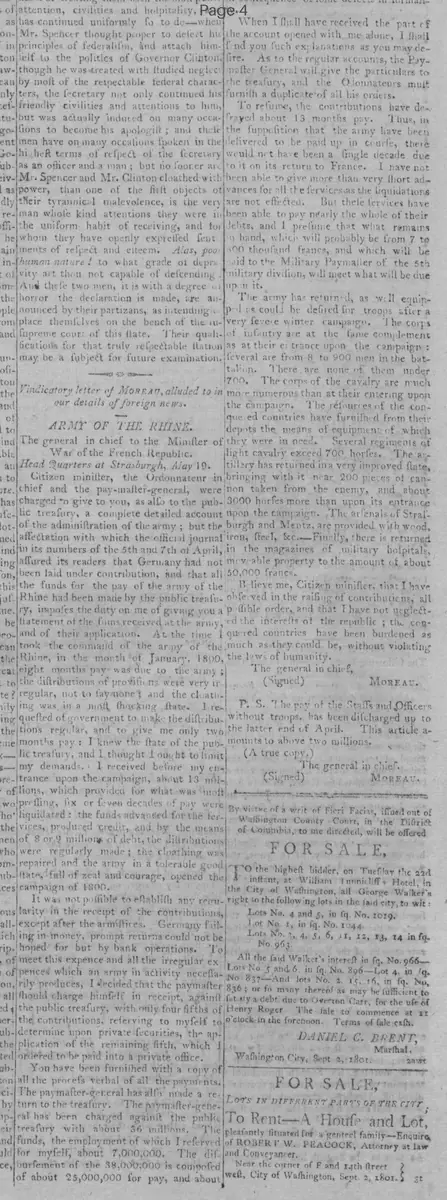
ARMY OF THE RHINE.
The general in chief to the Minister of War of the French Republic.
Head Quarters at Strasburgh, May 19.
Citizen minister, the Ordonnateur in chief and the pay-master-general, were charged to give to you, as also to the public treasury, a complete detailed account of the administration of the army: but the affectation with which the official journal in its numbers of the 5th and 7th of April, assured its readers that Germany had not been laid under contribution, and that all the funds for the pay of the army of the Rhine had been made by the public treasury, imposes the duty on me of giving you a statement of the sums received at the army, and of their application. At the time I took the command of the army of the Rhine, in the month of January, 1800, eight months pay was due to the army; the distributions of provisions were very irregular, not to say none; and the clothing was in a most shocking state. I requested of government to make the distributions regular, and to give me only two months pay: I knew the state of the public treasury, and I thought I ought to limit my demands. I received before my entrance upon the campaign, about 13 millions, which provided for what was most pressing, six or seven decades of pay were liquidated: the funds advanced for the services, produced credit, and by the means of 8 or 9 millions of debt, the distributions were regularly made; the clothing was repaired and the army in a tolerable good state, full of zeal and courage, opened the campaign of 1800.
It was not possible to establish any regularity in the receipt of the contributions, except after the armistices. Germany failing in money, prompt returns could not be hoped for but by bank operations. To meet this expense and all the irregular expenses which an army in activity necessarily produces, I decided that the paymaster should charge himself in receipt, against the public treasury, with only four fifths of the contributions, reserving to myself to determine upon private securities, the application of the remaining fifth, which I ordered to be paid into a private office.
You have been furnished with a copy of all the proces verbal of all the payments. The paymaster-general has also made a return to the treasury. The paymaster-general has been charged against the public treasury with about 36 millions. The funds, the employment of which I reserved for myself, about 7,000,000. The disbursement of the 38,000,000 is composed of about 25,000,000 for pay, and about
When I shall have received the part of the account opened with me alone, I shall send you such explanations as you may desire. As to the regular accounts, the Paymaster General will give the particulars to the treasury, and the Ordonnateurs must furnish a duplicate of all his orders.
To resume, the contributions have defrayed about 13 months pay. Thus, in the supposition that the army have been delivered to be paid up in course, there would not have been a single decade due to it on its return to France. I have not been able to give more than very short advances for all the services, as the liquidations are not effected. But these services have been able to pay nearly the whole of their debts, and I presume that what remains in hand, which will probably be from 7 to 800 thousand francs, and which will be paid to the Military Paymaster of the 5th military division, will meet what will be due upon it.
The army has returned, as well equipped as could be desired for troops after a very severe winter campaign. The corps of infantry are at the same complement as at their entrance upon the campaign: several are from 8 to 900 men in the battalion. There are none of them under 700. The corps of the cavalry are much more numerous than at their entering upon the campaign. The resources of the conquered countries have furnished from their depots the means of equipment of which they were in need. Several regiments at light cavalry exceed 700 horses. The artillery has returned in a very improved state, bringing with it near 200 pieces of cannon taken from the enemy, and about 3000 horses more than upon its entrance upon the campaign. The arsenals of Strasburgh and Mentz, are provided with wood, iron, steel, &c. Finally, there is returned in the magazines of military hospitals, movable property to the amount of about 50,000 francs.
Believe me, Citizen minister, that I have observed in the raising of contributions, all possible order, and that I have not neglected the interests of the republic; the conquered countries have been burdened as much as they could be, without violating the law of humanity.
The general in chief
(Signed)
MOREAU.
P. S. The Pay of the Staffs and Officers without troops, has been discharged up to the latter end of April.
This article amounts to above two millions.
(A true copy.)
The general in chief.
(Signed)
MOREAU.
What sub-type of article is it?
What keywords are associated?
What entities or persons were involved?
Where did it happen?
Foreign News Details
Primary Location
Strasburgh
Event Date
May 19, 1800
Key Persons
Outcome
army paid for 13 months using contributions; returned well-equipped with ~200 captured cannon, 3000 extra horses; arsenals stocked; hospital property worth 50,000 francs; no decades of pay due upon return to france.
Event Details
General Moreau reports on the financial administration of the Army of the Rhine in 1800, countering claims that no contributions were levied in Germany. Upon taking command in January 1800, the army was 8 months in arrears with irregular provisions and poor clothing. Received 13 million francs from treasury; used contributions totaling ~43 million (36M to treasury, 7M reserved) for pay (25M), services, and debts. Army opened campaign in good state; after armistices, contributions managed via bank operations and private securities. Infantry and cavalry at full or increased strength; artillery improved with captures.