Thank you for visiting SNEWPapers!
Sign up free
Story
November 16, 1874
The Charlotte Democrat
Charlotte, Mecklenburg County, North Carolina
What is this article about?
Article advocating drainage of wet land to enhance soil productivity by enabling air access, deeper root growth, and reduced nutrient loss, improving crop quality and drought resistance.
Clipping
OCR Quality
98%
Excellent
Full Text
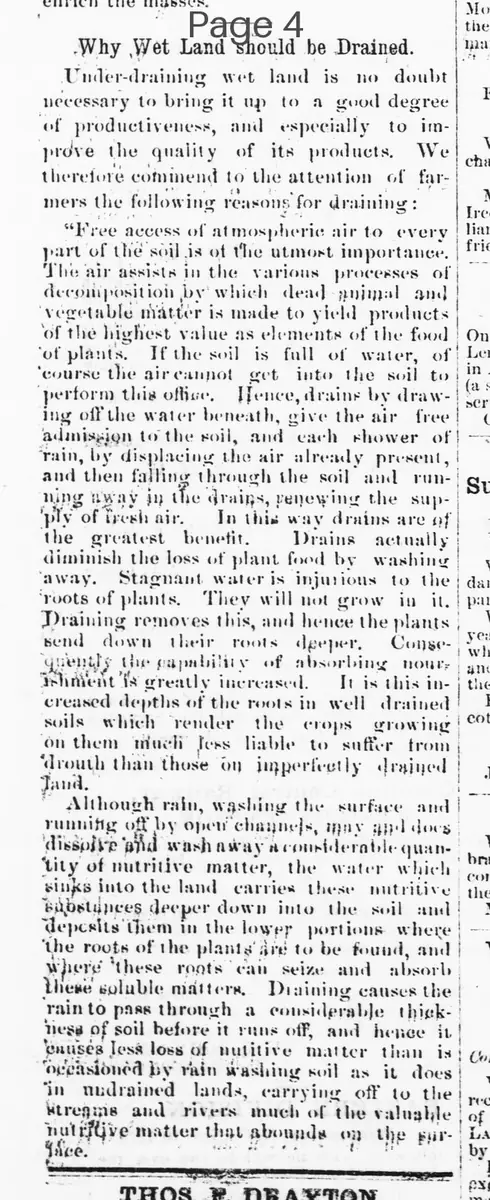
Why Wet Land should be Drained
Under-draining wet land is no doubt necessary to bring it up to a good degree of productiveness, and especially to improve the quality of its products. We therefore commend to the attention of farmers the following reasons for draining:
"Free access of atmospheric air to every part of the soil is of the utmost importance. The air assists in the various processes of decomposition by which dead animal and vegetable matter is made to yield products of the highest value as elements of the food of plants. If the soil is full of water, of course the air cannot get into the soil to perform this office. Hence, drains by drawing off the water beneath, give the air free admission to the soil, and each shower of rain, by displacing the air already present, and then falling through the soil and running away in the drains, renewing the supply of fresh air. In this way drains are of the greatest benefit. Drains actually diminish the loss of plant food by washing away. Stagnant water is injurious to the roots of plants. They will not grow in it. Draining removes this, and hence the plants send down their roots deeper. Consequently the capability of absorbing nourishment is greatly increased. It is this increased depth of the roots in well drained soils which render the crops growing on them much less liable to suffer from drouth than those on imperfectly drained land.
Although rain, washing the surface and running off by open channels, may and does dissolve and wash away a considerable quantity of nutritive matter, the water which sinks into the land carries these nutritive substances deeper down into the soil and deposits them in the lower portions where the roots of the plants are to be found, and where these roots can seize and absorb these soluble matters. Draining causes the rain to pass through a considerable thickness of soil before it runs off, and hence it causes less loss of nutritive matter than is occasioned by rain washing soil as it does in undrained lands, carrying off to the streams and rivers much of the valuable nutritive matter that abounds on the surface."
Under-draining wet land is no doubt necessary to bring it up to a good degree of productiveness, and especially to improve the quality of its products. We therefore commend to the attention of farmers the following reasons for draining:
"Free access of atmospheric air to every part of the soil is of the utmost importance. The air assists in the various processes of decomposition by which dead animal and vegetable matter is made to yield products of the highest value as elements of the food of plants. If the soil is full of water, of course the air cannot get into the soil to perform this office. Hence, drains by drawing off the water beneath, give the air free admission to the soil, and each shower of rain, by displacing the air already present, and then falling through the soil and running away in the drains, renewing the supply of fresh air. In this way drains are of the greatest benefit. Drains actually diminish the loss of plant food by washing away. Stagnant water is injurious to the roots of plants. They will not grow in it. Draining removes this, and hence the plants send down their roots deeper. Consequently the capability of absorbing nourishment is greatly increased. It is this increased depth of the roots in well drained soils which render the crops growing on them much less liable to suffer from drouth than those on imperfectly drained land.
Although rain, washing the surface and running off by open channels, may and does dissolve and wash away a considerable quantity of nutritive matter, the water which sinks into the land carries these nutritive substances deeper down into the soil and deposits them in the lower portions where the roots of the plants are to be found, and where these roots can seize and absorb these soluble matters. Draining causes the rain to pass through a considerable thickness of soil before it runs off, and hence it causes less loss of nutritive matter than is occasioned by rain washing soil as it does in undrained lands, carrying off to the streams and rivers much of the valuable nutritive matter that abounds on the surface."
What sub-type of article is it?
Agricultural Advice
Informational Essay
What keywords are associated?
Wet Land Draining
Soil Aeration
Plant Roots
Nutritive Matter
Agricultural Productivity
Story Details
Story Details
Explanation of benefits of under-draining wet land: allows air access for decomposition, reduces loss of plant food, removes stagnant water for deeper roots, and minimizes nutritive matter washout by percolating water through soil.