Thank you for visiting SNEWPapers!
Sign up free
The Lamar Register
Lamar, Prowers County, Colorado
What is this article about?
The article examines the legendary King Arthur's historicity, noting absence in Saxon chronicles and reliance on later accounts like Geoffrey of Monmouth's. It describes the 1177 discovery of his and Queen Guinevere's remains at Glastonbury Abbey by the abbot, eyewitnessed by Giraldus Cambrensis, and Arthur's historical battle against Saxon king Cedric at Cadbury hill.
Clipping
OCR Quality
Full Text
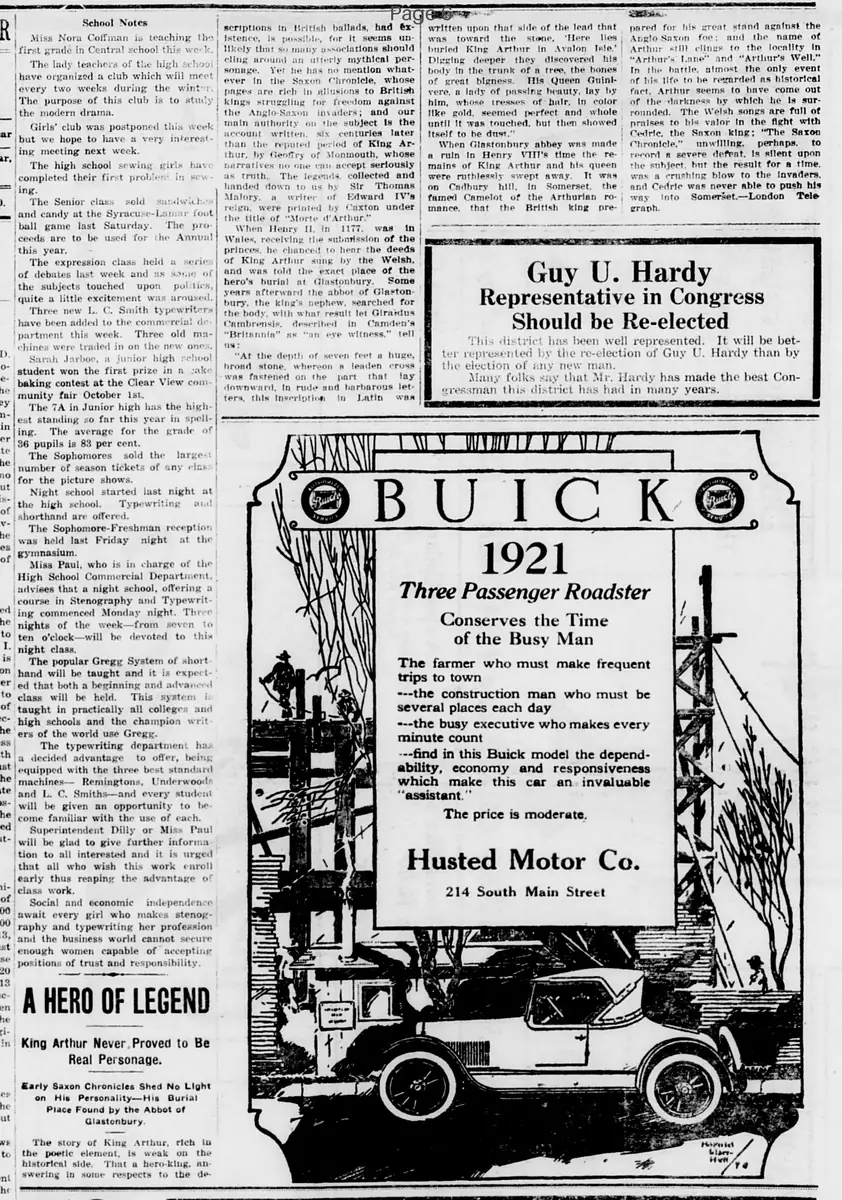
King Arthur Never Proved to Be Real Personage.
Early Saxon Chronicles Shed No Light on His Personality—His Burial Place Found by the Abbot of Glastonbury.
The story of King Arthur, rich in the poetic element, is weak on the historical side. That a hero-king, answering in some respects to the descriptions in British ballads, had existence, is possible, for it seems unlikely that so many associations should cling around an utterly mythical personage. Yet he has no mention whatever in the Saxon Chronicle, whose pages are rich in allusions to British kings struggling for freedom against the Anglo-Saxon invaders; and our main authority on the subject is the account written, six centuries later than the reputed period of King Arthur, by Geoffry of Monmouth, whose narratives no one can accept seriously as truth. The legends, collected and handed down to us by Sir Thomas Malory, a writer of Edward IV's reign, were printed by Caxton under the title of "Morte d'Arthur."
When Henry II., in 1177, was in Wales, receiving the submission of the princes, he chanced to hear the deeds of King Arthur sung by the Welsh, and was told the exact place of the hero's burial at Glastonbury. Some years afterward the abbot of Glastonbury, the king's nephew, searched for the body, with what result let Giraldus Cambrensis, described in Camden's "Britannia" as "an eye witness," tell us:
"At the depth of seven feet a huge, broad stone, whereon a leaden cross was fastened on the part that lay downward, in rude and barbarous letters, this Inscription in Latin was written upon that side of the lead that was toward the stone. 'Here lies buried King Arthur in Avalon Isle.' Digging deeper they discovered his body in the trunk of a tree, the bones of great bigness. His Queen Guinevere, a lady of passing beauty, lay by him, whose tresses of hair, in color like gold, seemed perfect and whole until it was touched, but then showed itself to be dust."
When Glastonbury abbey was made a ruin in Henry VIII's time the remains of King Arthur and his queen were ruthlessly swept away. It was on Cadbury hill, in Somerset, the famed Camelot of the Arthurian romance, that the British king prepared for his great stand against the Anglo-Saxon foe; and the name of Arthur still clings to the locality in "Arthur's Lane" and "Arthur's Well."
In the battle, almost the only event of his life to be regarded as historical fact, Arthur seems to have come out of the darkness by which he is surrounded. The Welsh songs are full of praises to his valor in the fight with Cedric, the Saxon king: "The Saxon Chronicle," unwilling, perhaps, to record a severe defeat, is silent upon the subject, but the result for a time, was a crushing blow to the invaders, and Cedric was never able to push his way into Somerset.—London Telegraph.
What sub-type of article is it?
What themes does it cover?
What keywords are associated?
What entities or persons were involved?
Where did it happen?
Story Details
Key Persons
Location
Glastonbury, Somerset, Wales, Cadbury Hill
Event Date
1177
Story Details
Legendary King Arthur's historicity is doubted due to lack of early records; his burial with Guinevere discovered at Glastonbury in 1177 by the abbot; he battled Saxon king Cedric at Cadbury hill, halting invasion.