Thank you for visiting SNEWPapers!
Sign up free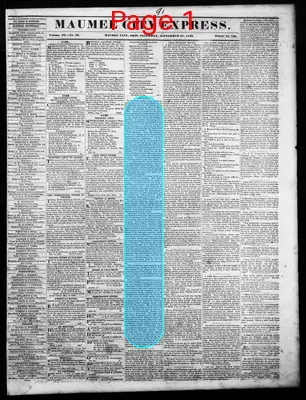
Maumee City Express
Maumee City, Maumee, Lucas County, Ohio
What is this article about?
Historical overview of Fort Defiance's founding by General Wayne in 1794 amid Native American conflicts, including peace overtures rejected against Little Turtle's advice, the Battle of Presque Isle, and reflections on regional development and economic challenges in 1839.
Clipping

OCR Quality
Full Text
To the distant reader, it may not be uninteresting for us to drop a remark or two touching the position and history of this village. The ground on which it stands, ought to be regarded, in some sort, as hallowed. It is now just forty-five years since the indomitable Wayne penetrated into the heart of the Indian country, and on this very spot planted the Stars and Stripes of Liberty. It was here, that, having erected a strong fortification, immediately at the confluence of the two Rivers, in the emphatic language for which he was distinguished, he declared, that he "Defied Hell and all her emissaries!" Hence its name - FORT DEFIANCE. Upon the completion of this work, feeling that he was now fully prepared for either peace or war, he made a last attempt at conciliation. "I have thought proper" said he, in one of his despatches, "to offer the enemy a last overture of peace; and as they have every thing that is dear and interesting at stake, I have reason to expect they will listen to the proposition. * * But should war be their choice, the blood be upon their own heads. America shall no longer be insulted with impunity. To an all-powerful and just God, I therefore commit myself and gallant army."
—"This overture," says the historian, "was rejected against the advice of the distinguished Chief Little Turtle, a man of great capacity and unimpeached courage, who, in a Council of the combined Indians, on the night previous to the battle, held the following language:
"We have beaten the enemy twice under separate commanders. We cannot expect the same good fortune to attend us always. The Americans are now led by a chief who never sleeps: the night and the day are alike to him. And during all the time he has been marching upon our villages, notwithstanding the watchfulness of our young men, we have never been able to surprise him. Think well of it. There is something whispers me it would be prudent to listen to his offers of peace."
On the day following, which was the 20th of August, 1794, the sanguinary but decisive battle of Presque Isle was fought, in which the most consummate skill and bravery were exhibited by the American General and his gallant troops.
At the time of which we are speaking the Maumee and Auglaize valleys presented less the appearance of a wild and uncultivated region, than we of this day are apt to imagine. The American General, writing to the Secretary of War, remarks:-"The very extensive and highly cultivated fields and gardens show the work of many hands. The margins of those beautiful rivers, the Miami of the Lake and Auglaize, appear like one continued village for a number of miles above and below the place; nor have I ever before beheld such immense fields of corn in any part of America, from Canada to Florida." This picture was drawn forty-five years ago, at a time when this vast region was in possession of the savage; when the presence of the white man carried with it desolation and death, where, till his approach, happiness and plenty reigned undisturbed.--Let us, of 1839, now that the red man kindles his council-fire far beyond the father of waters, blush for the little improvement with which we are surrounded.
This position was again occupied by the American troops, during the War of 1812 The remains of the palisades which protected the army of Winchester while here, are to be seen; and the embankments and trenches of Wayne, constructed in '94, are still more visible.
The advantages as to local situation, possessed by Defiance, are at once commanding and important; and despite the barriers which have hitherto tended to retard her onward march, she must eventually assume that rank among the commercial towns of this beautiful valley, assigned her by the intelligent and discerning. She stands in the very heart of a richly fertile country with no less than four natural channels of communication by water, two canals and numerous roads, radiating toward every point of the compass. But, notwithstanding all this, the prospect to him who cares not to penetrate the vista of futurity, is gloomy and disheartening. Business is almost at a dead stand. Operations upon the Public Works here and in our vicinity, have nearly ceased. Money is scarce, and although provisions are plenty in the hands of the producer, the mere consumer finds it difficult to furnish himself with many of the comforts of life. These things will in time regulate themselves: but not until we shall become thoroughly sobered. When we shall learn to throw aside Aladdin's lamp, and, relying no longer upon enchantment or chance, shall follow the dictates of reason and common sense, we shall move steadily forward in the road to opulence and wealth, pretty much as did our fathers and uncles in the days of our boyhood.— Defiance Barometer.
What sub-type of article is it?
What themes does it cover?
What keywords are associated?
What entities or persons were involved?
Where did it happen?
Story Details
Key Persons
Location
Fort Defiance, At The Confluence Of The Maumee And Auglaize Rivers
Event Date
1794
Story Details
General Wayne establishes Fort Defiance in 1794, defies Native American forces, offers peace rejected against Chief Little Turtle's counsel, leading to American victory at the Battle of Presque Isle on August 20. The article reflects on the region's transformation from Native cultivation to white settlement and current economic stagnation in 1839.