Thank you for visiting SNEWPapers!
Sign up free
Phenix Gazette
Alexandria, Virginia
What is this article about?
This letter, part of a series by 'BAYARD,' critiques Andrew Jackson's presidential candidacy, arguing that his supporters use inconsistent pretexts and falsely claim him as a champion of state rights, citing his disrespectful actions toward Georgia Governor Rabun during the Seminole War.
Clipping
OCR Quality
Full Text
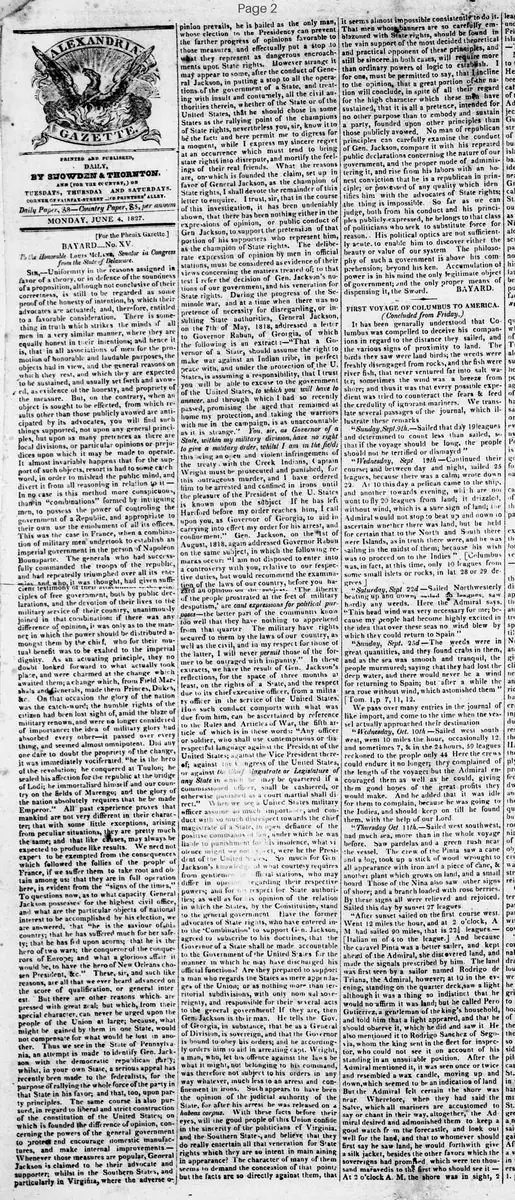
BAYARD....No. XV.
To the Honorable Louis McLane, Senator in Congress from the State of Delaware.
Sir,--Uniformity in the reasons assigned in favor of a theory, or in defence of the soundness of a proposition, although not conclusive of their correctness, is still to be regarded as some proof of the honesty of intention, by which their advocates are actuated; and, therefore, entitled to a favorable consideration. There is something in truth which strikes the minds of all men in a very similar manner, where they are equally honest in their intentions: and hence it is, that in all associations of men for the promotion of honorable and laudable purposes, the objects had in view, and the general reasons on which they rest, and which they are expected to be sustained, and usually set forth and avowed, as evidence of the honesty, and propriety of the measure. But, on the contrary, when an object is sought to be effected, from which results other than those publicly avowed are anticipated by its advocates, you will find such things supported, not upon any general principles, but upon as many pretences as there are local divisions, or particular opinions or prejudices upon which it may be made to operate. It almost invariably happens that for the support of such objects, resort is had to some catch word, in order to mislead the public mind, and divert it from all reasoning in relation to it.
In no case is this method more conspicuous, than in "combinations" formed by intriguing men, to possess the power of controlling the government of a Republic, and appropriate to their own use the emolument of all its offices. This was the case in France, when a combination of military men undertook to establish an imperial government in the person of Napoleon Buonaparte. The generals who had successfully commanded the troops of the republic, and had repeatedly triumphed over all its enemies and who, it was thought, had given sufficient testimony of the principles of free government, both by public declarations, and the devotion of their lives to the military service of their country, unanimously joined in that combination: if there was any difference of opinion, it was only as to the manner in which the power should be distributed amongst them by the chief, who for their mutual benefit was to be exalted to the imperial dignity. As an actuating principle, they no doubt looked forward to what actually took place, and were charmed at the change which awaited them; a change which, from Field Marshals and Generals, made them Princes, Dukes, &c. On that occasion the glory of the nation was the catch-word!; the humble rights of the citizen had been lost sight of, amid the blaze of military renown, and were no longer considered of importance: the idea of military glory had absorbed every other--it passed over every thing, and seemed almost omnipotent. Did any one dare to doubt the propriety of the change, it was immediately vociferated. "he is the hero of the revolution; he sealed his affection for the republic at the bridge of Lodi; he immortalised himself and our country on the fields of Marengo; and the glory of the nation absolutely requires that he be made Emperor." All past experience proves that mankind are not very different in their character from peculiar situations, they are pretty much the same; and that like causes, may always be expected to produce like results. We need not expect to be exempted from the consequences which followed the follies of the people of France, if we suffer them to take root and obtain among us: that they are in full operation here, is evident from the "signs of the times,"
To questions now, as to what capacity General Jackson possesses for the highest civil office, and what are the particular objects of national interest to be accomplished by his election, we are answered, that "he is the saviour of his country; that he has suffered much for her safety; that he has fed upon acorns; that he is the hero of two wars; the conqueror of the conquerors of Europe; and what a glorious affair it would be, to have the hero of New Orleans chosen President, &c." These, sir, and such like reasons, are all that we ever heard advanced on the score of qualification, or general interest. But there are other reasons which are pressed with great zeal; but which, from their special character, can never be urged upon the people of the Union at large; because, what might be gained by them in one State, would not compensate for what would be lost in another. Thus we see in the State of Pennsylvania, an attempt is made to identify Gen. Jackson with the democratic republican party; whilst, in your own State, a serious appeal has recently been made to the federalists, for the purpose of rallying the whole force of the party in that State in his favor; and that, too, upon party principles. The same course is also pursued, in regard to liberal and strict construction of the constitution of the United States; on which is founded the difference of opinion, concerning the powers of the general government to protect and encourage domestic manufactures, and make internal improvements. Whenever those measures are popular, General Jackson is claimed to be their advocate and supporter; whilst in the Southern States, and particularly in Virginia, where the adverse opinion prevails, he is hailed as the only man, whose election to the Presidency can prevent those measures, and effectually put a stop to the farther progress of opinions favorable to them upon State rights. However strange it may appear to some, after the conduct of General Jackson, in putting a stop to all the operations of the government of a State, and treating with insult and contumely, all the civil authorities therein, whether of the State or of the United States, that he should chose in some States as the rallying point of the champions of State rights, nevertheless you, sir, know it to be the fact: and here permit me to digress for a moment, while I express my sincere regret at an occurrence which must tend to bring state rights into disrepute, and mortify the feelings of their real friends. What the reasons are, on which is founded the claim, set up in favor of General Jackson, as the champion of State rights, I shall devote the remainder of this letter to enquire. I trust, sir, that in the course of this investigation, it has been undeniably shown, that there has been nothing either in the expressions of opinion, or public conduct of Gen Jackson, to support the pretension of that portion of his supporters who represent him, as the champion of State rights. The deliberate expression of opinion by men in official stations, must be considered as evidence of their views concerning the matters treated of; to that test I refer the decision of Gen. Jackson's notions of our government, and his veneration for State rights. During the progress of the Seminole war, and at a time when there was no pretence of necessity or disregarding, or insulting State authorities, General Jackson, on the 7th of May, 1818, addressed a letter to Governor Rabun, of Georgia, of which the following is an extract:--"That a Governor of a State, should assume the right to make war against an Indian tribe, in perfect peace with, and under the protection of the U. States, is assuming a responsibility, that I trust you will be able to excuse to the government of the United States, to which you will have to answer, and through which I had so recently passed, promising the aged that remained at home my protection, and taking the warriors with me in the campaign, is as unaccountable as it is strange." You, sir, as Governor of a State, within my military division, have no right to give a military order, whilst I am in the field; this being an open and violent infringement of the treaty with the Creek Indians, Captain Wright must be prosecuted and punished, for this outrageous murder, and I have ordered him to be arrested and confined in irons until the pleasure of the President of the U. States is known upon the subject If he has left Hartford before my order reaches him, I call upon you, as Governor of Georgia, to aid in carrying into effect my order for his arrest, and confinement."
Gen. Jackson, on the 1st of August, 1818, again addressed Governor Rabun on the same subject, in which the following remarks occur: "I am not disposed to enter into a controversy with you, relative to our respective duties, but would recommend the examination of the laws of our country, before you ha--zardan oplutoi on -slitoutsi• "The liberty of the people prostrated at the feet of military despotism,' are cant expressions for political purposes--the better part of the community know too well that they have nothing to apprehend from that quarter The military have rights secured to them by the laws of our country, as well as the civil, and in my respect for those of the latter, I will never permit those of the former to be outraged with impunity." In these extracts, we have the result of Gen. Jackson's reflections, for the space of three months at least, on the rights of a State, and the respect due to its chief executive officer, from a military officer in the service of the United States. How such conduct comports with what was due from him, can be ascertained by reference to the Rules and Articles of War, the fifth article of which is in these words: "Any officer or soldier, who shall use contemptuous or disrespectful language against the President of the United States; against the Vice President thereof; against the Congress of the United States, or against the Chief Magistrate or Legislature of any State in which he may be quartered if a commissioned officer, shall be cashiered, or otherwise punished as a court martial shall direct." When we see a United States military officer assume so much importance, and conduct with so much disrespect towards the chief magistrate of a State, in open defiance of the positive commands of law, under which he was liable to punishment for his insolence, what violence might we not expect, were he the President of the United States. So much for Gen Jackson's knowledge of what courtesy requires from gentlemen in official stations, who may differ in opinion regarding their respective powers; and for his respect for State authorities; as well as for his opinion of the relation in which the States, by the Constitution, stand to the general government have the former advocates of State rights, who have entered into the 'Combination' to support Gen. Jackson, agreed to subscribe to his doctrines, that he Governor of a State shall be made accountable to the Government of the United States for the manner in which he may have discharged his official functions? Are they prepared to support a man who regards the States as mere appendages of the Union; or as nothing more than territorial subdivisions, with only nominal sovereignty, and responsible for their several acts to the general government? If they are, then Gen. Jackson is their man. He tells the Gov. of Georgia, in substance, that he as a General of Division, is sovereign, and that the Governor is bound to obey his orders; and he accordingly orders him to aid in arresting capt. Wright, a man, who, let his offence against the laws be what it might, not belonging to his command, was therefore not subject to his orders in any way whatever, much less to an arrest and confinement in irons. Such appears to have been the opinion of the judicial authority of the State, for after his arrest he was released on a habeas corpus. With these acts before their eyes, will the good people of this Union confide in the sincerity of the politicians of Virginia, and the Southern States, and believe that they do really entertain all that veneration for State rights which they are so intent in maintaining in appearance? The character of many of them seems to demand the concession of that point; but the facts are so directly against them, that it seems almost impossible consistently to do it. That men whose banners are so carefully emblazoned with State rights, should be found in the vain support of the most decided theoretical and practical opponent of these principles, and still be sincere in both cases, will require more than ordinary powers of logic to establish. I for one, must be permitted to say, that I incline to the opinion, that a great portion of the nation will conclude, in spite of all their regard for the high character which these men have sustained, that it is all a pretence, intended for no other purpose than to embody and sustain a party, founded upon other principles than those publicly avowed. No man of republican principles can carefully examine the conduct of Gen. Jackson, compare it with his repeated public declarations concerning the nature of our government, and the proper mode of administering it, and rise from his labors with an honest conviction that he is a republican in principle; or possessed of any quality which identifies him with the advocates of State rights; the thing is impossible. So far as we can judge, both from his conduct and his principles publicly expressed, he belongs to that class of politicians who seek to substitute force for reason. His political optics are not sufficiently acute, to enable him to discover either the beauty or value of our system The philosophy of such a government is above his comprehension; beyond his ken. Accumulation of power is in his mind the only legitimate object of government; and the only proper means of dispensing it, the Sword.
BAYARD.
What sub-type of article is it?
What themes does it cover?
What keywords are associated?
What entities or persons were involved?
Letter to Editor Details
Author
Bayard
Recipient
The Honorable Louis Mclane, Senator In Congress From The State Of Delaware
Main Argument
supporters of general jackson promote him with inconsistent and misleading arguments, falsely portraying him as a champion of state rights despite his conduct showing disrespect for state authorities, as evidenced by his letters to georgia governor rabun during the seminole war.
Notable Details