Thank you for visiting SNEWPapers!
Sign up free
Grand Rapids Herald Review
Grand Rapids, Itasca County, Minnesota
What is this article about?
Last week, Minnesota auctioned 75 million feet of northern state timber at public sale, but only half sold amid complaints of overhigh appraisals and falling lumber prices. Minneapolis firms boycotted, citing unfair state tax practices.
Clipping
OCR Quality
Full Text
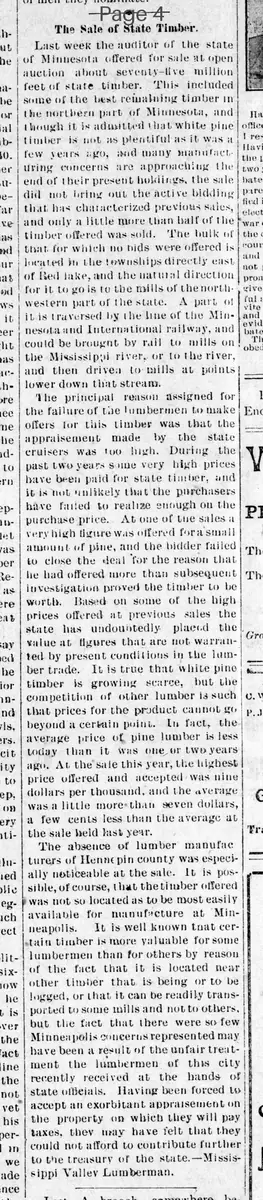
Last week the auditor of the state of Minnesota offered for sale at open auction about seventy-five million feet of state timber. This included some of the best remaining timber in the northern part of Minnesota, and though it is admitted that white pine timber is not as plentiful as it was a few years ago, and many manufacturing concerns are approaching the end of their present holdings, the sale did not bring out the active bidding that has characterized previous sales, and only a little more than half of the timber offered was sold. The bulk of that, for which no bids were offered, is located in the townships directly east of Red lake, and the natural direction for it to go is to the mills of the northwestern part of the state.
A part of it is traversed by the line of the Minnesota and International railway, and could be brought by rail to mills on the Mississippi river, or to the river, and then driven to mills at points lower down that stream.
The principal reason assigned for the failure of the lumbermen to make offers for this timber was that the appraisement made by the state cruisers was too high. During the past two years some very high prices have been paid for state timber, and it is not unlikely that the purchasers have failed to realize enough on the purchase price. At one of the sales a very high figure was offered for a small amount of pine, and the bidder failed to close the deal for the reason that he had offered more than subsequent investigation proved the timber to be worth. Based on some of the high prices offered at previous sales the state has undoubtedly placed the value at figures that are not warranted by present conditions in the lumber trade. It is true that white pine timber is growing scarce, but the competition of other lumber is such that prices for the product cannot go beyond a certain point. In fact, the average price of pine lumber is less today than it was one or two years ago. At the sale this year, the highest price offered and accepted was nine dollars per thousand, and the average was a little more than seven dollars, a few cents less than the average at the sale held last year.
The absence of lumber manufacturers of Hennepin county was especially noticeable at the sale. It is possible, of course, that the timber offered was not so located as to be most easily available for manufacture at Minneapolis. It is well known that certain timber is more valuable for some lumbermen than for others by reason of the fact that it is located near other timber that is being or to be logged, or that it can be readily transported to some mills and not to others, but the fact that there were so few Minneapolis concerns represented may have been a result of the unfair treatment the lumbermen of this city recently received at the hands of state officials. Having been forced to accept an exorbitant appraisement on the property on which they will pay taxes, they may have felt that they could not afford to contribute further to the treasury of the state. -Mississippi Valley Lumberman.
What sub-type of article is it?
What themes does it cover?
What keywords are associated?
Where did it happen?
Story Details
Location
Northern Minnesota
Event Date
Last Week
Story Details
Minnesota's state auditor auctioned about 75 million feet of state timber, including prime white pine, but only slightly more than half sold due to high state appraisals deemed excessive given declining lumber prices and market conditions. Bidders were sparse, with Minneapolis manufacturers notably absent, possibly due to recent unfair tax treatments by state officials.