Thank you for visiting SNEWPapers!
Sign up free
The Virginia Gazette
Richmond, Williamsburg, Richmond County, Virginia
What is this article about?
On October 28, 1775, British Parliament opened with debates on the King's speech regarding disputes with American colonies. In the House of Lords, an address supporting government measures passed 66-33 (with proxies). In the Commons, a similar address passed 278-108. Opposition criticized the war and called for reconciliation. London Common Council petitioned for cessation of hostilities.
Merged-components note: Clear textual continuation of the parliamentary debate from October 28 across pages.
Clippings
1 of 2
OCR Quality
Full Text
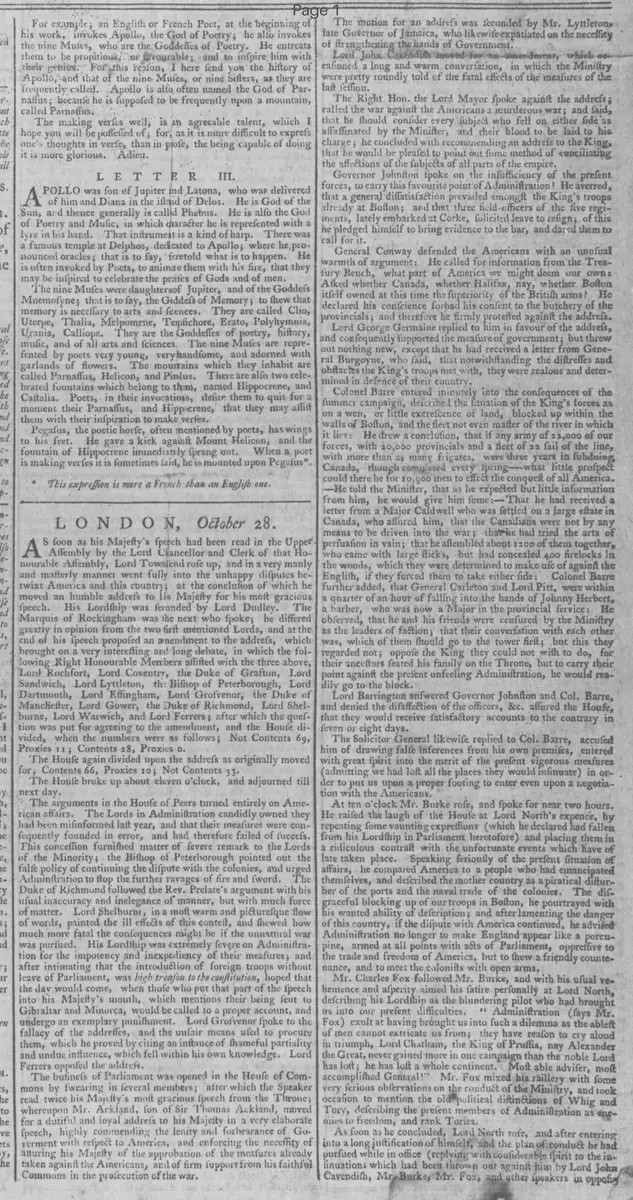
Soon as his Majesty's speech had been read in the Upper Assembly by the Lord Chancellor and Clerk of that Honourable Assembly, Lord Townsend rose up, and in a very manly and masterly manner went fully into the unhappy disputes betwixt America and this country; at the conclusion of which he moved an humble address to his Majesty for his most gracious speech. His Lordship was seconded by Lord Dudley. The Marquis of Rockingham was the next who spoke; he differed greatly in opinion from the two first mentioned Lords, and at the end of his speech proposed an amendment to the address, which brought on a very interesting and long debate, in which the following Right Honourable Members assisted with the three above, Lord Rochfort, Lord Coventry, the Duke of Grafton, Lord Sandwich, Lord Lyttleton, the Bishop of Peterborough, Lord Dartmouth, Lord Effingham, Lord Grosvenor, the Duke of Manchester, Lord Gower, the Duke of Richmond, Lord Shelburne, Lord Warwick, and Lord Ferrers; after which the question was put for agreeing to the amendment, and the House divided, when the numbers were as follows; Not Contents 69, Proxies 11; Contents 28, Proxies 0.
The House again divided upon the address as originally moved for; Contents 66, Proxies 10; Not Contents 33.
The House broke up about eleven o'clock, and adjourned till next day.
The arguments in the House of Peers turned entirely on American affairs. The Lords in Administration candidly owned they had been misinformed last year, and that their measures were consequently founded in error, and had therefore failed of success. This concession furnished matter of severe remark to the Lords of the Minority; the Bishop of Peterborough pointed out the false policy of continuing the dispute with the colonies, and urged Administration to stop the further ravages of fire and sword. The Duke of Richmond followed the Rev. Prelate's argument with his usual inaccuracy and inelegance of manner, but with much force of matter. Lord Shelburne, in a most warm and picturesque flow of words, painted the ill effects of this contest, and shewed how much more fatal the consequences might be if the unnatural war was pursued. His Lordship was extremely severe on Administration for the impotency and inexpediency of their measures; and after intimating that the introduction of foreign troops without leave of Parliament, was high treason to the constitution, hoped that the day would come, when those who put that part of the speech into his Majesty's mouth, which mentions their being sent to Gibraltar and Minorca, would be called to a proper account, and undergo an exemplary punishment. Lord Grosvenor spoke to the fallacy of the address, and the unfair means used to procure them, which he proved by citing an instance of shameful partiality and undue influence, which fell within his own knowledge. Lord Ferrers opposed the address.
The business of Parliament was opened in the House of Commons by swearing in several members; after which the Speaker read twice his Majesty's most gracious speech from the Throne; whereupon Mr. Ackland, son of Sir Thomas Ackland, moved for a dutiful and loyal address to his Majesty in a very elaborate speech, highly commending the lenity and forbearance of Government with respect to America, and enforcing the necessity of assuring his Majesty of the approbation of the measures already taken against the Americans, and of firm support from his faithful Commons in the prosecution of the war.
The motion for an address was seconded by Mr. Lyttleton late Governor of Jamaica, who likewise expatiated on the necessity of strengthening the hands of Government.
Lord John Cavendish moved for an amendment, which occasioned a long and warm conversation, in which the Ministry were pretty roundly told of the fatal effects of the measures of the last session.
The Right Hon. the Lord Mayor spoke against the address: called the war against the Americans a murderous war; and said, that he should consider every subject who fell on either side as assassinated by the Minister, and their blood to be laid to his charge; he concluded with recommending an address to the King, that he would be pleased to point out some method of conciliating the affections of the subjects of all parts of the empire.
Governor Johnstone spoke on the insufficiency of the present forces, to carry this favourite point of Administration! He averred, that a general dissatisfaction prevailed amongst the King's troops already at Boston; and that three field-officers of the five regiments, lately embarked at Corke, solicited leave to resign; of this he pledged himself to bring evidence to the bar, and dared them to call for it.
General Conway defended the Americans with an unusual warmth of argument: He called for information from the Treasury Bench, what part of America we might deem our own: Asked whether Canada, whether Halifax, nay, whether Boston itself owned at this time the superiority of the British arms? He declared his conscience forbade his consent to the butchery of the provincials; and therefore he firmly protested against the address.
Lord George Germaine replied to him in favour of the address, and consequently supported the measure of government; but threw out nothing new, except that he had received a letter from General Burgoyne, who said, that notwithstanding the distress and fatigues the King's troops met with, they were zealous and determined in defence of their country.
Colonel Barre entered minutely into the consequences of the summer campaign, described the situation of the King's forces as on a wharf, or little excrescence of land, blocked up within the walls of Boston, and the fleet not even master of the river in which it lies: He drew a conclusion, that if any army of 22,000 of our forces, with 20,000 provincials and a fleet of 22 sail of the line, with more than as many frigates, were three years in subduing Canada, though cultivated every spring—what little prospect could there be for 10,000 men to effect the conquest of all America.
—He told the Minister, that as he expected but little information from him, he would give him some:—That he had received a letter from a Major Caldwell who was settled on a large estate in Canada, who assured him, that the Canadians were not by any means to be driven into the war; that he had tried the arts of persuasion in vain; that he assembled about 1200 of them together, who came with large sticks, but had concealed 400 firelocks in the woods, which they were determined to make use of against the English, if they forced them to take either side: Colonel Barre further added, that General Carleton and Lord Pitt, were within a quarter of an hour of falling into the hands of Johnny Herbert, a barber, who was now a Major in the provincial service: He observed, that he and his friends were censured by the Ministry as the leaders of faction; that their conversation with each other was, which of them should go to the tower first; but this they regarded not; oppose the King they could not wish to do, for their ancestors seated his family on the Throne, but to carry their point against the present unfeeling Administration, he would readily go to the block.
Lord Barrington answered Governor Johnstone and Col. Barre, and denied the disaffection of the officers, &c. assured the House, that they would receive satisfactory accounts to the contrary in seven or eight days.
The Solicitor General likewise replied to Col. Barre, accused him of drawing false inferences from his own premises, entered with great spirit into the merit of the present vigorous measures (admitting we had lost all the places they would insinuate) in order to put us upon a proper footing to enter even upon a negotiation with the Americans.
At ten o'clock Mr. Burke rose, and spoke for near two hours. He raised the laugh of the House at Lord North's expense, by repeating some vaunting expressions (which he declared had fallen from his Lordship in Parliament heretofore) and placing them in a ridiculous contrast with the unfortunate events which have of late taken place. Speaking seriously of the present situation of affairs, he compared America to a people who had emancipated themselves, and described the mother country as a piratical disturber of the ports and the naval trade of the colonies. The disgraceful blocking up of our troops in Boston, he pourtrayed with his wonted ability of description; and after lamenting the danger of this country, if the dispute with America continued, he advised Administration no longer to make England appear like a porcupine, armed at all points with acts of Parliament, oppressive to the trade and freedom of America, but to shew a friendly countenance, and to meet the colonists with open arms.
Mr. Charles Fox followed Mr. Burke, and with his usual vehemence and asperity aimed his satire personally at Lord North, describing his Lordship as the blundering pilot who had brought us into our present difficulties. "Administration (says Mr. Fox) exult at having brought us into such a dilemma as the ablest of men cannot extricate us from; they have reason to cry aloud in triumph, Lord Chatham, the King of Prussia, nay Alexander the Great, never gained more in one campaign than the noble Lord has lost; he has lost a whole continent. Most able adviser, most accomplished General!" Mr. Fox mixed his raillery with some very serious observations on the conduct of the Ministry, and took occasion to mention the old political distinctions of Whig and Tory, describing the present members of Administration as enemies to freedom, and rank Tories.
As soon as he concluded, Lord North rose, and after entering into a long justification of himself, and the plan of conduct he had pursued while in office (replying with considerable spirit to the insinuations which had been thrown out against him by Lord John Cavendish, Mr Burke, Mr. Fox, and other speakers in opposition
Session) his Lordship justified the measures of Administration, shewing, by strong arguments, that they were founded as much in prudence and wisdom as the situation of affairs would allow. His Lordship next entered into a disquisition of the terms Whig and Tory, and proved that the present Ministers acted on the true principles of Whiggism, and that the measures sketched out in the speech, and echoed back in the address, as proper to be offered to America, were most likely to effect an honourable reconciliation.
At 20 minutes after one Mr. Dunning rose. He pointed out the illegality of introducing foreign troops into any part of his Majesty's dominions, without the consent of Parliament, and shewed the bad tendency of such a measure, and of what evil consequences it might hereafter be productive, were it now suffered to pass into a precedent. He was replied to by the Attorney General.
The House did not rise till past four o'clock on Friday morning. Upon a division there appeared, for the address without any amendment 278, against it 108, majority 170.
The following is a copy of the petition of the Common Council to the House of Lords and Commons, which was presented to each House by the Sheriffs on Thursday last. They are both in the same words, with only a variation of the address.
The humble petition of the Lord Mayor, Aldermen, and Commons, of the city of London, in Common Council assembled,
SHEWETH,
That this Court having taken into its most serious consideration the present distressed situation of our fellow subjects in America, are exceedingly alarmed for the consequences of those coercive measures, which are pursued against them; measures that must (notwithstanding the great uncertainty of their success) eventually be productive of new and more burthensome taxes, the increase of an enormous national debt; and finally, we fear the loss of the most valuable branch of our commerce, on which the existence of an infinite number of industrious manufacturers and mechanics entirely depends,
That his Majesty having been graciously pleased, in answer to a late humble and dutiful address and petition to the Throne, praying a cessation of hostilities with America for the purpose of obtaining time, and thereby giving an opportunity for a happy and lasting reconciliation with his Majesty's American colonies, to declare that he should abide by the sense of his Parliament, this Court conceive it to be their indispensable duty, thus early in the session, in the most respectful manner to apply to this Right Hon. House, that it will be pleased to adopt such measures for the healing of the present unhappy disputes between the mother country and the colonies, as may be speedy, permanent, and honourable.
What sub-type of article is it?
What keywords are associated?
What entities or persons were involved?
Where did it happen?
Foreign News Details
Primary Location
America
Event Date
October 28
Key Persons
Outcome
house of lords: amendment rejected (not contents 69+11, contents 28+0); address passed (contents 66+10, not contents 33). house of commons: address passed 278-108, majority 170. london common council petitioned for reconciliation measures.
Event Details
British Parliament debated the King's speech on disputes with American colonies. In the House of Lords, Lord Townsend moved an address supporting the speech, seconded by Lord Dudley; Marquis of Rockingham proposed amendment, leading to debate with multiple lords; amendment rejected, address passed. Arguments focused on American affairs, with administration admitting past errors and opposition criticizing continuation of war. In the House of Commons, Mr. Ackland moved address commending government measures, seconded by Mr. Lyttleton; Lord John Cavendish proposed amendment; debate included speeches against the war by Lord Mayor, Governor Johnstone, General Conway, Colonel Barre, Mr. Burke, Mr. Charles Fox, Mr. Dunning; supporters included Lord George Germaine, Lord Barrington, Solicitor General, Lord North; address passed. London Common Council petition presented urging cessation of hostilities and reconciliation.