Thank you for visiting SNEWPapers!
Sign up free
The Liberator
Boston, Suffolk County, Massachusetts
What is this article about?
Trial of Reuben Crandall in Washington, D.C., for circulating incendiary anti-slavery publications began on April 15, 1836. Proceedings involved debates on evidence admissibility, character witnesses, and ended with virtual acquittal by April 25 amid public sympathy for his eight-month imprisonment.
Clipping
OCR Quality
Full Text
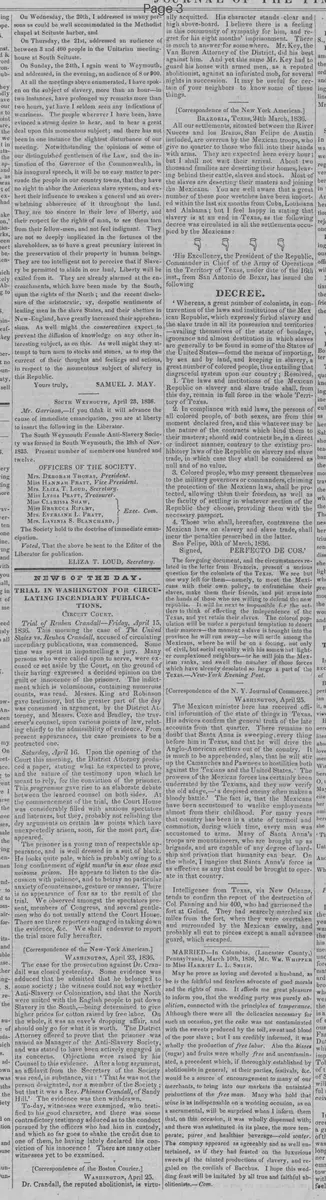
TRIAL IN WASHINGTON FOR CIRCULATING INCENDIARY PUBLICATIONS.
CIRCUIT COURT.
Trial of Reuben Crandall--Friday, April 15, 1836. This morning the case of The United States vs. Reuben Crandall, accused of circulating incendiary publications, was commenced. Some time was spent in impannelling a jury. Many persons who were called upon to serve, were excused or set aside by the Court, on the ground of their having expressed a decided opinion on the guilt or innocence of the prisoner. The indictment which is voluminous, containing numerous counts, was read. Messrs. King and Robinson gave testimony, but the greater part of the day was consumed in argument, by the District Attorney, and Messrs. Coxe and Bradley, the prisoner's counsel, upon various points of law, relating chiefly to the admissibility of evidence. From present appearances, the case promises to be a protracted one.
Saturday, April 16. Upon the opening of the Court this morning, the District Attorney produced a paper, stating what he expected to prove, and the nature of the testimony upon which he meant to rely, for the conviction of the prisoner. This programme gave rise to an elaborate debate between the learned counsel on both sides. At the commencement of the trial, the Court House was considerably filled with anxious spectators and listeners, but they, probably not relishing the dry arguments on certain law points which have unexpectedly arisen, soon, for the most part, disappeared.
The prisoner is a young man of respectable appearance, and is well dressed in a suit of black. He looks quite pale, which is probably owing to a long confinement of eight months in our close and noisome prison. He appears to listen to the discussion with patience, and to betray no particular anxiety of countenance, gesture or manner. There is no appearance of fear as to the result of the trial. We observed amongst the spectators present, members of Congress, and several gentlemen who do not usually attend the Court House. There are three reporters engaged in taking down the evidence, &c. We shall endeavor to report the trial more fully hereafter.
[Correspondence of the New-York American.]
WASHINGTON. April 23, 1836.
The case for the prosecution against Dr. Crandall was closed yesterday. Some evidence was adduced that he admitted that he belonged to some society; the witness could not say whether Anti-Slavery or Colonization, and that the North were united with the English people to put down Slavery in the South, being determined to give higher prices for cotton raised by free labor. On the whole, it was an eaves dropping affair, and should only go for what it is worth. The District Attorney offered to prove that the prisoner was named as Manager of the Anti-Slavery Society, and was stated to have been actively engaged in its concerns. Objections were raised by his Counsel to this evidence. After a long argument, an affidavit from the Secretary of the Society was read, in substance, viz: 'That he was not the person designated, nor a member of the Society ; but that it was a Rev. Phineas Crandall, of Sandy Hill.' The evidence was then withdrawn.
To-day. witnesses were examined. who testified to his good character, and there was some contradictory testimony adduced as to the conduct pursued by the officers who had him in custody, and which so far goes to shake the credit due to one of them, he having lately declared his conviction of his innocence! There are many other witnesses yet to be examined.
[Correspondence of the Boston Courier.]
WASHINGTON, April 25.
Dr. Crandall, the reputed abolitionist, is virtu-
ally acquitted. His character stands clear and high above-board. I believe there is a feeling in this community of sympathy for him, and regret for his eight months' imprisonment. There is much to answer for somewhere. Mr. Key, the Van Buren Attorney of the District, did his best against him. And yet this same Mr. Key had to guard his house with armed men, as a reputed abolitionist, against an infuriated mob, for several nights in succession. It may be useful for certain of your neighbors to know some of these things.
What sub-type of article is it?
What keywords are associated?
What entities or persons were involved?
Where did it happen?
Domestic News Details
Primary Location
Washington
Event Date
April 15 25, 1836
Key Persons
Outcome
virtually acquitted; character cleared; public sympathy for eight months' imprisonment
Event Details
Trial of Reuben Crandall for circulating incendiary anti-slavery publications involved jury selection, testimony from King and Robinson, legal arguments on evidence admissibility, prosecution case closure with withdrawn evidence linking him to Anti-Slavery Society, character witnesses, and contradictory testimony on officer conduct.