Thank you for visiting SNEWPapers!
Sign up free
The Washington Union
Washington, District Of Columbia
What is this article about?
Critique of Westminster Review's inaccurate portrayal of the US Supreme Court's Dred Scott decision on slavery and citizenship, echoing American abolitionist misconceptions, as opposed to the actual ruling emphasizing state powers over slavery.
Clipping
OCR Quality
Full Text
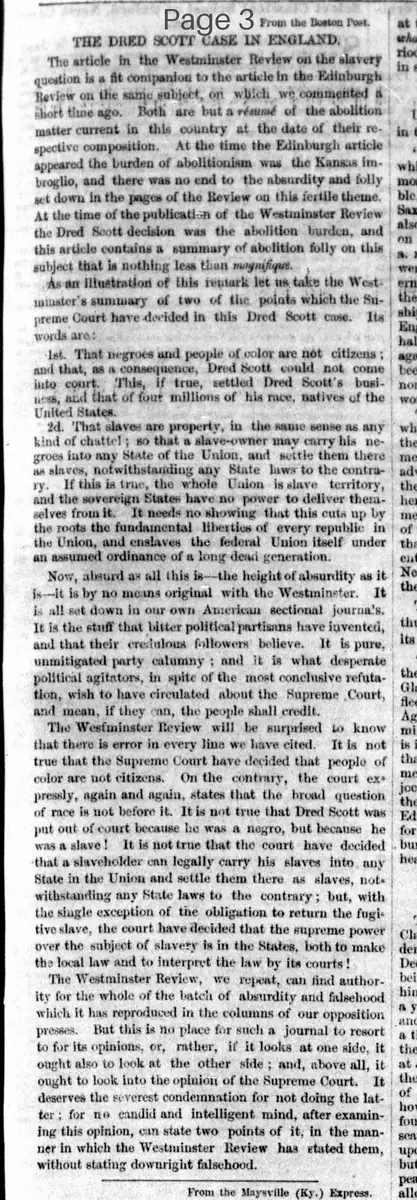
The article in the Westminster Review on the slavery question is a fit companion to the article in the Edinburgh Review on the same subject, on which we commented a short time ago. Both are but a résumé of the abolition matter current in this country at the date of their respective composition. At the time the Edinburgh article appeared the burden of abolitionism was the Kansas imbroglio, and there was no end to the absurdity and folly set down in the pages of the Review on this fertile theme. At the time of the publication of the Westminster Review the Dred Scott decision was the abolition burden, and this article contains a summary of abolition folly on this subject that is nothing less than magnifique.
As an illustration of this remark let us take the Westminster's summary of two of the points which the Supreme Court have decided in this Dred Scott case. Its words are:
1st. That negroes and people of color are not citizens; and that, as a consequence, Dred Scott could not come into court. This, if true, settled Dred Scott's business, and that of four millions of his race, natives of the United States.
2d. That slaves are property, in the same sense as any kind of chattel; so that a slave-owner may carry his negroes into any State of the Union, and settle them there as slaves, notwithstanding any State laws to the contrary. If this is true, the whole Union is slave territory, and the sovereign States have no power to deliver themselves from it. It needs no showing that this cuts up by the roots the fundamental liberties of every republic in the Union, and enslaves the federal Union itself under an assumed ordinance of a long dead generation.
Now, absurd as all this is—the height of absurdity as it is—it is by no means original with the Westminster. It is all set down in our own American sectional journals. It is the stuff that bitter political partisans have invented, and that their credulous followers believe. It is pure, unmitigated party calumny: and it is what desperate political agitators, in spite of the most conclusive refutation, wish to have circulated about the Supreme Court, and mean, if they can, the people shall credit.
The Westminster Review will be surprised to know that there is error in every line we have cited. It is not true that the Supreme Court have decided that people of color are not citizens. On the contrary, the court expressly, again and again, states that the broad question of race is not before it. It is not true that Dred Scott was put out of court because he was a negro, but because he was a slave! It is not true that the court have decided—that a slaveholder can legally carry his slaves into any State in the Union and settle them there as slaves, notwithstanding any State laws to the contrary; but, with the single exception of the obligation to return the fugitive slave, the court have decided that the supreme power over the subject of slavery is in the States, both to make the local law and to interpret the law by its courts!
The Westminster Review, we repeat, can find authority for the whole of the batch of absurdity and falsehood which it has reproduced in the columns of our opposition presses. But this is no place for such a journal to resort to for its opinions, or, rather, if it looks at one side, it ought also to look at the other side; and, above all, it ought to look into the opinion of the Supreme Court. It deserves the severest condemnation for not doing the latter: for no candid and intelligent mind, after examining this opinion, can state two points of it, in the manner in which the Westminster Review has stated them, without stating downright falsehood.
What sub-type of article is it?
What keywords are associated?
What entities or persons were involved?
Where did it happen?
Foreign News Details
Primary Location
England
Key Persons
Event Details
The article criticizes the Westminster Review's summary of the Dred Scott case, claiming it misrepresents the Supreme Court's decisions on citizenship for people of color and the status of slaves as property. It argues these points are false, based on American partisan calumny, and that the Court did not rule that negroes are not citizens or that slaveholders can settle slaves in any state against local laws. The Review is faulted for not consulting the actual opinion and relying on opposition presses.