Thank you for visiting SNEWPapers!
Sign up free
Editorial
October 12, 1843
The Madisonian
Washington, District Of Columbia
What is this article about?
The editorial defends the State Rights Party's influence in U.S. politics, arguing they hold the balance of power in elections and cannot be ignored by Democratic candidates like Van Buren. It criticizes Van Buren's newspaper organ for trying to undermine them and praises their unwavering principles.
Clipping
OCR Quality
98%
Excellent
Full Text
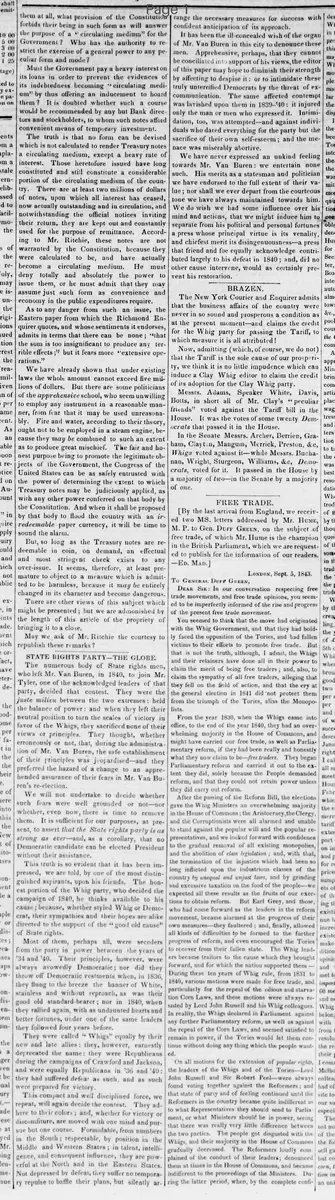
STATE RIGHTS PARTY-THE GLOBE.
The numerous body of State rights men, who left Mr. Van Buren, in 1840, to join Mr. Tyler, one of the acknowledged leaders of that party, decided that contest. They were the juste milieu between the two extremes: held the balance of power: and when they left their neutral position to turn the scales of victory in favor of the Whigs, they sacrificed none of their views or principles. They thought, whether erroneously or not, that, during the administration of Mr. Van Buren, the safe establishment of their principles was jeopardised—and they preferred the hazard of a change to an apprehended assurance of their fears in Mr. Van Buren's re-election.
We will not undertake to decide whether such fears were well grounded or not—nor whether, even now, there is time to remove them. It is sufficient for our purposes, at present, to assert that the State rights party is as strong as ever—and, as a corollary, that no Democratic candidate can be elected President without their assistance.
This truth is so evident that it has been impressed, we are told, by one of the most distinguished aspirants, upon his friends. The honest portion of the Whig party, who decided the campaign of 1840, he thinks available to his cause; because, whether styled Whig or Democrat, their sympathies and their hopes are alike directed to the support of the "good old cause" of State rights.
Most of them, perhaps all, were seceders from the party in power between the years of '34 and '40. Their principles, however, were always avowedly Democratic; nor did they throw off Democratic vestments when, in 1836, they flung to the breeze the banner of White, stainless and without reproach, as was their good old standard-bearer; nor in 1840, when they rallied again, with as undaunted hearts and better fortunes, under one of the same leaders they followed four years before.
They were called "Whigs" equally by their new and late allies: they, however, earnestly deprecated the name: they were Republicans during the campaigns of Crawford and Jackson, and were equally Republicans in '36 and '40: they had suffered defeat as such, and as such were prepared for victory.
This compact and well disciplined force, we repeat, will again decide the contest. They adhere to their colors; and, whether for victory or discomfiture, are moved with one mind and pursue but one course. Formidable, from numbers in the South; respectable, by position in the Middle and Western States; in talent, intelligence, and consequent influence, they are powerful at the North and in the Eastern States.
Not depressed by defeat, they suffer no temporary repulse to baffle their plans, but silently arrange the necessary measures for success with confident anticipation of its approach.
It has been the ill-concealed wish of the organ of Mr. Van Buren in this city to denounce these men. Apprehensive, perhaps, that they cannot be conciliated into support of his views, the editor of this paper may hope to diminish their strength by affecting to despise it: or to intimidate these truly unterrified Democrats by the threat of excommunication. The same affected contempt was lavished upon them in 1839-'40: it injured only the man or men who expressed it. Intimidation, too, was attempted—and against individuals who dared everything for the party but the sacrifice of their own self-esteem; and the menace was miserably abortive.
We have never expressed an unkind feeling towards Mr. Van Buren: we entertain none such. His merits as a statesman and politician we have endorsed to the full extent of their value; nor shall we ever depart from the courteous tone we have always maintained towards him.
We do wish we had some influence over his mind and actions. that we might induce him to separate from his political and personal fortunes a press whose principal virtue is its venality, and chiefest merit its disingenuousness—a press that friend and foe equally acknowledge contributed largely to his defeat in 1840; and, did no other cause intervene, would as certainly prevent his restoration.
The numerous body of State rights men, who left Mr. Van Buren, in 1840, to join Mr. Tyler, one of the acknowledged leaders of that party, decided that contest. They were the juste milieu between the two extremes: held the balance of power: and when they left their neutral position to turn the scales of victory in favor of the Whigs, they sacrificed none of their views or principles. They thought, whether erroneously or not, that, during the administration of Mr. Van Buren, the safe establishment of their principles was jeopardised—and they preferred the hazard of a change to an apprehended assurance of their fears in Mr. Van Buren's re-election.
We will not undertake to decide whether such fears were well grounded or not—nor whether, even now, there is time to remove them. It is sufficient for our purposes, at present, to assert that the State rights party is as strong as ever—and, as a corollary, that no Democratic candidate can be elected President without their assistance.
This truth is so evident that it has been impressed, we are told, by one of the most distinguished aspirants, upon his friends. The honest portion of the Whig party, who decided the campaign of 1840, he thinks available to his cause; because, whether styled Whig or Democrat, their sympathies and their hopes are alike directed to the support of the "good old cause" of State rights.
Most of them, perhaps all, were seceders from the party in power between the years of '34 and '40. Their principles, however, were always avowedly Democratic; nor did they throw off Democratic vestments when, in 1836, they flung to the breeze the banner of White, stainless and without reproach, as was their good old standard-bearer; nor in 1840, when they rallied again, with as undaunted hearts and better fortunes, under one of the same leaders they followed four years before.
They were called "Whigs" equally by their new and late allies: they, however, earnestly deprecated the name: they were Republicans during the campaigns of Crawford and Jackson, and were equally Republicans in '36 and '40: they had suffered defeat as such, and as such were prepared for victory.
This compact and well disciplined force, we repeat, will again decide the contest. They adhere to their colors; and, whether for victory or discomfiture, are moved with one mind and pursue but one course. Formidable, from numbers in the South; respectable, by position in the Middle and Western States; in talent, intelligence, and consequent influence, they are powerful at the North and in the Eastern States.
Not depressed by defeat, they suffer no temporary repulse to baffle their plans, but silently arrange the necessary measures for success with confident anticipation of its approach.
It has been the ill-concealed wish of the organ of Mr. Van Buren in this city to denounce these men. Apprehensive, perhaps, that they cannot be conciliated into support of his views, the editor of this paper may hope to diminish their strength by affecting to despise it: or to intimidate these truly unterrified Democrats by the threat of excommunication. The same affected contempt was lavished upon them in 1839-'40: it injured only the man or men who expressed it. Intimidation, too, was attempted—and against individuals who dared everything for the party but the sacrifice of their own self-esteem; and the menace was miserably abortive.
We have never expressed an unkind feeling towards Mr. Van Buren: we entertain none such. His merits as a statesman and politician we have endorsed to the full extent of their value; nor shall we ever depart from the courteous tone we have always maintained towards him.
We do wish we had some influence over his mind and actions. that we might induce him to separate from his political and personal fortunes a press whose principal virtue is its venality, and chiefest merit its disingenuousness—a press that friend and foe equally acknowledge contributed largely to his defeat in 1840; and, did no other cause intervene, would as certainly prevent his restoration.
What sub-type of article is it?
Partisan Politics
Constitutional
What keywords are associated?
State Rights Party
Van Buren
Tyler
Whigs
Democrats
Election 1840
Political Balance
What entities or persons were involved?
State Rights Men
Mr. Van Buren
Mr. Tyler
Whigs
Democrats
The Globe
Editorial Details
Primary Topic
Influence Of State Rights Party In Presidential Elections
Stance / Tone
Supportive Of State Rights Party, Critical Of Van Buren's Press
Key Figures
State Rights Men
Mr. Van Buren
Mr. Tyler
Whigs
Democrats
The Globe
Key Arguments
State Rights Men Held Balance Of Power In 1840 Election
They Supported Tyler Without Sacrificing Principles
State Rights Party Remains Strong And Essential For Democratic Victory
Van Buren's Organ Tries To Undermine Them Through Contempt And Intimidation
Author Respects Van Buren But Criticizes His Press For Venality